
The Receipt
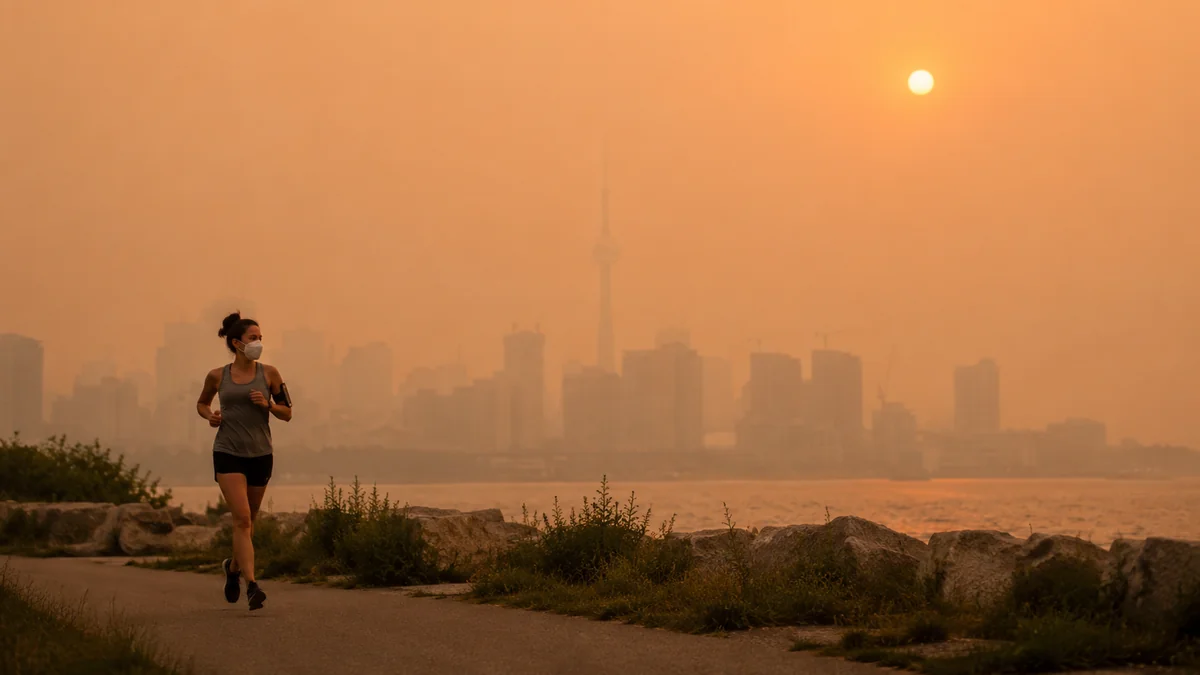
This month, wildfire smoke pushed Toronto briefly to the top of the world's most-polluted-city rankings, turned the sky over the U.S. Midwest and Northeast an unbreathable orange, and raised questions about a World Cup final in New York. None of it was new information to Canada. The country's own strategy documents identified worsening fire, straining response capacity, and growing reliance on foreign crews years before the smoke reached the skylines.
Canada coordinates wildfire prevention and firefighting through national institutions, chiefly the Canadian Interagency Forest Fire Centre. What none of the reviewed instruments does is require a single body to reconcile prevention investment against suppression capacity, measure the combined result against the risk, and answer publicly for whether the package is adequate. Over 2005 to 2015, reported spending on the national prevention program reached about a quarter of its projection while firefighting preparedness reached most of its own; the government's 2016 review recorded that a national response plan called for a decade earlier had not begun. The pieces were identified. Assembling them into an accountable whole was not any single institution's job.
This is not a story about incompetence, and it does not allege that anyone chose this outcome or failed at their assigned task. It is a story about an architecture that can produce this result even when each part performs its function, because responsibility for the balance between prevention and response was never assigned to anyone. That is why writing another strategy, or replacing an official, has not closed the gap.
There is a comfortable version of the Canadian wildfire story. In it, a competent country is simply losing to a warming planet: the smoke, the evacuations, the crews flown in from the Southern Hemisphere are the unavoidable cost of a problem beyond anyone's control. Climate change is real and it is doing genuine work here, lengthening seasons and drying fuel. But it is not the whole story, and treating it as the whole story quietly forecloses a separate question the record keeps open: whether Canada built the prevention, preparedness, and coordination its own reviews said it needed. The climate question and the governance question are different questions. The record permits criticism of the second without diminishing the first.
The failure you can see from space
Start with what is not in dispute. In 2023, Canada's national preparedness level — the Canadian Interagency Forest Fire Centre's daily measure of how strained the firefighting system is [1] — reached its maximum, Level 5, and stayed there for a record 113 days, more than double the previous record of 55 [2]. At Level 5, national demand is extreme, domestic resources are heavily committed, and international assistance may be required. Across that season, CIFFC recorded more than 7,300 cumulative personnel mobilizations through its domestic and international resource-sharing system, more than double the previous record, and Canada drew firefighters and equipment from twelve countries: the United States, Australia, New Zealand, South Africa, Costa Rica, Mexico, Chile, France, Portugal, Spain, South Korea, and Brazil [3]. Depending on the national dataset, roughly 15 to 17 million hectares burned; CIFFC's season report records about 17.2 million, many times the recent average [2].
2023 was an outlier in scale, not in kind. Reliance on shared crews is a standing feature of the system rather than a one-season emergency, drawing foreign personnel into Canada across several recent seasons before 2023 pushed it to record scale [4]. And the smoke that reaches major cities, once treated as freak weather, now arrives most summers. This July, wildfire smoke again drove Toronto and Montreal high into global pollution rankings and pushed air quality across a wide swath of the eastern United States into unhealthy ranges [5]. On July 9, the federal government counted 796 active wildfires nationally, 60 of them out of control [6]. A 2025 study in Nature estimated that exposure to the 2023 season's smoke contributed to tens of thousands of premature deaths across North America and Europe [7].
Canada wrote down what it needed. Repeatedly.
The first Canadian Wildland Fire Strategy was signed by federal, provincial, and territorial forest ministers in 2005, with an implementation plan estimating a required investment of $2.3 billion [8]. It predicted, with uncomfortable accuracy, much of what has since arrived: more extreme fire behaviour, increasing impacts, the growing effect of climate change, and eroding response capacity [8].
Eleven years later, the working group behind that strategy published a ten-year review, and it reads like a country grading its own homework and recording the marks. On firefighting capacity, the 2016 review states that "Canadian jurisdictions are reaching the limits of what existing suppression resources can achieve" [9]. On the borrowed crews, it warns that "pan-Canadian support is becoming more and more not enough and Canadian jurisdictions are increasing their reliance on international resources" [9]. That was written in 2016, seven years before the record season that made the same point in orange skies.
The review is candid about why the knowing had not turned into doing. Investment across the decade, it says, had been "somewhat ad hoc and not always strategically coordinated," and "a lack of standardized reporting makes it difficult to attribute actions and progress" [9]. In an appendix cataloguing why its priorities had stalled, it adds the line that "the challenge is not what needs to be done or why, but how to advance the agenda" [10]. And it records, in the same list of unfinished business, that the need for a National Response Plan "was identified in the CWFS, but development of such a plan has yet to begin" [9].
These are not small admissions, but they should be read for exactly what they say. The 2005 strategy identified the need for a national response plan and for balancing prevention against suppression; the 2016 review reports that the response plan had not begun and that implementation had been uneven and hard to track. What the documents describe is a set of identified components — response planning, stronger prevention, balanced capacity, better horizontal integration — that Canada named and then struggled for years to deliver. What they do not describe, and what this article does not claim they prescribed, is a single institution to reconcile those pieces and answer for their combined result. That instrument is the thing still missing. Canada identified the parts. It did not assemble them into an accountable whole.
The number that shows the tilt
The 2016 review's spending table shows how the pieces came apart in practice. Over 2005 to 2015, the strategy projected $885.3 million for FireSmart, its community prevention and mitigation objective, but jurisdictions reported spending $213.9 million, about 24 percent of target. Fire response preparedness, by contrast, was projected at $1,361.3 million and came in at $1,171.9 million, roughly 86 percent [9]. The review cautions that this reporting was inconsistent and that spending was difficult to attribute cleanly to the strategy, so the figures describe reported effort against the plan's own objectives rather than a full national ledger [9]. Even with that caveat, the tilt is stark: the prevention line reached a quarter of plan while the response line reached most of it.
The direction is not mysterious, and it does not require attributing anyone a motive. When the choice is between spending to prevent a fire that has not started and spending to fight one that is burning, the burning fire commands the cheque, because someone is always operationally responsible for putting it out. No one is comparably responsible for maintaining the balance between prevention and response over time. The tilt toward suppression is what a system produces when firefighting has an owner and the prevention-suppression balance does not.
A coordinator, not a reconciler
Here the story has to be more precise than the headlines, because an easy version of this critique overreaches. It is not true that no one bridges prevention and firefighting in Canada. The Canadian Interagency Forest Fire Centre does. Since 2020 its mandate has spanned prevention and mitigation as well as operational response, and in April 2026 it launched a five-year Prevention and Mitigation Action Plan to implement the national prevention strategy [11]. That plan's measures centre on awareness, community recognition, and home assessments; it contains no suppression-capacity component [12]. On the firefighting side, CIFFC has coordinated mutual aid and international resource-sharing for decades, and the 2021–2026 CCFM working-group action plan already spanned the full life cycle of prevention, mitigation, preparedness, response, and recovery, while expressly allowing each jurisdiction to tailor its own contribution [13]. A body plainly touches both domains.
But touching both domains is not the same as reconciling them. CIFFC describes itself, on its own homepage, as a not-for-profit "owned and operated by the federal, provincial and territorial wildland fire management agencies to coordinate resource sharing, mutual aid, and information sharing" [14]. It coordinates, and it now manages some federally funded shared assets such as leased aircraft. What it does not do is own the provincial and territorial fire services, command their operations, or hold an explicit national mandate for the combined prevention-and-suppression outcome. Public Safety Canada's own description confirms the shape: provinces, territories, and local authorities are primarily responsible for wildfire preparedness and response and own most firefighting capacity, and the federal government steps in when a province files a Request for Federal Assistance [15].
The prevention strategy is built the same way. The 2024 Canadian Wildland Fire Prevention and Mitigation Strategy is, by its own description, "a call to action to mobilize all of society," setting a shared vision and inviting whole-of-society partners to contribute "based on their sphere of responsibility, influence, and capability" [16]. Its nearest-term national commitments run to awareness campaigns and, through the linked National Adaptation Strategy, a target that by 2025, 60 percent of Canadians in high-risk areas are aware of the risks facing their household [16]. Awareness is a reasonable thing to want, but a headline national target measured in whether people know they are at risk is the target of a coordinator, not of a body answerable for outcomes. And Québec, which operates a distinct provincial system through SOPFEU, participates as a member-observer and is expressly not bound by the strategy's targets, objectives, and commitments [17][18].
What the people who built the plan said
The clearest evidence that this is a real structural gap, rather than an outsider's framing, comes from inside the prevention plan. When CIFFC built its 2026–2031 Action Plan, it commissioned a Partnership Audit: fifteen interviews with people across the wildfire prevention ecosystem, including policymakers, responders, academics, and industry. The audit is careful that respondents did not agree on a single top problem; there was, in its words, "no dominant issue," and it describes two roughly equal camps, one focused on structural complexity and one on getting past "committee" and into implementation [19]. The audit itself notes that both camps were, in different language, underscoring a need for more definitive leadership.
That structural camp named the gap precisely. For those respondents, the audit records, "the main challenge was leadership — to craft strategy, assign clear lines of responsibility and monitor and measure the implementation of responsibilities and strategies" [19]. One participant asked the question this article is built around: "how are you going to do this — where is the funding, the networking, the accountabilities, the governance" [19]. On the coordinating body's proper role, another was explicit that it "needs to be a role of facilitation, not directing or even coordinating" [19]. And on the jurisdictional reality: "the provinces and territories have the jurisdiction to implement, so they can have the greatest Action Plan in the world but if they don't get provincial, territorial and federal buy-in, we won't have a national plan" [19].
In fairness, the same audit was strongly positive about CIFFC. Virtually all respondents viewed it favourably, most considered it the logical national leader for prevention and mitigation, and one observed that "all the most important players are represented around the CIFFC table" [19]. That evidence cuts hard against any suggestion that no linking institution exists; it plainly does, and the people closest to the file trust it. The narrower and harder question is the one this article presses: whether CIFFC's leadership mandate extends to combined targets, reconciled resources, and accountability across both prevention and suppression, or stops at coordination. On the record reviewed here, it stops at coordination.
The strongest case for the current design
A critique this pointed owes the opposing view its full strength, because the opposing view is serious. Canada's model is deliberately federated, not accidentally leaderless. Most frontline wildfire management and most fire-service capacity sit with provinces and territories, which hold the land-management authority, the personnel, the operational knowledge, and their own political accountability for outcomes; the federal government holds substantial but defined responsibilities over federal lands, national parks, Indigenous programs, emergency assistance, defence support, and interprovincial and international coordination. On this reading, CIFFC gives those agencies a standing national table, standardized mutual aid, international interoperability, prevention committees, and shared assets without imposing a federal command detached from local conditions. There is academic support for it: research on wildfire governance finds that polycentric arrangements, with many overlapping centres of authority rather than one top-down command, depend on effective mechanisms for coordination, learning, and accountability across those centres [20].
Even the reliance on foreign crews has a defensible reading. Northern and Southern Hemisphere fire seasons are partly counter-seasonal, so reciprocal international assistance can be a rational, resilient design rather than a symptom of shortfall; maintaining permanent domestic capacity sized for the rarest continental peak would be expensive and idle most years. The 2016 review itself calls facilitated sharing "critical" and notes Canada's international renown for response. Recurring foreign help is not, on its own, proof of failure.
That case is strong, and it changes the shape of the criticism without dissolving it. It establishes that Canada does not need a national operational commander, and this article does not argue for one. Canada has built substantial linking capacity through CIFFC and the CCFM; the linking function is present. What the same governance research treats as the harder condition is accountability across the centres: whether the links extend far enough to reconcile prevention investment against suppression capacity and to answer for their combined adequacy. That is the function the country's own consulted experts identified as missing, and it is a question about reconciliation and reporting, not about command. A federated system can reconcile budgets, targets, and gap assessments while leaving operations provincial. Canada has done the first part and not the second.
The remaining objection is that the binding constraint is money or climate, not structure. Both are real constraints. More money can buy real capacity: prescribed burning, vegetation management, aircraft, crews, evacuation infrastructure, and home hardening all have direct effects, and some seasons may exceed practicable suppression capacity under any feasible arrangement. What money alone cannot buy is a mechanism for deciding whether prevention and response investments are balanced, collectively adequate, and producing the intended reduction in risk. That mechanism is what is absent, and its absence is not fixed by the size of the cheque.
What the record still shows in 2026
Recent action has not closed the gap, though there has been action. In February 2026 Ottawa committed $316.7 million over five years for a national aerial firefighting surge capacity, routed through CIFFC to lease ten aircraft and two support assets for the 2026 season [21]. In May it added $47.8 million over five years for wildfire preparedness, response, and risk reduction on Parks Canada lands [15]. These are meaningful investments on the firefighting side. None of the announcements identifies a new institution with combined prevention-and-response outcome accountability. At the most recent ministerial meeting on the file, the headline deliverable was the release of a Canadian Wildland Fire Risk Assessment Framework, a common national method for assessing and comparing fire risk and hazard [19]. It is a useful tool, and it is an instrument for measuring the problem consistently rather than a body answerable for reconciling the response to it.
So the picture as of this writing is unchanged in its essentials. Canada identified worsening fire and straining capacity in its own strategies, warned itself in writing that support was becoming insufficient, recorded that a national response plan it had called for had not begun, funded prevention at a fraction of its own targets, and built a coordination architecture in which mandates are real and none is the whole. The structure can produce this result even when each actor performs its assigned function: provinces fight their fires, CIFFC moves the crews and convenes the table, the federal government funds the aircraft and the ministers meet, the strategies get written and the frameworks get released. What no one is required to do is stand back at the end of a season and answer for whether prevention and response together were adequate to the risk.
That is the shape of a systemic failure. The gap cannot be repaired by replacing one official, because no one official holds the missing mandate. Canada can staff every part of this system with capable people and the same accountability gap will remain next season, because the thing that is absent is not talent or effort or even, at the margin, money. It is an answer to a single question that none of the national instruments reviewed here assigns to anyone: when the season ends, who is accountable for whether the country's prevention and response, taken together, were enough?
What Would Change This Assessment
This piece argues a structural finding, and a structural finding should come with the specific conditions that would weaken or overturn it. Each of the following would genuinely threaten it:
- An adopted federal-provincial-territorial instrument, whether one institution or a binding joint mechanism, with responsibility to reconcile prevention and response plans, identify funding and capacity gaps, publish combined targets, and report on results. Proposals for such a body exist; an adopted one would materially change this assessment.
- Evidence that CIFFC's mandate already constitutes that reconciliation in substance: board-approved objectives covering both prevention and suppression, performance measures spanning both, a duty to reconcile budgets and capacity, an obligation to report gaps and results, and an identified body to which it answers. CIFFC's own self-description as a resource-sharing coordinator is the current basis for concluding it does not; a documented combined-outcome mandate would revise that.
- A multi-year, fire-weather-adjusted evaluation showing declining community exposure, structure loss, evacuation burden, or unfilled resource requests under the current governance model, without a new national reconciliation mechanism, which would suggest the devolved design is closing the gap on its own. Post-2023 mobilization and outcome trends will be the near-term test.
- A successor plan, or a linked set of binding plans, that explicitly reconciles prevention priorities with suppression-capacity planning and assigns responsibility for the joint assessment.
This article does not allege that any official, agency, or government chose for the system to fail, wanted the outcome, or acted in bad faith, and it does not assess whether each actor performed its own mandate well. Its claim is about the architecture: a structure that identified the components of an adequate response and never assigned anyone responsibility for reconciling them or answering for the combined result. That is a criticism of design, and design can be changed.