
The Receipt
The federal government does publish how much glyphosate is sprayed on Canada's forests. Natural Resources Canada's National Forestry Database records the herbicide by product, by province, by application method, and by year, in hectares treated and in kilograms applied. The number exists, and anyone can download it. That turns out to be the problem, not the solution.
Read at face value, the record shows a collapse. National recorded area treated with glyphosate falls from about 116,500 hectares in 2013 to 7,257 hectares in 2023, a drop of more than ninety per cent. But the decline is mostly an artifact of who filed a report. In 2023 only seven of twelve jurisdictions reported any glyphosate figure at all. Ontario, which recorded 33,286 hectares in 2021, appears blank for 2022 and 2023. New Brunswick, which recorded 14,539 hectares in 2022, appears blank for 2023. When two of the largest sprayers stop filing, the national total falls, and nothing about the spraying itself has been established either way.
This is not a claim that glyphosate is unsafe; Health Canada holds it registered and considers it acceptable when used as directed. Nor is it a claim that no figures exist anywhere: several provinces publish their own forestry-herbicide numbers, and some of those show use continuing in years the national table shows as blank. The finding is narrower and more specific. The country's one national compilation of forest herbicide use presents a face-value total that a reader cannot trust, because it does not distinguish a province that stopped spraying from a province that stopped filing, or a real zero from a missing one. The record is public. What it appears to say is not what it means.
Somewhere near you, a store will sell you a bottle of glyphosate, the weed-killer most people know as the active ingredient in Roundup. Depending on where you live, using it on your own lawn may be against a municipal bylaw. In Montreal it is: the city prohibited the domestic sale and use of dozens of pesticide molecules, glyphosate among them, at the start of 2022. [6] The reasoning municipalities usually gave combined two ideas — that lawn treatment is a non-essential use, and that even a small or uncertain risk is not worth taking for a non-essential purpose.
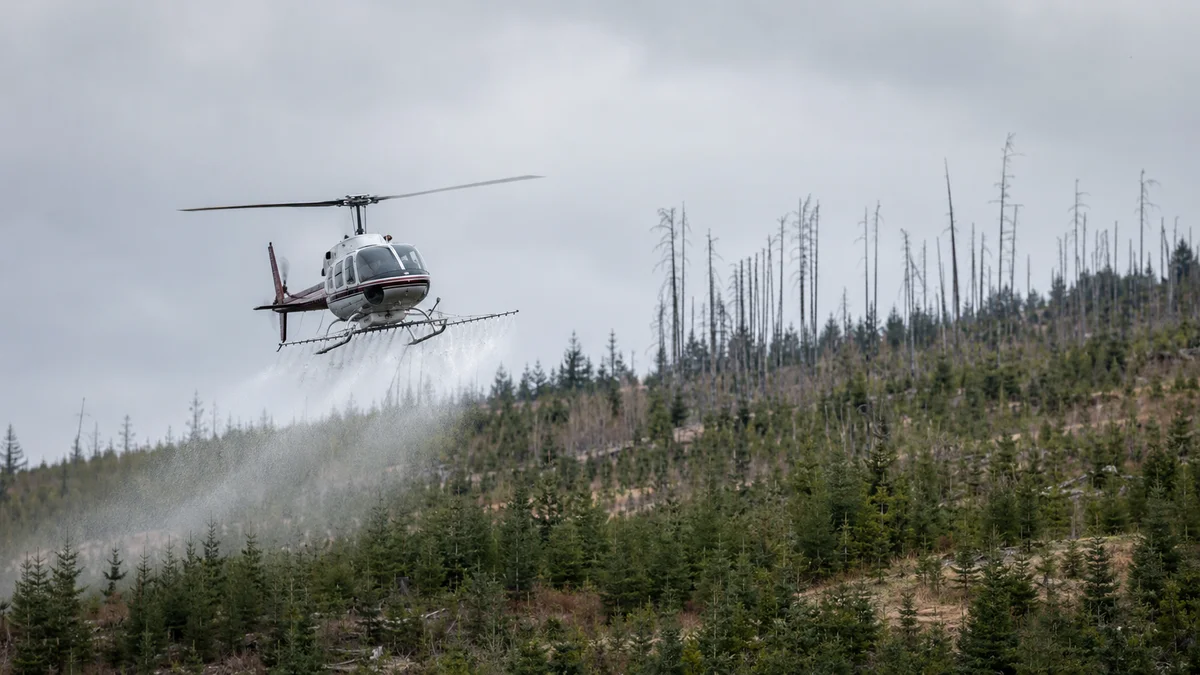
That same active ingredient, in different commercial products, is sprayed by helicopter and by hand across tens of thousands of hectares of Canadian forest each year, to suppress the aspen and other broadleaf plants that compete with the conifers a mill will later cut. The contrast that first suggests itself, a chemical restricted on a driveway but permitted from the air, has a clean answer, and it is not the interesting one. The interesting question is simpler. For an industrial-scale use of this size, in a country that keeps a national database precisely to compile this kind of figure, how much is actually sprayed? The honest answer, from the government's own record, is that no one can tell you within a usable margin.
The number the government publishes
Begin by giving the record its due, because an earlier version of this story would have said the number does not exist, and that would have been wrong. It does exist. The National Forestry Database, maintained by the Canadian Forest Service within Natural Resources Canada and compiled from provincial and territorial submissions, publishes several forestry-herbicide tables. One reports area treated with herbicides by product and application method. Another reports the rate and amount of herbicide applied by product, with the amount expressed as active ingredient in kilograms. [1] Glyphosate appears in both as its own line, separated from 2,4-D, triclopyr, hexazinone and the rest, broken out province by province and year by year back to 1990. [1]
So the raw material for a national total is there in a way it is not for many environmental questions. The database is the country's designated place for this figure, and glyphosate is in it by name. The difficulty is not absence. It is that the published cells do not combine into a number that means what a reader would take it to mean.
The ninety per cent that isn't
The headline figure a casual reader would extract is a steep decline. In 2013 the database records roughly 116,500 hectares of forest treated with glyphosate across the country. By 2018 the figure is about 74,000; by 2022, about 24,000; by 2023, 7,257. [1] Taken at face value that is a fall of ninety-four per cent over a decade, and more than ninety-five per cent from the mid-2000s. It would be a remarkable environmental story if it were describing spraying.
It is not describing spraying. It is describing reporting. The count of jurisdictions that filed any glyphosate figure drops alongside the total: eleven provinces reported in 2013, ten through the late 2010s, and only seven in 2023. [1] The two largest single-year disappearances tell the story. Ontario reported 33,286 hectares in 2021 and then filed nothing for 2022 or 2023. New Brunswick reported 14,539 hectares in 2022 and then filed nothing for 2023. [1] Those two absences alone are large enough to account for a substantial share of the apparent decline between 2021 and 2023, and likely most of it. The provinces did not announce that they had stopped spraying. They stopped appearing in the table. On the database's own evidence, nothing can be concluded about whether their forests received more or less glyphosate than the year before, because the cell is empty and an empty cell carries no claim.
The same zero, three meanings
The deeper problem sits one layer down, in what the filled-in cells mean. The database records a zero for many province-years, and the zero is not consistent. Read across a single recent column, the same value stands for at least three different realities.
In Quebec, the zero is real. The province recorded 6,103 hectares of glyphosate in 1999 and 5,491 in 2000, and then zero in 2001 and in every year since. [1] That is the fingerprint of a policy: Quebec moved away from chemical herbicides on its public forests in 2001, and the federal data show the use going to nothing and staying there. [7] The change followed a public inquiry by the province's Bureau d'audiences publiques sur l'environnement into forest-regeneration herbicide use. [8] Here the zero means what it says.
In Saskatchewan, the zero is unresolved. The province records zero glyphosate in forestry year after year across the recent record. [1] Saskatchewan's pesticide rules do contemplate forestry use, so the reading is genuinely ambiguous: the figure could reflect truly low or no recent use, or use that is simply not reported into this table, and the database alone cannot distinguish those possibilities. The honest statement is that no one consulting the national record can tell which it is.
And in British Columbia, the largest forestry province, the national record simply stops while the province's own record keeps going. B.C. reported glyphosate to the national database every year from 1990 through 2016, its figures running from nearly 49,000 hectares early in that period down to 3,550 in 2016; then it files a single zero in 2019 and nothing after. [1] But the province did not stop. B.C.'s own Ministry of Forests figures record forest-sector herbicide treatment continuing through the years the national table shows as blank, on the order of 13,000 hectares in 2018 and several thousand as recently as 2021, while noting the use is declining rather than absent. [9] The fullest recent public accounting was assembled not from the national database but by the outlet The Narwhal, whose reporter reviewed more than two thousand pages of herbicide-application records obtained under freedom-of-information law. [2] The B.C. figure exists, in provincial hands; after 2016 it stops reaching the national table that is supposed to hold it. A reader consulting the national record for recent British Columbia would find nothing, and would have no way of knowing that the nothing is a province that stopped filing, not a province that stopped spraying.
One symbol, at least three meanings: a real ban in Quebec, an unresolved silence in Saskatchewan, and in British Columbia a figure that has moved to the province's own ledgers and stopped reaching the national one. A total built by summing these cells treats all three as the same number, and cannot help doing so.
Why it will not add up
Even setting the zeros aside, the database cautions against the arithmetic a face-value total invites. The kilograms table reports two different quantities: a rate, in kilograms of active ingredient per hectare, and a total amount applied, in kilograms. Its own footnote warns that the amount of herbicide applied will not always equal area treated multiplied by rate, because a site may be sprayed more than once or product may be left over. [1] That is a narrow caution, not proof of general incoherence — but it means the two columns cannot simply be cross-checked against each other to validate a national figure. The figures are entered by each jurisdiction into a shared reporting tool rather than measured by a common method, and they arrive tagged with cell-level qualifiers marking them as actual, estimated, preliminary or revised. [1]
The result is a dataset that is real, official, and not reliably summable at face value into the clean national figure its existence seems to promise. A determined analyst could still build a defensible estimate — holding coverage constant across the provinces that report consistently, or borrowing the provincial figures that exist outside the table. But the number the national database presents, taken as published, is not that estimate. It is a total that does not distinguish a true zero from a missing report from a province that has quietly dropped out, and offers the reader no way to tell them apart. That is a narrower finding than "the number is hidden," and a more uncomfortable one. The number is published. The reconciliation that would make it mean something is not.
The registration underneath
Beneath the reporting question is an older one about how forestry use was ever weighed. Registering a pesticide in Canada requires two findings under the Pest Control Products Act: that the risks are acceptable, and that the product has value, which the Act defines as its "actual or potential contribution to pest management," including efficacy, effects on host organisms, and economic, social and environmental impact. [3] Glyphosate was first registered in Canada in 1976 and remains registered following later re-evaluation and label changes. [4] Health Canada re-evaluated it in a decision finalized in 2017, maintaining the registration with new risk-reduction measures. [5]
That re-evaluation re-tested the chemical. What its published decision does not contain is a distinct analysis of forestry use against the value test; its value discussion is framed across agricultural and non-agricultural land management together, rather than asking separately whether suppressing broadleaf competition to favour conifers clears the benefit threshold on its own. [5] This is a transparency observation rather than a procedural charge: the decision may well have weighed forestry within its aggregate judgment, but a reader cannot see that weighing done for the single use that puts the most product on the most land.
The strongest case for the arrangement
The strongest response to all of this is not weak, and it has two parts. The first is jurisdictional. Canada's pesticide system was built to be layered: the Pest Control Products Act's own preamble records that the federal and provincial governments have traditionally administered complementary regulatory systems. [3] On this account the federal role is to register products and compile what provinces submit, while application on the ground is provincial business. The National Forestry Database is exactly such a compilation, and its gaps reflect what provinces send it. The absence of a clean national total is then not a federal failing but the shape of divided authority.
The second part is that a compilation mechanism does exist, which is more than can be said in many areas. There is a national table, glyphosate is in it, and the Canadian Forest Service maintains it year to year. Several provinces, moreover, publish their own forestry-herbicide figures: Ontario reports treated hectares through its provincial forestry dataset, New Brunswick posts annual silviculture results and states roughly twelve to fourteen thousand hectares of Crown land are treated each year, and British Columbia's figures appear in ministry briefing material. [9] A defender can fairly say the information largely exists somewhere in the public record, and that the shortfall is one of provincial submission to the national table, not of public accounting as such.
Both points are sound, and neither closes the gap. That the provincial figures exist somewhere is exactly the problem: the national table is the instrument that is supposed to bring them together, and it does not reconcile them or flag when a province has dropped out. A compilation that cannot distinguish a provincial ban from a provincial silence is not yet producing an accountable number; it is producing a figure that looks like a measurement and is not one. Divided jurisdiction explains why the total is hard to assemble. It does not explain why the published record offers no way to tell a real zero from a missing one, and it does not make the more-than-ninety-per-cent decline any less misleading to a reader who takes the database at its word. The machinery exists. What it produces cannot be trusted at face value.
What Would Change This Assessment
This piece argues that a published national total cannot be trusted at face value, not that glyphosate is unsafe or that spraying has secretly risen. The following would weaken or overturn it:
- A published reconciliation from Natural Resources Canada or a province that distinguishes, in the forestry-herbicide record, a true zero from a non-report — for example a coverage note stating which jurisdictions did and did not submit in a given year. That would restore the total's meaning and defeat the central finding.
- Provincial application records showing that the jurisdictions blank in the national table (Ontario and New Brunswick after 2021, British Columbia throughout) in fact reported comparable figures elsewhere that simply were not ingested, which would make this a data-transfer problem rather than an accountability one.
- Evidence that the year-to-year national totals are in fact comparable — that coverage is stable and the decline reflects real reductions in spraying. The jurisdiction counts in the database argue against this, but province-level confirmation would settle it.
One line of attack is worth addressing directly: the theory that glyphosate is quietly being replaced by another forestry herbicide such as triclopyr. In the same database, triclopyr use is small and also declining, from roughly 1,000 hectares nationally in the mid-2010s to near zero in 2023. [1] That record shows no substitution surge large enough to rescue the theory — but it is subject to the same reporting collapse as glyphosate, so it cannot rule the possibility out either. What it can say is that the visible pattern is disappearance from the record, not a swap of one chemical for another.