
The Receipt
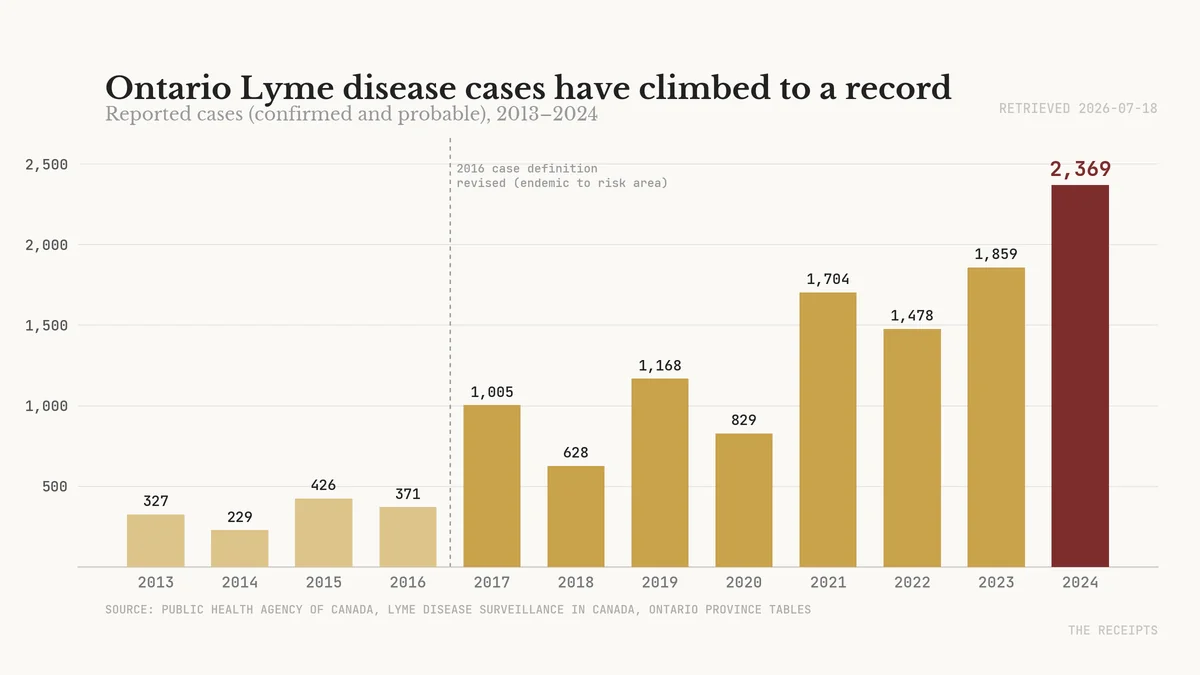
The blacklegged tick that carries Lyme disease is expanding its Canadian range northward, at an estimated rate that one climate model puts at roughly 46 kilometres a year [1]. Ontario recorded 229 Lyme disease cases in 2014. By 2024 the province recorded 2,369, the highest in the continuous federal surveillance series [2]. Separately, Public Health Ontario reported 3,002 finalized provincial cases for 2025, a figure drawn from a later provincial extract under a revised case definition, not the next point on the federal line [3]. Anaplasmosis, a second infection carried by the same tick, put 21 per cent of its reported 2023–2025 cases in hospital and was associated with four deaths, against a 3.8 per cent hospitalization rate and no deaths for Lyme over the same period [4].
Four institutions touch this problem. The Public Health Agency of Canada issues prevention advice. Public Health Ontario counts cases and maps risk areas. Ontario's Ministry of the Environment classifies pesticides. Health Canada's Pest Management Regulatory Agency registers the products that companies submit to it. Each executes its mandate. None of them holds the outcome of reducing human tick-borne illness, and no document reviewed for this article assigns that outcome to anyone.
What accumulates in the space between those mandates is visible on a shelf and in a registry. Federal guidance recommends managing your property without acknowledging that what you can lawfully apply to it varies by province. Licensed applicators sell barrier spraying at $350 to $900 a season. The only randomized controlled trial of that intervention found it cut tick counts by 63 per cent and produced no measurable reduction in human illness [5]. And every domestic tick product registered in Canada by the country's dominant registrant carries the same active ingredient at the same concentration, across thirteen years and three registrations.
The record does not show any of these four institutions failing at its own job. What it shows is that the jobs were written for other purposes, and that no one among them is answerable for the thing that is getting worse.
Start with the part that is not in dispute. Reported tick-borne disease is becoming more common in Ontario and, in at least one case, more severe, and the established range of the tick that carries it keeps moving north. Everything else in this article, the regulatory questions, the product registry, the price of a season of spraying, sits downstream of that. It is worth establishing first, because the rest of the piece asks a question that only matters if the problem is real.
The problem is real, and it is accelerating
Ontario's Lyme disease trajectory is steep. Federal surveillance records the province's reported cases, confirmed and probable, at 229 in 2014, rising through 1,005 in 2017, 1,704 in 2021, 1,478 in 2022, 1,859 in 2023, and 2,369 in 2024 — the highest in that continuous series [2]. Public Health Ontario, drawing on a later provincial extract under a case definition revised in early 2025, puts the 2025 total higher still, at 3,002 [3]; that figure sits under a different definition and cut-off and is not directly continuous with the federal line. The direction is not in question. The exact slope depends on which counting rule applies in which year, which is the next thing to establish.
The counting rule is not a footnote here. The national Lyme case definition was revised in 2016, replacing the older "endemic area" concept with "risk area," and revised again in a change implemented in February 2025 that allows some laboratory-only cases to be classified as probable [6]. The first revision shows up in the counts from 2017 onward; the second affects the 2025 figure. The 2013-to-2024 series above comes from a single federal surveillance system and is internally consistent, which is why 2024's 2,369 can fairly be called a record within it. The 2025 total of 3,002 comes from Ontario's separate provincial system under the newer definition and cannot be laid end-to-end with the federal series without noting the break. What survives all of that is the direction and the scale. No plausible reading of the definitional changes turns a rise from a few hundred cases to a few thousand into a flat line.
Anaplasmosis is the more pointed number. Public Health Ontario's June 2026 surveillance update reports that of reported anaplasmosis cases in the province between mid-2023 and the end of 2025, 112 required hospital admission, a rate of 21 per cent, and that the disease was associated with four deaths [4]. Over the same window, reported Lyme disease produced 281 hospitalizations at a rate of 3.8 per cent, and no deaths. The observed hospitalization rate was thus more than five times higher for anaplasmosis than for Lyme, though the two diseases differ in case volume, patient mix, and how mature their surveillance is, and the four deaths are too few to read as a stable rate. The admission-rate contrast is the firmer signal, and it rests on hundreds of hospitalizations across the two diseases.
The tick's established range is expanding, and infected ticks are becoming more common within it. One climate-sensitive model estimated a range-front expansion of roughly 46 kilometres a year, within a temperature-dependent band of about 35 to 55 kilometres [1]; this is a model-derived estimate of the invasion front, not a directly observed annual measurement. The share of tested blacklegged ticks positive for Anaplasma phagocytophilum has also risen, reaching 6 per cent in 2024 from 3 per cent in 2022 [4]. Wider established range, and a higher positivity rate in the ticks that are tested.
Eastern Ontario has been at the leading edge of this for over a decade. Peer-reviewed passive surveillance covering 2008 to 2012 found that in the Leeds, Grenville and Lanark District and in Kingston, Frontenac, Lennox and Addington, the submission rate for engorged and B. burgdorferi-positive blacklegged ticks ran 47 times higher than the rest of the province [7]. Public Health Ontario's risk-area mapping now covers most of southern and eastern Ontario [8].
How many households sit inside those risk areas is not published. Statistics Canada counted 5,491,201 occupied private dwellings in Ontario in the 2021 Census [9], and the province's population is concentrated in the south, but no authoritative source converts risk-area maps into a household count. This article does not estimate one. The gap is worth naming: the number of Canadians living inside established tick habitat is not a figure any institution publishes.
What Canadians are told to do
Federal advice to the individual homeowner is habitat management and personal protection. The Public Health Agency of Canada's Lyme disease prevention toolkit recommends keeping lawns mowed, removing leaf litter, moving play structures onto wood chips, creating barriers, wearing repellent and checking yourself for ticks [10]. Ontario's own tick-borne diseases page recommends a border of gravel or wood chips one metre or wider, removal of leaf litter, and relocation of play equipment [11]. Public Health Ontario's technical products address surveillance and clinical management rather than homeowner chemical control [12].
The federal technical literature says more than the consumer guidance does. A 2015 review in the Canada Communicable Disease Report, PHAC's own publication, states that pesticides applied to vegetation where ticks occur, such as transition areas between woodlands and lawns, can substantially reduce tick populations [13]. The National Collaborating Centre for Environmental Health's review of environmental management strategies notes that acaricides have been shown to kill Ixodes nymphs and adults in residential settings, while cautioning that the effectiveness of widespread application as a public health measure is unknown [14].
So the recommendation to manage vegetation exists in the technical record, and the consumer guidance points at the same transition zone without naming a chemical. What no federal guidance reviewed for this article does is acknowledge that the measures it recommends may be unavailable, restricted, or economically impractical depending on which province the reader lives in. That is an absence rather than a contradiction, and it is reported here as one. The federal advice is the same everywhere. What a Canadian can act on is not.
Four mandates, four correct executions, no accountable owner
The Public Health Agency of Canada advises, surveils nationally, and funds research. It publishes the prevention toolkit and national case data, and it supported the Lyme Disease Research Network. The Federal Framework on Lyme Disease Act, passed in 2014, produced a national conference and a framework document [15]. Read the framework for what it assigns: coordination, surveillance, research, education, awareness. It does not assign accountability for a case count, and it does not attach a number to anyone.
Public Health Ontario counts. It maintains the case definitions, runs the surveillance system, publishes the risk-area maps [8][12]. Counting is the mandate, performed competently. Counting is not reducing.
Ontario's Ministry of the Environment, Conservation and Parks classifies pesticides. Since May 2020 the province mirrors Health Canada's federal classes automatically [16]. This is a chemical-safety mandate, and it is worth being precise about what it does not cover, because the assumption runs the other way. Ontario's cosmetic pesticide ban does not bar an otherwise lawful, labelled pesticide application genuinely undertaken to control disease-carrying ticks. Under section 17 of Ontario Regulation 63/09, the destruction, prevention or control of animals that bite, sting, are venomous or carry disease is defined as promotion of public health or safety [17]. Blacklegged ticks carry disease. Genuine tick-vector control is therefore not a cosmetic purpose, and the ban that most people assume is the obstacle does not, on its own, reach it; as the market section shows, that exemption settles which purpose is permitted, not which products a homeowner may apply or how.
Health Canada's Pest Management Regulatory Agency registers pest control products. New uses ordinarily enter the system through registrant submissions; the agency evaluates those submissions, and periodically re-evaluates active ingredients and uses already on the register. What it does not do is commission products, identify unmet public-health needs, or solicit applications for uses the market has not proposed. Its evaluation work is real, but it is set in motion by what arrives at the door.
Each of these four institutions is doing the job it was given. In our assessment, the difficulty is not that any of them is performing badly. It is that the four jobs, added together, do not produce a fifth: no institution's mandate is the number of Canadians who get sick from a tick bite this year, and no institution is measured against it.
What that produces on the ground
Health Canada's pesticide label search is the authoritative federal record of registered products and their labels; what a Canadian may lawfully apply also turns on provincial rules, applicator status, and use conditions. Searching that register by registrant returns 80 registered products from 753146 Alberta Ltd., operating as UltraSol Industries under the Doktor Doom brand, the registrant with the largest set of tick-related products identified in this search [18]. Within those 80, the products labelled for outdoor residential tick use share a property worth pausing on.
Registration 30869, "Maximum Strength Residual Barrier Tick & Flea Killer," first registered in April 2013: permethrin, 0.25 per cent [19]. Registration 34405, "Tick Killer Plus+ for Yards and Buildings," first registered in May 2022: permethrin, 0.25 per cent [20]. Registration 34673, "Tick Killer + for Yards and Buildings II," first registered in March 2023: permethrin, 0.25 per cent [21]. Across those thirteen years, three registrations, and one concentration, the names escalate — Maximum Strength, Residual Barrier, Plus, II — while the active ingredient and its strength stay put.
It would be tempting to attribute that uniformity to a single regulatory cap, but the record does not support the inference. Health Canada's 2019 re-evaluation of permethrin reduced the maximum amount of active ingredient that may be applied to residential yards, to 0.123 grams per square metre, and cancelled indoor residential broadcast application [22]. That is a limit on how much product may be deposited per square metre, not a limit on how concentrated a registered product may be; a more concentrated formulation could in principle comply by being diluted or applied at lower volume. So the rate cap constrains application, and the three products happen to share a 0.25 per cent formulation, but the public record reviewed here does not establish that the former produced the latter. What the register shows is the observed result: the domestic outdoor tick products identified here cluster at one concentration.
The registered label of 34405 is worth reading closely, because it is not what the product name implies. The label covers cockroaches, sowbugs, ants, silverfish, firebrats, spiders, crickets, rice weevils, red flour beetles, carpet beetles, clothes moths, fleas, whiteflies and aphids. It includes directions for African violets, begonias, chrysanthemums, English ivy, rubber plants and zinnias. This is a general household insecticide. Its outdoor tick direction is two sentences: to help control ticks in outdoor activity areas, treat a band of vegetation and leaf litter 1.8 to 3 metres wide adjacent to activity areas, especially where dense vegetation occurs [20].
That band is a lawful use, and it is the transition zone the federal technical literature points at. It is also the only outdoor tick direction the product carries. The label states the legal position in the registrant's own words: this pest control product is to be used only in accordance with the directions on the label, and it is an offence under the Pest Control Products Act to use it in a way that is inconsistent with those directions [20].
What the label does not state is how much product the band takes. It specifies the width of the treatment area and never the volume required to cover it. A homeowner with 150 metres of woodland edge is told to treat a strip three metres deep and left to work out the rest against a ready-to-use trigger bottle priced around $30 a litre. The arithmetic is available to anyone who wants to do it. The label does not do it for them.
The product Americans buy, a concentrate diluted in a backpack sprayer, has no Canadian equivalent, and the reason is narrower than it appears. Bifenthrin, the active ingredient in the barrier sprays that dominate the US market, was registered in Canada only for potato and raspberry, identified as critical needs by Canadian growers [23]. Health Canada cancelled those registrations effective the end of 2020 on the grounds that bifenthrin meets the criteria for Track 1 substances under the Toxic Substances Management Policy [23]. That was an agricultural decision about an agricultural product; it was not a refusal of a residential tick spray. Nor is there a refusal on the record: no application, proposed decision, refusal, or withdrawal for a residential outdoor turf tick product, at bifenthrin or a high-rate permethrin concentrate, was identified in the public PMRA label and decision records reviewed for this article. That is a meaningful absence, but it is a bounded one. Those public databases show what was registered and what proceeded far enough to generate a published decision; they do not necessarily disclose a pre-submission consultation, a screened-out or abandoned application, or confidential correspondence. The record supports "no such product exists, and no public decision about one can be found." It does not support the stronger claim that no registrant ever approached the agency.
Importing the American product is not a workaround. Section 6(1) of the Pest Control Products Act prohibits importing an unregistered pest control product [24]. A personal-use exemption exists, and its conditions are narrow: total quantity not exceeding 500 grams or 500 millilitres, a product that would be domestic-class if registered in Canada, in the importer's possession at the time of importation. Health Canada's guidance is explicit that online purchases of unregistered pesticides and their shipment to Canada are not permitted under the exemption [25]. The Grower Requested Own Use program, which allows import of foreign versions of Canadian-registered products, is restricted to agricultural growers [26].
The border enforces this at volume. Health Canada's Pesticide Compliance Program reported 2,501 shipments referred by the Canada Border Services Agency in 2024–25, of which 2,169, or 87 per cent, were refused entry [27]. Ninety-three per cent of refused pesticides were for personal use, 72 per cent originated in the United States, and the report names the categories: insecticides at 71 per cent, including lawn care and structural pesticides, flea and tick control products, and personal insect repellents.
Two provinces show where the constraint actually sits. Manitoba repealed its residential lawn pesticide restrictions in 2022; the province states that Manitobans can now apply any pesticide product registered with Health Canada, except in sensitive areas [28]. British Columbia has no residential cosmetic ban. In neither province does the cosmetic-pesticide framework bar a homeowner from using a federally registered domestic product for an otherwise lawful residential use, and a homeowner in either still cannot buy the American barrier spray. The reason they cannot is that it is not federally registered, which is a federal fact, not a provincial one. That is what locates this particular barrier at the federal level, whatever else provinces continue to regulate around sale, applicator licensing, and sensitive sites.
The market in the gap
Licensed applicators advertise multi-visit tick-control programs that the ready-to-use domestic products are not practically suited to replicate. Ontario operators quote tick barrier treatments at $99 to $249 per application, with full-season programs of three to six treatments running $350 to $900 [29][30]. These are marketing figures. No government body publishes pricing for this service, and this article attributes the numbers to the companies quoting them rather than presenting them as an independent finding.
The legal authority is the same section that exempts tick control from the cosmetic ban. Under Ontario Regulation 63/09, controlling animals that carry disease is a health-or-safety purpose, and a Structural exterminator or a Mosquito and Biting Flies exterminator may perform the extermination [17]. This is a permitted non-cosmetic use, not an off-label exception. The commercial-class product is registered and legal to apply. A homeowner may not apply it; a licensed exterminator may.
What the public record does not show is which product that price buys. No named Ontario applicator reviewed for this article discloses the registration number of what it sprays; company descriptions refer generically to a synthetic pyrethroid. Without those numbers, it cannot be established whether the applicator uses a commercial-class product a homeowner may not apply, a differently labelled product, or a formulation with materially different residual performance. So the licensed-versus-homeowner comparison is real as a matter of who may legally apply which product classes, but it cannot be pinned to a specific chemical hierarchy, and this article does not claim one.
What the record does show is that the best large trial of the intervention found a result at odds with what the market implies. A CDC-funded trial published in Clinical Infectious Diseases in 2016 randomized 2,727 households across three northeastern US states, double-blinded, placebo-controlled, over two years, using a single springtime bifenthrin barrier application [5]. Questing tick abundance on treated properties fell 63 per cent. There was no difference between treatment groups in human-tick encounters, in self-reported tick-borne disease, or in medical-record-validated tick-borne disease. The authors' conclusion: used as recommended, acaricide barrier sprays do not significantly reduce the household risk of tick exposure or the incidence of tick-borne disease.
That finding licenses one claim and not another. It licenses saying that the best large randomized trial of a single spring bifenthrin barrier treatment found no reduction in measured human outcomes. It does not license saying the spray does no work at all: it killed 63 per cent of the ticks, and that was measured. Nor does it settle the question for the multi-visit commercial programs, other acaricides, or higher-incidence settings that the trial did not test.
Why the two results diverge is unresolved. Exposure may be occurring away from the treated property, on trails, at work, at a cottage. The trial used one application where commercial programs use three to six. Tick-borne disease may be rare enough per household that even 2,727 homes cannot detect a real effect. Tick counts may simply be a poor proxy for infection risk. A 2021 review identifies how well homeowners and pest control companies actually perform broadcast application, relative to the efficacy reported in research studies, as an open knowledge gap [31]. Nobody has established which explanation is correct.
The most consequential unknown is where Canadians are being bitten. The share of Canadian Lyme or anaplasmosis infections acquired on a patient's own residential property has not been systematically established, and the likeliest answer is that exposure is heterogeneous: some residential, some recreational, some occupational. PHAC itself names summer activities including gardening and camping among those associated with exposure. What limited direct evidence exists does gesture toward the yard: a 2021 anaplasmosis cluster in Estrie, Quebec, the largest known in Canada at the time, found that all 25 cases were domestically acquired, meaning acquired in Canada, with yard maintenance the most common at-risk activity reported [32]. That is suggestive, not dispositive. "Domestically acquired" is not the same as "acquired on the patient's own property," yard maintenance may include work away from home, and only seven of the 25 recalled a tick bite at all. The cluster suggests yard-related exposure may matter in some Canadian settings; it does not establish that patients were infected on their own lawns, or that a barrier treatment would have intercepted the relevant exposure. Whichever way it falls, no institution's mandate is to find out.
What the structure produces is three tiers of spending toward the same hoped-for outcome. A homeowner with $900 hires a licensed applicator. A homeowner without it buys ready-to-use trigger bottles at 0.25 per cent permethrin and treats a three-metre band. A homeowner who orders the American concentrate — a different active ingredient, bifenthrin — commits a federal offence and will probably have the parcel refused at the border. The products, doses, and treatment programs differ across the three, and may differ from each other in ways the public record does not resolve. What they share is that none of the identified approaches has been shown to reduce medically confirmed human illness under Canadian conditions.
No public decision on the record
The strongest case against everything above deserves full weight, and it is genuinely strong.
Start with the evidence. The best large trial of residential barrier spraying found no human benefit from the protocol it tested [5], and reducing questing-tick abundance is an unreliable surrogate for reducing disease. Opening the residential market to concentrate pyrethroid application would impose a real environmental cost for a benefit nobody has demonstrated. That cost is documented on the label of the product homeowners are already permitted to use: toxic to aquatic organisms, toxic to birds, toxic to bees, toxic to beneficial insects, with directions not to contaminate lakes, rivers, streams, ponds, tidal marshes or estuaries, and to time applications to provide the maximum interval before bee activity [20]. The Canadian Water Quality Guidelines document permethrin as a persistent aquatic hazard [33]. Health Canada's 2023 re-evaluation of pyrethrins imposed bee and aquatic buffer zones and bloom-period restrictions [34]. Quebec cited pollinator harm when it prohibited retail sale of permethrin and pyrethrins for household and greenspace uses effective July 2025 [35]. A 2021 review warns that repeated area-wide broadcast of acaricides across tick habitat at large scales is not environmentally responsible [31]. And wider availability could carry its own risk: users who spray may substitute it for the repellents, tick checks, and habitat measures that the evidence better supports.
There is a further, structural point, and it is the strongest one. Health Canada's registration system is designed to be application-driven. It evaluates the products companies bring to it; it is not built to canvass every conceivable unmet pest-control use and commission the missing ones. On that logic, the absence of a residential tick concentrate is not a regulatory failure at all. No company applied, and a regulator that never ruled on a product nobody submitted has not neglected a duty; there is no general duty to adjudicate hypotheticals. A reader could stop there and conclude the system worked exactly as designed: nothing requiring a decision arrived, so no decision was owed.
That rebuttal is strong enough that the article's point has to be narrower than "the system failed to approve a good product." It is this: the same design that makes PMRA application-driven means no institution is positioned to notice when a documented and worsening public-health problem has no adequately evaluated tool available to the people told to manage it. PMRA waits for submissions. PHAC advises and surveils. PHO counts. MECP classifies. Each is doing its assigned job, and the question of whether the tools Canadians are directed toward actually reduce illness falls to none of them. The gap is not a bad decision. It is the absence of a place where the decision would be made.
On the specific trade-off, the record shows no ruling either way. No PMRA decision document weighs aquatic toxicity against case counts, because no application was found that would have prompted one. Ontario's environment ministry ran consultations on the cosmetic ban in 2019 and 2020, received 93 comments, and retained the ban with its existing exceptions, adding cemeteries [36][37]; ticks do not appear in the outcome. No municipality, health unit, member of the Legislature, or petition between 2009 and 2026 has been identified in the public record as formally asking to amend the ban for tick or Lyme-vector control. That is an absence in the searchable record, not proof that the matter was never raised in internal briefings or non-public correspondence, and it is reported as the former.
What can be said is bounded and, in our assessment, still substantial. The record does not show any of the four institutions failing to perform its assigned function; the finding concerns what those functions, added together, do not produce. The mandates were drawn in 2008, 2009, 2014, and 2019. The established range of the tick has kept moving north throughout. Four institutions are executing correctly, and no one is answerable for the result.
What Would Change This Assessment
This article rests on documented absences and bounded claims. Each is testable, and each would be defeated by a specific document. They are ordered from the one that most directly tests the central finding.
- A statute, mandate letter, accountability agreement, public-health standard, departmental results framework, or funded program assigning a named federal or provincial institution a measurable target for reducing human tick-borne disease incidence or severe outcomes would defeat the central finding that no one is accountable for the result. This is the most direct test of the headline.
- A current federal or provincial homeowner-guidance document that identifies which pesticide-based tick-control options are legally available in the relevant province, states who may apply each class, describes the evidence for human-health benefit and environmental risk, and explains when chemical control is or is not recommended would defeat the finding that the guidance is disconnected from availability. It would not, on its own, defeat the broader accountability finding.
- A prospective, controlled study with medically confirmed outcomes and adequate statistical power showing a significant reduction in human tick-borne disease from a homeowner-accessible acaricide program would move the tool from unproven to effective, and would convert the regulatory picture from an unexamined question into a denial worth arguing about.
- A dated Environmental Registry posting, Legislature bill, health unit resolution, or municipal request between 2009 and 2026 naming tick or Lyme-vector control as grounds to amend Ontario's cosmetic pesticide framework would defeat the finding that no such request appears in the public record. It would not by itself defeat the mandate-gap thesis.
- Any PMRA record — an application, application amendment, logged pre-submission consultation, proposed decision, refusal, withdrawal, screening rejection, or agency confirmation, concerning a residential outdoor tick product above the current 0.25 per cent domestic formulation would defeat the finding that no such submission appears in the public record, and would relocate that thread from an unexamined question to a decision that can be examined on its merits.
- Disclosure showing that Ontario applicators generally apply the same domestic product, at the same rate and by the same method available to homeowners, would defeat any implied access hierarchy in the market section; disclosure of a materially different commercial product would confirm one.