
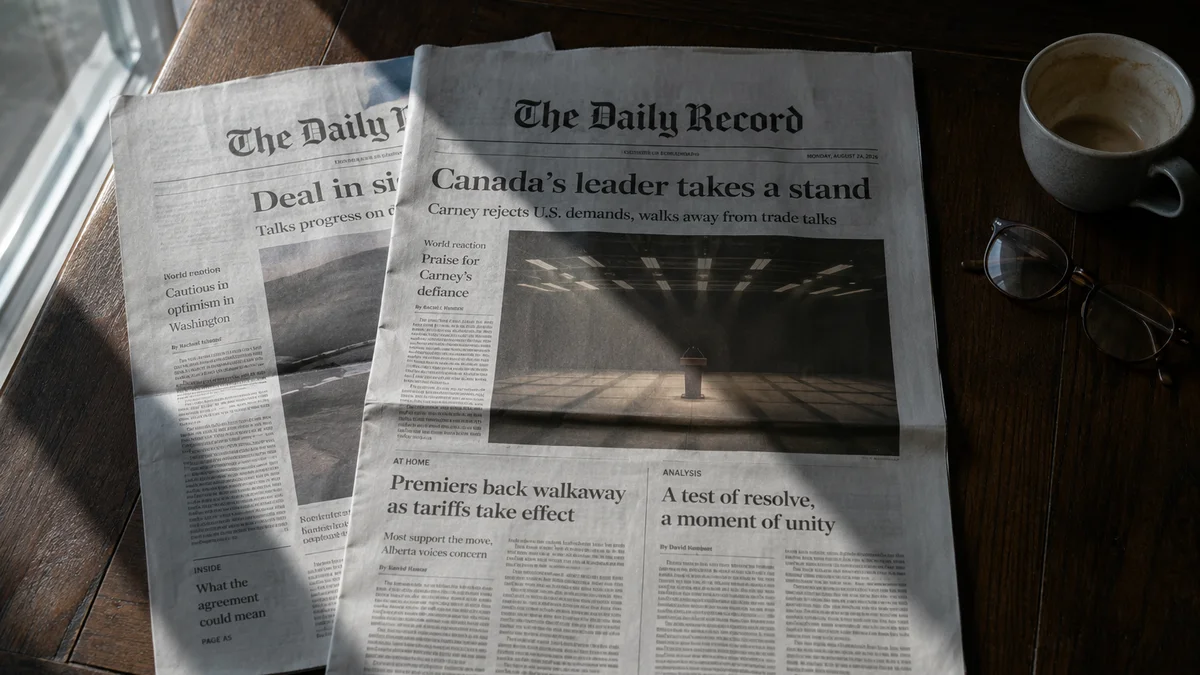
The Receipt
On August 11, 2026, Fen Osler Hampson wrote in the Globe and Mail that Mark Carney faced his “Neville Chamberlain moment”: a prime minister playing a weak hand, unable to avoid major concessions, negotiating under conditions that favoured the other side.[1] On August 25, in the same newspaper, Andrew Coyne argued that Canada had set an example for the civilized world and closed with Churchill’s own language: “broad and sunlit uplands.”[2] Chamberlain to Churchill, in the same masthead, in fourteen days.
Between those two columns, Canada’s trade talks with the United States collapsed, Carney walked away from the table, and international reaction reframed him within thirteen days of Hampson’s assessment. AFP reported that he had “stood up to” Trump.[3] The Washington Post described Carney as having presented himself as the voice of the world’s middle powers.[4] The Irish Times noted his popularity had soared.[5] Axios quoted a McMaster University political scientist calling him Canada’s “man for the moment.”[6]
Both framings describe something real. The concession record is documented. The international reaction is sourced. What the thirteen-day window reveals is not that one framing is right and the other wrong, but that political reputation was repriced by a new event without the earlier record being resolved. The concession ledger stayed open. The new frame didn’t need it closed.
The Receipts has tracked the trade file across multiple published articles and through two rounds of adversarial verification. The concession record documented in that series and the international reaction to the walkaway now coexist in the same file. This piece holds them side by side.
The Concession Record
The Receipts has documented the arc of Canada’s trade concessions across three published articles. “The 30-Day Deal” tracked the terms Canada accepted to secure a temporary tariff pause.[7] “Before and After” compared pre-tariff and post-tariff conditions across key sectors.[8] “The Cost of Waiting” measured what the delay between tariff imposition and negotiation cost Canadian businesses and workers.[9]
The concession ledger that emerges from that reporting is specific: tariff rates accepted, sectors exposed, timeline of escalation, cost to industries and communities. This article does not re-argue those findings. They are published, sourced, and available for review. The relevant fact for this piece is simpler: that record exists. It was open on August 11 when Hampson reached for the Chamberlain analogy. It was still open on August 24 when the international reaction arrived.
The Walkaway
On August 22, after a 72-hour extension of a tariff deadline, Carney announced he had instructed his negotiators to return to Ottawa.[10] He identified three categories of last-minute U.S. changes: the scope of auto tariff coverage was narrowed to exclude medium and heavy-duty trucks, the U.S. introduced language restricting Canada’s ability to pursue trade deals with other countries, and the U.S. maintained efforts to restrict protections for Canada’s cultural industries.[10] Fifty per cent tariffs on $27.6 billion in Canadian goods took effect that day. Carney announced retaliatory duties on U.S. goods, effective September 8.[10]
U.S. Trade Representative Jamieson Greer offered a different account, stating that Canada had “declined to finalize the trade deal under the terms agreed earlier this week” and that new Canadian demands had “upended the careful balance reached in the past days.”[11] This article does not adjudicate between the two accounts. Both are part of the record.
The international reaction was immediate. AFP framed Carney as having “stood up to” Trump despite the economic risk.[3] The Washington Post described him as having presented himself as the voice of middle powers.[4] The Irish Times reported that his popularity had soared and that standing up to Trump was broadly approved by other nations’ electorates.[5]
Domestically, the response tracked the same direction. Ontario Premier Doug Ford said he was glad the deal died.[12] Manitoba Premier Wab Kinew had spent the week saying Canada should fight.[13] The federal Conservatives supported the walkaway while calling for deal details to be released.[14] The notable dissenter was Alberta Premier Danielle Smith, who said she was “deeply disappointed” and warned that tariffs and counter-tariffs hurt businesses, workers, and families on both sides of the border.[15]
Why the Exit Was the Easy Door
Three days after the collapse, The Receipts published “When the Deal Died, Team Canada Was Relieved. That’s the Problem.”[16] That article documented a structural finding that reframes the walkaway: the Team Canada consultation process had produced consensus to reject but never consensus to accept. Eighteen months of federal-provincial coordination aligned Canada’s resistance posture. It never produced agreement on what deal the provinces would actually implement.
On August 19, Carney briefed the premiers on a deal taking shape in Washington and asked them to return American alcohol to store shelves. The response was not uniform. Nova Scotia’s Tim Houston was optimistic; British Columbia’s David Eby said progress had been made. But Kinew questioned whether accepting permanent tariffs was worth surrendering leverage. Quebec Premier Christine Fréchette said she had not decided whether her province would restock. Newfoundland’s Tony Wakeham told reporters all premiers had agreed to restock; within hours, multiple premiers contradicted or hedged that characterization.[16] The finding is not that the premiers were collectively opposed. It is that there was no demonstrable unified yes.
Ford, whose province was most exposed on steel and autos, stayed publicly silent while the deal was alive and emerged at full volume within hours of its death.[16]
The structural problem was not that premiers disagreed. Disagreement in a federation is ordinary. The problem was that the deal required provincial cooperation to deliver, and no mechanism existed to convert provincial inputs into a coordinated yes under deadline pressure. The booze bans that made Team Canada popular had become the very concessions Washington demanded. Each premier who had pulled American alcohol went from consultative participant to operational gatekeeper. Ottawa could negotiate the international framework. It could not guarantee the domestic implementation.[16]
Walking away required none of that coordination. Saying no required one federal decision. Delivering yes required cooperation from multiple provinces. The path of least structural resistance and the path of maximum political reward happened to be the same path. The collapse also eliminated a domestic delivery problem that eighteen months of consultation had not solved.
The strongest counter-reading deserves full weight. The walkaway may have been correct on the merits regardless of the coordination problem. Carney identified substantive last-minute U.S. changes: narrowed auto coverage, sovereignty restrictions on third-country trade deals, threats to cultural protections.[10] A prime minister who walks away from a deteriorating offer may simply be doing the job well. The domestic coordination gap does not automatically make the walkaway a default rather than a decision. And the facts themselves changed. On August 11, Hampson assessed Carney while Canada was negotiating and conceding. By August 22, the U.S. had introduced materially different demands and Carney refused them. Different conduct can warrant different assessments without anything illegitimate occurring.
That is precisely why both assessments can be true. The finding here is not that the second frame contradicts the first. It is that the second frame became politically dominant without requiring an accounting of what accumulated under the first. The documented premier reactions complicate the picture further. The resistance recorded on Wednesday and Thursday was resistance to the deal before the U.S. changed terms on Friday.[16] The version Carney described as on trajectory toward favourable terms could not get Ford to publicly confirm he would restock bourbon, could not stop Kinew from telling Manitobans to boycott, and could not get Quebec to commit.[16] Asked directly whether premier pushback factored in his decision, Carney said: “The short answer is no.”[10]
The Repricing
Political reputation can be repriced by a new event without the earlier record being resolved. The concession record documented by The Receipts and the reaction to the walkaway coexist in the same file. No mechanism required a reconciliation between them before the new frame took hold.
The Globe and Mail comparison is the sharpest illustration. Hampson’s “Concession Carney” and Coyne’s Churchill language are not contradictions. They are two columnists assessing different moments. Neither had any obligation to reconcile with the other. That is how commentary works. But the structural observation holds: the concession record that produced the first assessment was never settled, addressed, or accounted for before the second assessment was awarded. The walkaway generated a new frame that did not require an accounting of the concessions preceding it.
Note what this piece is not arguing. It is not arguing that the walkaway was wrong, that the international reaction was unearned, or that Carney acted cynically. The rally effects are real. Canadians genuinely preferred the walkaway to a deal widely perceived as inadequate. That preference is a legitimate democratic signal, not a manufactured one. Carney’s Davos speech and the walkaway both serve real middle-power interests that the international community has reason to support on the merits.[17]
The structural finding is narrower than any of those claims. It is simply this: a documented concession record and international recognition for defiance now sit in the same file. The event that produced the repricing was real and may have been justified on the merits. But the repricing did not require the old ledger to be settled first. Both records are true. The latest one is the only one being read.
What Would Change This Assessment
This article rests on two related but separable findings. The first is that political reputation was repriced without reconciliation of the concession record. The second is that the walkaway simultaneously eliminated a provincial delivery problem. Each has its own conditions for falsification.
The repricing finding would be weakened or falsified by:
- Evidence that Carney or a senior minister publicly addressed the concession record and explained how the walkaway represented a corrected course, reconciling the two frames rather than overwriting one with the other.
- Documentation that the international reaction specifically accounted for the concession history rather than treating the walkaway as an isolated event. If the repricing was informed rather than amnesiac, the structural finding weakens.
The delivery-problem finding would be weakened or falsified by:
- Evidence that the Team Canada consultation gap documented in “When the Deal Died, Team Canada Was Relieved” was closed before August 22: provincial minimum thresholds pre-agreed, delivery mechanism in place, coordinated yes achievable under deadline pressure. If that gap was closed, the argument that the walkaway also eliminated a domestic implementation problem would be falsified.