
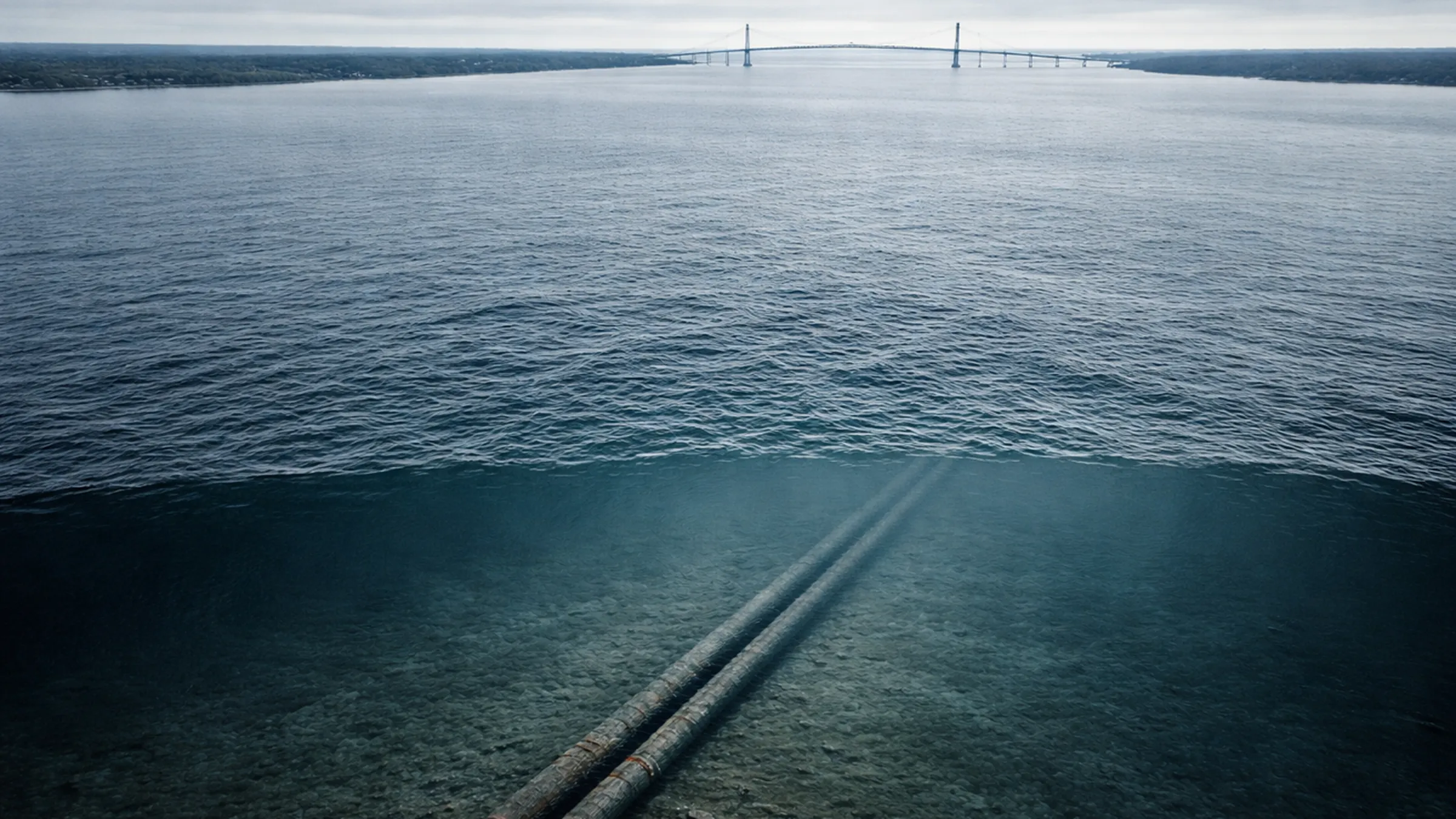
Canada has no commercial crude oil pipeline route from Alberta to Ontario or Quebec that does not transit through the United States. [1] [2]
Line 5 was built in 1953 as an extension of the Enbridge Mainline from Edmonton to Superior, Wisconsin. The route through the U.S. was chosen over an all-Canadian path north of the Great Lakes because of lower project costs and faster timelines. [2] [14]
Ontario depends entirely on crude oil delivered via the United States, with no immediate alternatives available. Quebec relies on crude oil transiting the U.S. for approximately 60% of its refinery consumption. [3]
The Energy East pipeline — proposed in 2013 to carry 1.1 million barrels per day from Alberta to New Brunswick through an all-Canadian route — was cancelled by TransCanada in October 2017. [12]
Line 5 has spilled at least 33 times since 1968, discharging more than 1.1 million gallons of oil cumulatively along its inland route. [9] [17]
The U.S. Supreme Court heard oral arguments on February 24, 2026, in Enbridge v. Nessel, a case that could determine whether Michigan state courts retain jurisdiction over the pipeline shutdown lawsuit. [10]
Canada invoked a 1977 bilateral Transit Pipelines Treaty in response to Michigan's shutdown efforts, asserting that no public authority in either country can impede cross-border petroleum flows. [7]
The Architecture of a Dependency
In 1953, when the Enbridge Mainline was extended from Superior, Wisconsin, to Sarnia, Ontario, the routing decision was straightforward. An all-Canadian path north of the Great Lakes would have been more expensive and slower to build. The route through Michigan was cheaper, and Canada and the United States were close allies with no foreseeable reason to distrust each other's infrastructure commitments. [14]
Canadian politicians at the time had pushed for a domestic route. C.D. Howe, the minister responsible, described the pipeline as "an essential factor in our preparedness program for the defense of Canada." But economics prevailed. [2]
That decision, rational in 1953, created a structural dependency that has compounded over seven decades. Today, the Enbridge Mainline system carries approximately 58% of all Canadian crude oil exports. [5] At Superior, the system splits: Line 5 runs north of Lake Michigan through the Straits of Mackinac to Sarnia; Lines 6, 14, and 61 run south of the lake. From Sarnia, Line 9 carries crude east to Montreal. [2]
This is not one of several supply routes to eastern Canada. For Ontario, it is the only route. For Quebec, it supplies over 60% of refinery feedstock. [3]
The vulnerability has three simultaneous dimensions, and no single proposed fix addresses all three.
Dimension One: Environmental
Two 20-inch pipelines, built 73 years ago, sit exposed on the bottom of the Straits of Mackinac at depths ranging from 100 to 270 feet. The Straits are one of the busiest shipping channels in the Great Lakes. University of Michigan scientists have called it the worst possible place for an oil spill in the Great Lakes. [22]
The pipeline has already spilled 33 times along its inland route. [17] In 2018, a ship anchor struck and dented the pipeline. [6] Roughly 23 million gallons of oil flow through this crossing every day. The Great Lakes hold 21% of the world's surface freshwater. [17]
Dimension Two: Jurisdictional
Canada's energy supply to the majority of its population is subject to U.S. state law, U.S. federal law, U.S. courts, U.S. executive orders, and U.S. domestic politics. Governor Whitmer revoked the pipeline's easement in 2020. [8] The Michigan Attorney General sued to shut it down. [10] A federal judge ruled that federal pipeline safety law preempts state authority. [11] The U.S. Supreme Court is now deciding which court system has jurisdiction. The Army Corps of Engineers controls the tunnel permit. Every one of these decision points is controlled by a foreign government.
Dimension Three: Political
This is the dimension that has changed most dramatically. The traditional risk analysis for Line 5 focused on engineering failure and legal outcomes — both probabilistic and debatable. But the pipeline's operational continuity now also depends on the discretionary decisions of a foreign executive branch that has demonstrated a pattern of using infrastructure approvals as political leverage.
The evidence is in the public record. In August 2025, the Trump administration reportedly threatened to withhold support for the Line 5 tunnel project unless Illinois Governor Pritzker personally asked for help — in a dispute about an entirely separate infrastructure project. [19] The administration paused the Brandon Road Asian carp barrier project for review despite a presidential memo directing maximum speed. [18] The Army Corps tunnel permit — which Canada needs for the long-term Line 5 solution — sits within the same administrative apparatus.
The point is not that any particular executive action is imminent. The point is that the structure exists. Canada's energy supply to Ontario and Quebec requires ongoing approvals from a foreign executive branch. That executive branch is led by a president who has called Canada's Prime Minister "the future Governor of Canada," who has imposed tariffs on Canadian goods, who declared a national energy emergency expanding his executive authority over pipeline permitting, and who has shown — across multiple unrelated disputes — that he will use any available lever in any negotiation.
The pipeline's continued operation is not secured by treaty, by contract, or by law that cannot be reinterpreted. It is secured by the assumption that the current and future occupants of a foreign executive office will continue to find it in their interest to let it operate.
Canada's oil supply to most of its population runs through a pipeline in another country. That country's leader has shown he'll use anything as leverage in a negotiation. The pipeline is one of those things.
How Canada Eliminated Its Own Alternatives
The current vulnerability is not the result of a single bad decision. It is the cumulative product of a decades-long pattern in which every level of Canadian government had legitimate reasons to oppose specific pipeline projects — and none proposed or advanced an alternative that would restore domestic energy sovereignty.
The All-Canadian Route That Wasn't
When the original Mainline was built in the 1950s, Canadian politicians argued for a domestic route. They lost that argument to cost and speed. The same dynamic has repeated in every subsequent proposal. [14]
Energy East, proposed by TransCanada in 2013, was the most serious attempt at an all-Canadian oil pipeline to the east coast. It would have carried 1.1 million barrels per day from Alberta through Saskatchewan, Manitoba, Ontario, and Quebec to refineries and a port terminal in New Brunswick. Roughly 70% of the route would have used existing converted natural gas pipeline. [12]
The project would have eliminated Canada's dependence on U.S.-transited crude for its eastern refineries and provided tidewater access for exports.
It died in October 2017 for a combination of reasons: regulatory delays after the National Energy Board process was compromised by improper meetings with a TransCanada consultant; political opposition in Quebec, where polling showed only one-third support; environmental concerns about tanker traffic near beluga whale habitat; Indigenous rights objections along the route; and a sustained decline in global oil prices that weakened the project's economics. [12] [21]
Each objection was individually defensible. The NEB process was genuinely compromised. Quebec's environmental concerns were grounded in real risk. Indigenous consultation was constitutionally required. The economics were uncertain. But the collective result was that Canada's last viable path to energy self-sufficiency in its most populated provinces was closed — and nothing replaced it.
The Veto Without an Alternative
This is the structural governance failure at the heart of the vulnerability. Canadian infrastructure politics has developed a consistent pattern: proposals are advanced, objections are raised on legitimate grounds, projects are delayed or killed, and no alternative is proposed by those who blocked the original project.
Northern Gateway: killed. Energy East: killed. Keystone XL: killed by the U.S., but Canada could not advance a domestic substitute. Trans Mountain: nearly killed, rescued only by federal nationalization at a final cost of $34 billion and 12 years of delays. [20] The result is that the infrastructure Canada actually depends on is legacy infrastructure from the 1950s, routed through another country, because nothing new can survive the domestic approval process.
The federal government did not propose an alternative when Energy East died. Quebec — the province most vocally opposed — did not propose one either. First Nations groups, whose constitutional rights to consultation were a factor in delays, were not offered a stake in an alternative project that might have secured their support. Provincial governments pointed fingers at each other. The pipeline kept running through Michigan.
No actor in this sequence was wrong on the merits of their specific objection. But the system as a whole failed to produce an outcome. The difference between governance and mere opposition is that governance requires arriving at a solution, not just identifying problems with each proposed one. Canada identified problems. It did not arrive at a solution. And every year that passed without one was another year in which the single point of failure became more deeply embedded.
The Most Electrified Province in the Country Still Needs Oil
Quebec presents the sharpest illustration of the contradiction. It is the most electrified province in Canada — 94% of its electricity comes from hydropower, and its electrical grid is essentially carbon-free. [1] Quebec has legitimate reasons to see itself as a leader on energy transition and to be skeptical of new fossil fuel infrastructure.
But Quebec has no commercial crude oil production of its own. [1] Its two refineries — Suncor in Montreal (137,000 barrels per day) and Valero in Lévis near Quebec City (265,000 barrels per day) — have a combined capacity of 402,000 barrels per day. [1] Those refineries produce the gasoline, diesel, jet fuel, propane, and petrochemical feedstocks that hydroelectricity cannot replace. You cannot run a truck fleet on dam power. You cannot heat a rural propane-dependent home with it. You cannot fly planes out of Trudeau International Airport with it. You cannot manufacture plastics with it.
Over 60% of the crude feeding those refineries arrives via the Enbridge Mainline — through the United States, through Michigan, through Line 5. [3] Quebec has three rail terminals capable of receiving crude with a combined capacity of approximately 123,000 barrels per day [1] — less than a third of refinery capacity, and a mode of transport whose safety record in Quebec needs no footnote beyond the words "Lac-Mégantic."
Quebec was the most powerful voice against Energy East. That opposition was grounded in legitimate concerns: the NEB process was compromised, the environmental risks of tanker traffic near beluga habitat were real, and the province's electorate did not want a bitumen pipeline through its territory. [12]
But the practical consequence of killing Energy East without proposing an alternative is that Quebec remains dependent on oil that transits through exactly the kind of infrastructure it objected to — just someone else's infrastructure, in someone else's country, under someone else's jurisdiction, sitting on the bottom of someone else's freshwater.
The critique is not that Quebec was wrong to oppose a specific project. The critique is that opposing a project without proposing or supporting any alternative route leaves the underlying dependency intact — and deepens it, because every year without a domestic alternative is another year the vulnerability compounds. "No" is not a policy. "No, and here is what we should build instead" is a policy. Quebec said no. And then nothing.
The Tunnel: Solving One Problem While Locking In Two Others
Enbridge's proposed solution is a tunnel bored through the bedrock beneath the Straits of Mackinac, housing a replacement pipeline. The tunnel would eliminate the environmental risk of the current lakebed crossing — no more exposed pipes, no more anchor strike vulnerability, no more aging infrastructure sitting in open water. [6]
But the tunnel solves only the environmental dimension of the vulnerability. It does nothing about the jurisdictional dimension — the pipeline would still transit U.S. territory, still be subject to U.S. courts, still require U.S. federal permits. And it does nothing about the political dimension — the tunnel permit itself is a federal decision that sits within the discretionary authority of the U.S. executive branch. Building the tunnel locks in the foreign dependency for another generation of infrastructure life.
The tunnel is estimated at roughly $500 million CAD. An overland all-Canadian route would cost orders of magnitude more — the Trans Mountain expansion, as a comparator, came in at $34 billion. [20] But an overland route would address all three dimensions simultaneously: no freshwater crossing, no foreign jurisdiction, no foreign political exposure. The question Canada has never honestly answered is whether the cost of building its own infrastructure is greater than the cost of permanently depending on someone else's.
What a Single Point of Failure Means in 2026
In engineering, a single point of failure is a component whose loss causes the entire system to fail. The term implies no redundancy, no fallback, no graceful degradation. That is a precise description of Canada's crude oil supply chain to Ontario and Quebec.
If Line 5 were disrupted tomorrow — by accident, by court order, by executive action, or by political calculation — Ontario and Quebec would face an immediate shortage of transportation fuel, heating fuel, jet fuel, and petrochemical feedstocks. Ontario has no immediate alternative. Quebec could partially compensate with St. Lawrence tanker deliveries and rail, but not at the volumes required. CAPP's own analysis states it plainly: if the U.S. were to cut off delivery of these crucial commodities, Canada would face energy shortages and high prices. Ontario and Quebec are particularly vulnerable. [3]
This is not an abstract risk. The world order that made the 1953 routing decision reasonable — stable bilateral relations, predictable regulatory environments, mutual trust between allies — has been visibly ruptured. The president of the United States has called Canada's prime minister a future governor. He has imposed tariffs. He has used infrastructure approvals as leverage in unrelated disputes. The bilateral relationship that Canada's energy security depends on is not the relationship that existed when the pipeline was built, or when Energy East was cancelled, or even two years ago.
And yet the pipeline keeps running through Michigan, across the bottom of the Great Lakes, under the jurisdiction of a foreign government, with no Canadian alternative anywhere in the planning, approval, or construction pipeline. Not proposed. Not under review. Not funded. Not started. Nothing.
What proponents of pipeline development tend to omit: Indigenous rights to consultation are constitutionally entrenched and the failure to meaningfully engage First Nations in alternative routing — including offering equity stakes and co-governance — has been a primary cause of project failure, not an obstacle to be overcome.
What opponents of pipeline development tend to omit: Blocking specific projects without proposing alternatives does not eliminate the dependency — it just means the dependency continues to be served by older, riskier, foreign-controlled infrastructure. The crude oil Quebec consumes did not stop flowing when Energy East was cancelled. It continued flowing through Michigan.
What both sides tend to omit: This is now a national security question, not primarily an environmental or economic one. The terms of the debate have been overtaken by geopolitical events that neither side anticipated when these positions were formed.
Canada's energy infrastructure to its most populated provinces constitutes a single point of failure across three simultaneous dimensions: environmental (catastrophic spill risk in the world's largest freshwater system), jurisdictional (supply chain subject to foreign law, foreign courts, and foreign executive authority), and political (operational continuity dependent on the discretionary decisions of a foreign leader who has demonstrated willingness to use infrastructure as leverage).
This is a governance failure, not an engineering failure. Every level of government — federal, provincial, and Indigenous — had legitimate grounds to oppose specific projects. But the system produced no alternative. The cumulative effect of decades of objection without solution is a permanent structural vulnerability that no actor is accountable for creating, because no single actor created it. They all did, by each doing their part to ensure nothing was built while the dependency deepened.
Counter-interpretation: The governance system worked as designed — it prevented projects with genuine environmental, regulatory, and rights-based deficiencies from proceeding. The fact that no acceptable alternative has emerged reflects the genuine difficulty of routing major infrastructure through a country with constitutionally protected Indigenous rights, provincial jurisdiction over natural resources, and legitimate environmental constraints. The alternative — overriding these protections — would represent a different and arguably worse governance failure.
- This analysis is wrong if Canada has viable short-term alternatives for supplying Ontario and Quebec refineries that do not depend on Line 5 or U.S.-transited infrastructure — alternatives not identified in this reporting or in CAPP's published supply chain analysis.
- This analysis is overstated if the bilateral relationship between Canada and the United States is more structurally resilient than current political dynamics suggest — that is, if the institutional frameworks (treaties, trade agreements, regulatory cooperation) are robust enough to prevent any U.S. executive from using energy infrastructure as leverage regardless of political dynamics.
- This analysis becomes moot if Canada initiates a serious domestic alternative — an all-Canadian crude oil pipeline or equivalent supply chain — with federal backing, provincial cooperation, and meaningful Indigenous partnership. No such project is currently proposed, under review, funded, or in any stage of planning.
Sources (22)
- Canada Energy Regulator — Provincial and Territorial Energy Profiles: Quebec. cer-rec.gc.ca
- Canadian Association of Petroleum Producers (CAPP) — Canadian Imports of U.S. Crude Oil, Natural Gas, and Refined Products, January 2026. capp.ca
- CAPP — Canadian Imports of U.S. Crude Oil, Natural Gas, and Refined Products, July 2025. capp.ca
- Natural Resources Canada — The Refining Sector in Canada. natural-resources.canada.ca
- Canada Energy Regulator — Canada's Pipeline System 2021: Crude Oil Pipeline Transportation System. cer-rec.gc.ca
- Enbridge — Line 5 and the Great Lakes Tunnel project information. enbridge.com
- Transit Pipelines Treaty between Canada and the United States, 1977. Treaty text via Global Affairs Canada.
- Michigan Governor Gretchen Whitmer — Notice of Revocation and Termination of Easement, November 13, 2020.
- Michigan Attorney General Dana Nessel — Complaint filed in Ingham County Circuit Court, 2019. Supreme Court docket: Enbridge v. Nessel.
- U.S. Supreme Court — Oral argument transcript, Enbridge v. Nessel, February 24, 2026. grist.org (reporting)
- U.S. District Court, Western District of Michigan — Judge Robert Jonker, ruling on federal preemption of state pipeline authority, December 2025. michiganpublic.org (reporting)
- Energy East — National Energy Board / Canada Energy Regulator regulatory record; TransCanada (TC Energy) cancellation announcement, October 5, 2017. wikipedia.org (overview)
- Bad River Band of Lake Superior Chippewa — Federal court trespass ruling, U.S. District Judge William Conley, 2023. greatlakesnow.org
- Canadian Energy Centre — "Big vulnerability: How Ontario and Quebec became reliant on the U.S. for oil and gas," May 7, 2025. canadianenergycentre.ca
- Native American Rights Fund / Earthjustice — Bay Mills Indian Community filings re: Line 5 tunnel. narf.org
- Michigan Public Service Commission — Line 5 tunnel siting approval, December 1, 2023. congress.gov (CRS report)
- National Wildlife Federation / Oil & Water Don't Mix — Line 5 spill history and environmental impact documentation. oilandwaterdontmix.org
- Engineering News-Record — "$1.2B Great Lakes Asian Carp Barrier Project Paused Amid Trump Administration Review," January 26, 2026. enr.com
- Chicago Tribune — Trump administration Line 5 tunnel leverage reporting, August 2025.
- Trans Mountain Corporation — Expansion project: operations commenced May 1, 2024; final cost C$34 billion. wikipedia.org (overview)
- Policy Options (IRPP) — "Five routes for western Canadian oil to get to eastern Canada," June 2019. policyoptions.irpp.org
- University of Michigan Water Center — Straits of Mackinac oil spill risk assessment and current modeling. oilandwaterdontmix.org (citing)
If you have corrections, primary sources we missed, or contrary evidence that challenges this analysis, we want to see it. This article will be updated as new data emerges — particularly around the Supreme Court ruling, the Army Corps tunnel decision, and any Canadian policy response. Contact: tips@thereceipts.ca