
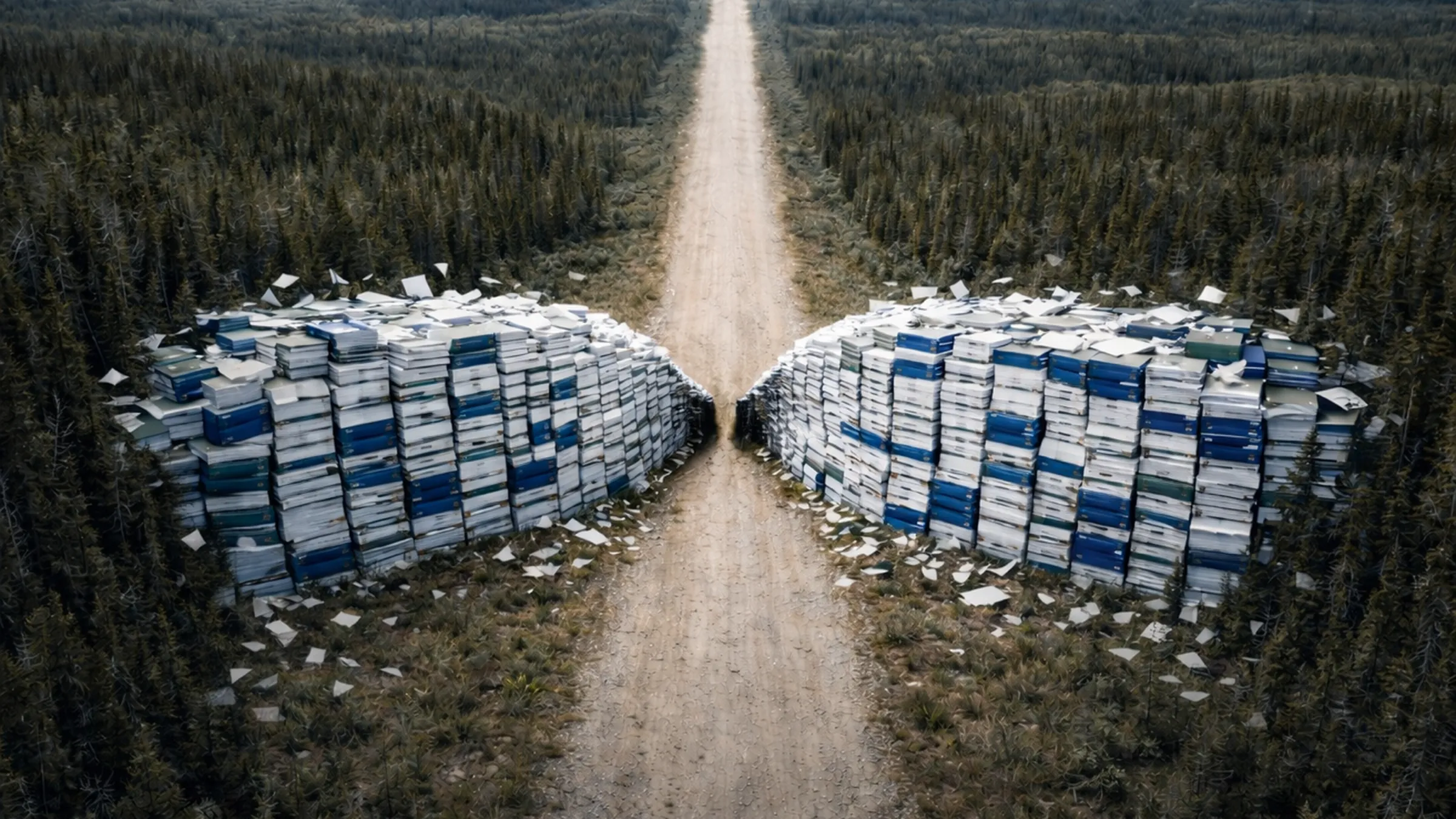
Canada spent 12 years and $34.2 billion building one pipeline expansion (TMX). Pipeline constraints cost producers an estimated $15–20 billion annually. [11, 12]
The Trans Mountain Expansion took twelve years and $34.2 billion. [13, 14, 15, 16, 17]
Bill C-48 (2019) banned crude tankers on BC's north coast. Bill C-69 (2019) was found partially unconstitutional by the Supreme Court in 2023. Combined effect: one major pipeline completed in over a decade. [20, 21, 22]
GFANZ's June 2022 report, co-chaired by Mark Carney, classified "gas pipelines" as high-emitting assets requiring managed phaseout. [24]
Federal officials recorded "no project application" for a new pipeline (2022) and "no private sector proposal" presented (2025). [30, 31]
The Strait of Hormuz closure (Feb 28, 2026) disrupted ~13 million barrels/day of crude. South Korea activated a $68.3 billion stabilization fund. European gas prices doubled in two weeks. [1, 2, 7]
On February 28, 2026, the United States and Israel launched coordinated airstrikes on Iran. Iran's Revolutionary Guard declared the Strait of Hormuz closed. Within days, tanker traffic through the world's most critical oil chokepoint dropped to near zero. Approximately 13 million barrels of crude oil per day — roughly one-third of all seaborne crude trade — stopped moving.[1]
The consequences arrived fast. South Korea imposed a fuel price cap for the first time in thirty years and activated a 100 trillion won ($68.3 billion) market stabilization fund — larger than its entire annual defence budget.[2] Japanese refiners, who source roughly 95% of their crude from Gulf states, requested the government release strategic oil reserves.[3] China ordered its largest refineries to halt diesel and petrol exports.[4] Pakistan formally requested Saudi Arabia reroute oil shipments through Red Sea ports that bypass Hormuz.[5] An LNG tanker carrying Nigerian gas, originally bound for France, turned around mid-voyage and headed toward Asia, where buyers were outbidding European importers.[6] European benchmark gas prices doubled in two weeks — the largest weekly gain since Russia's invasion of Ukraine.[7]
The same day the crisis escalated, Bloomberg reported that Canada — the country with 166 billion barrels in proven reserves, the world's third-largest — was "urgently exploring options" with provinces and the energy industry to boost oil supply.[8]
The question is not whether Canada has the resource. The question is why, after more than a decade of documented capacity constraints, it still cannot move enough of it to market. The answer is a feedback loop — one constructed from both sides simultaneously.
The bottleneck
The capacity constraint that now defines Canada's energy position was first flagged as a serious economic threat around 2012–2013, when oil sands production growth began outpacing pipeline takeaway capacity. By September 2018, production had reached approximately 4.30 million barrels per day against total pipeline export capacity of roughly 3.95 million barrels per day.[9]
The result was catastrophic for Canadian producers. The Western Canadian Select discount to West Texas Intermediate blew out to a record of approximately US$50 per barrel in the fall of 2018, with WCS dropping as low as US$5.90 per barrel.[10] Alberta Premier Rachel Notley was forced to impose mandatory production curtailment. The Fraser Institute estimated pipeline constraints cost Canadian oil producers $20.6 billion in lost revenue in 2018 alone; the University of Calgary School of Public Policy put annual losses at roughly $14 billion.[11, 12]
The Trans Mountain Expansion — the project that was supposed to solve this — took twelve years from Kinder Morgan's initial announcement in February 2012 to commercial operations on May 1, 2024. The cost escalated from $5.4 billion to a reported $34.2 billion — roughly 6.3 times the original estimate. Along the way, the federal government purchased the pipeline for $4.5 billion after Kinder Morgan threatened to walk away, the Federal Court of Appeal unanimously overturned the original approval, and construction required a second NEB hearing, a Supreme Court challenge, and the direct intervention of three successive federal governments.[13, 14, 15, 16, 17]
The expansion nearly tripled the pipeline's capacity from 300,000 to 890,000 barrels per day. The WCS-WTI differential narrowed, and the project generated an estimated $13 billion in additional revenues in its first year.[18] But analysts now warn Canada will overrun egress capacity again within one to two years at current production growth rates. Alberta hit record production of 4.53 million barrels per day in December 2023, and output continues to climb.[19]
One pipeline. Twelve years. $34.2 billion. And the constraint is already returning.
Side one: the legislative framework
Two pieces of Trudeau-era legislation are most directly implicated in the infrastructure gap.
The Oil Tanker Moratorium Act (Bill C-48), which received Royal Assent on June 21, 2019, prohibits oil tankers carrying more than 12,500 metric tonnes of crude oil from loading or unloading along British Columbia's north coast — from the northern tip of Vancouver Island to the Alaska border. Violations carry penalties of up to CA$5 million. The practical effect was to block any pipeline project terminating at northern BC ports from loading crude onto tankers bound for Asian markets.[20]
The Impact Assessment Act (Bill C-69), which received Royal Assent the same day, overhauled the environmental review process for major projects. It broadened assessments beyond environmental effects to include health, social, economic, and gender-based impacts, required consideration of Indigenous traditional knowledge and Canada's climate commitments, and allowed any member of the public to participate in reviews. Alberta Premier Jason Kenney called it the "no more pipelines bill." Enbridge CEO Al Monaco warned that under the amendments, "no further pipelines will be built in Canada."[21]
Alberta referred the Act to its Court of Appeal, which found it unconstitutional in its entirety in a 4–1 decision in May 2022. The Supreme Court of Canada confirmed, in a 5–2 ruling in October 2023, that the "designated projects" regime exceeded Parliament's jurisdiction. The Act was subsequently amended to narrow its scope — but a Torys law firm analysis noted that no major project had been approved through the IAA process aside from Cedar LNG, which relied mostly on BC's provincial process.[22]
Together, C-48 and C-69 created a regulatory environment in which building new oil export infrastructure to tidewater was, in practice, either prohibited by statute or so procedurally uncertain as to be commercially unviable.
Side two: the financial framework
While the legislative constraints operated on the regulatory side, a parallel pressure system was being constructed on the financing side — co-chaired by the man who is now Prime Minister.
Mark Carney co-chaired the Glasgow Financial Alliance for Net Zero from its founding in 2021 through 2023, alongside Michael Bloomberg. GFANZ organized over 550 financial institutions holding more than $130 trillion in assets around commitments to align their portfolios with net-zero emissions by 2050.[23]
The most consequential institutional document produced under Carney's co-chairmanship was the June 2022 report, "The Managed Phaseout of High-emitting Assets." It explicitly listed examples of assets subject to managed phaseout: "coal mines, fossil-fuel power stations, oil fields, gas pipelines, steel mills, ships, cement plants and consumer gasoline-powered vehicles."[24]
Carney's public statements during this period were consistently global in framing — extensive research across GFANZ publications, speeches, interviews, and media coverage reveals no direct, specific quotes naming Trans Mountain, Keystone XL, Northern Gateway, Energy East, or Canada's specific oil export constraints. But the implications were unmistakable.
At the CNBC Sustainable Future Forum on October 21, 2021, weeks before COP26, Carney said: "We have both too many hydrocarbons, enormous stranded assets, whether it's in coal, three-quarters of coal, half of gas, roughly the same of oil, we have too many fossil fuels." He stated explicitly that the contribution from fossil fuels "clearly has to go down significantly, and ultimately, wound down."[25]
In a Bloomberg Green interview on April 24, 2022, Carney used pipelines as an illustrative example of fossil fuel financing, asking: "Does the buyer of the pipeline have a transition plan and what's the horizon they are going to run the pipeline for?" — framing pipeline ownership as acceptable only with a credible phaseout timeline.[26]
His book Value(s) (2021) laid the intellectual groundwork: "To meet the 1.5°C target, more than 80 per cent of current fossil fuel reserves (including three-quarters of coal, half of gas, one-third of oil) would need to stay in the ground, stranding these assets." Canada holds 166 billion barrels of those reserves.[27]
A notable tension persisted throughout: while co-chairing GFANZ, Carney served as Vice Chair of Brookfield Asset Management, which owned Inter Pipeline — one of the largest oil sands and gas infrastructure companies in Canada. Carney defended this, stating: "Just because we're net zero doesn't mean everything's green. We have assets that span the spectrum and we have a commitment that we will manage those assets and work to decarbonise those assets over time."[28]
In fairness, Carney also showed nuance. In May 2022, he acknowledged that "a smooth transition will require some limited and targeted investment in fossil fuels" and warned that "solely restricting hydrocarbon supply will boost rents in the energy sector, while constraining governments and hobbling households."[29] These statements, however, did not alter the GFANZ framework's classification of pipelines as phaseout assets.
The loop
The two sides converge in a single, documented sequence.
On one side, the legislative framework constrained the regulatory environment for pipeline construction — C-48 blocked northern tanker access, C-69 created assessment uncertainty that the Supreme Court ultimately found exceeded federal jurisdiction, and the combined effect was that one pipeline expansion took twelve years and $34.2 billion to complete.
On the other side, the financial framework pressured the investment environment — GFANZ classified pipelines as high-emitting phaseout assets, organized financial institutions to require transition timelines for fossil fuel infrastructure financing, and made the cost of capital for new pipeline projects higher and less certain.
Then the government observed that nobody was proposing to build anything.
In August 2022, a Global Affairs Canada briefing note stated: "While there is no project application to build a new west-to-east natural gas or oil pipeline …"[30]
In July 2025, Natural Resources Minister Tim Hodgson told Reuters: "Canada's federal government has not been presented with any private sector proposal to build a new crude pipeline to the Pacific coast." He added: "Now it's up to the private sector to make those decisions."[31]
Two days later, Prime Minister Carney said it would be up to the private sector to make the proposal, rather than a "top-down approach" from the government.[32]
The same month that the federal briefing note recorded the absence of pipeline applications — August 2022 — German Chancellor Olaf Scholz visited Canada to discuss energy cooperation. Europe was scrambling for alternatives to Russian gas after the invasion of Ukraine. Prime Minister Trudeau, standing beside Scholz, said that while he was not ruling out a role for Canadian natural gas, "there isn't a clear business case yet" for building an LNG export terminal.[33]
Germany, at the time, was racing to build floating LNG import terminals and restarting coal plants. Canada, with the world's fifth-largest natural gas reserves, said the business case wasn't there. As documented in The 16,000-Mile Receipt, the consequence arrived in the form of an Australian LNG tanker sailing halfway around the world to deliver gas to a Canadian port — because Canada could not get its own gas to its own coast.
This is the feedback loop: government constrains the regulatory environment, a parallel financial framework pressures the financing environment, and then government observes that the private sector has not proposed to build the infrastructure that both frameworks were designed to discourage.
The reversal
The policy direction has now reversed — in some cases, by the same actors who built it.
On his first day in office, Carney scrapped Canada's consumer carbon tax. His government subsequently paused the zero-emission vehicle sales mandate and fast-tracked approval for an LNG export facility expansion in British Columbia.[34]
On November 27, 2025, Carney and Alberta Premier Danielle Smith signed a Memorandum of Understanding committing Ottawa and Alberta to work toward a new bitumen pipeline from Alberta to the Pacific coast — at least one million barrels per day — for export to Asian markets. The MOU scraps the planned emissions cap on the oil and gas sector, suspends the Clean Electricity Regulations in Alberta, and commits the federal government to "make any appropriate adjustments to the Oil Tanker Moratorium Act" if a new pipeline is designated a Project of National Interest under the Building Canada Act.[35]
The Building Canada Act (Bill C-5), which received Royal Assent in June 2025, allows cabinet to designate "Projects of National Interest" and fast-track them — effectively creating a parallel process that bypasses the Impact Assessment Act's early planning phase.[36]
The backlash came from both directions. Former Environment Minister Steven Guilbeault resigned from Cabinet the day the MOU was signed. Two founding members of the federal Net-Zero Advisory Body resigned, saying their work was being ignored as Ottawa moved toward new oil and gas projects. The Coastal First Nations declared they "will never tolerate any exemptions or carveouts." The Assembly of First Nations voted unanimously for the MOU to be scrapped.[37, 38, 39]
GFANZ itself has collapsed. The alliance Carney co-founded lost most of its membership — including all of Canada's biggest banks — and shut down.[40]
As of March 2026, no private-sector proponent has stepped forward to propose the new pipeline envisioned in the MOU. The Oil Tanker Moratorium Act remains in force, unamended.[41]
The world this week
The Strait of Hormuz handles roughly 20% of global seaborne oil trade and 20% of global LNG flows. The crisis has exposed, with unusual clarity, which countries built the infrastructure to respond to a supply shock — and which did not.
Japan sources roughly 75% of its oil imports from the Middle East, with about 70% of that volume delivered through the Strait of Hormuz. Its refiners have asked the government to release strategic reserves. Japan holds approximately 254 days of supply.[42]
South Korea imports about 70% of its crude through Hormuz. Its major refiners — SK Energy, GS Caltex, S-Oil, and HD Hyundai Oilbank — are competing with Japan for alternative supplies from Singapore, India, and Pakistan. The country secured an emergency shipment of 6 million barrels from the UAE via alternative ports that bypass the strait. The Hyundai Research Institute estimated that if crude averages $100 a barrel in 2026, South Korea's growth rate could fall at least 0.3 percentage points and consumer prices could rise an additional 1.1 percentage points.[43]
India — 90% dependent on imported crude, with less than 30 days of strategic reserves — faces the largest combined exposure of any major economy.[5]
Qatar's Ras Laffan complex, the world's largest LNG production facility, was hit by Iranian drones and went offline. Qatar supplies 20% of global LNG — all of it from a single industrial complex, all of it shipped through the Strait of Hormuz. An energy analyst at Rapidan described the facility as "a sitting duck," noting that unlike oil production, which is distributed across many fields and countries, LNG production is concentrated in one location.[44] QatarEnergy declared force majeure on its contracts and delayed a planned expansion to 2027.[45]
The LNG disruption hit Europe hard. Qatar supplies around 10% of Europe's LNG, but the knock-on effects are larger: as Asian buyers outbid European importers for available cargoes from the United States and Australia, tankers are being diverted mid-voyage. The Dutch TTF natural gas benchmark — Europe's reference price — doubled in two weeks.[46]
In August 2022, Germany asked Canada for gas. Canada said there was no business case. In March 2026, European gas prices have doubled and the tankers are turning around.
The structural finding
Canada's energy bottleneck was not an accident of geography or a failure of market interest. It was constructed — from both sides, over more than a decade, by actors who are now in the same government trying to reverse it.
From the public-policy side: legislation that banned tanker traffic on the north coast, an assessment framework that the Supreme Court found exceeded federal jurisdiction, and a regulatory environment so uncertain that one pipeline expansion took twelve years and cost 6.3 times its original estimate.
From the financial-framework side: a global alliance, co-chaired by Canada's current Prime Minister, that classified gas pipelines as high-emitting assets requiring managed phaseout, organized $130 trillion in financial assets around transition commitments, and created financing pressure that reinforced the regulatory constraints from the capital side.
The feedback loop closed when government officials — operating within the environment that both frameworks had built — noted the absence of private-sector pipeline proposals and concluded that the market had spoken.
The market had spoken. It said: you made this too expensive, too slow, and too uncertain to build.
The reversal now underway — the MOU, the emissions cap removal, the tanker moratorium adjustment, the Building Canada Act's fast-track mechanism — acknowledges the structural problem. Whether it resolves the problem is a different question. As of this writing, no private proponent has stepped forward. The legislative amendments have not been enacted. And the world is short 13 million barrels a day.
The right omits: Carney made no Canada-specific pipeline statements during his GFANZ tenure — his framing was consistently global. He also acknowledged in May 2022 that "a smooth transition will require some limited and targeted investment in fossil fuels" and warned against solely restricting supply. The TMX cost escalation reflects construction, supply chain, and COVID-related factors in addition to regulatory delay. Environmental and Indigenous consultation concerns that informed C-48 and C-69 remain substantive regardless of the economic consequences.
The left omits: The regulatory and financial frameworks had measurable, compounding effects on investment appetite — the absence of private pipeline proposals was a predictable outcome of the environment both frameworks created, not evidence that the market independently concluded the projects were uneconomic. The TMX expansion, once completed, generated an estimated $13 billion in additional revenue in its first year — evidence of suppressed demand, not absent demand. Germany literally asked for Canadian gas in August 2022 and was told there was no business case.
The energy bottleneck was constructed from two directions simultaneously: legislative constraint (C-48, C-69) from the public-policy side, and managed-phaseout financing pressure (GFANZ) from the financial-framework side. The current Prime Minister was not an incidental participant in the financial framework — he co-chaired it, and the organization's published reports classified the infrastructure Canada needed as assets to be wound down. The feedback loop — constrain, discourage investment, observe no proposals, conclude the market has decided — is documented across federal briefing notes, ministerial statements, and GFANZ publications between 2022 and 2025.
Counter-interpretation: Carney's defenders argue his pivot represents pragmatic evolution in response to changed circumstances — the Hormuz crisis, tariff pressure, and energy security imperatives that did not exist at the same scale during GFANZ's active period. The regulatory constraints served environmental protection and Indigenous consultation purposes that retain validity independent of their economic effects. The TMX cost overrun is partly attributable to construction and supply chain factors, not solely regulatory friction. And the absence of private proposals may reflect genuine commercial uncertainty about global oil demand trajectories, not only regulatory deterrence.
- Evidence that private pipeline proposals were actively under consideration during 2021–2025 despite the regulatory and financial environment — this would weaken the feedback-loop thesis by showing investment appetite existed regardless of the constraints.
- Evidence that GFANZ's framework had no measurable effect on pipeline financing decisions in Canada — for example, data showing Canadian pipeline projects faced no additional financing costs or restrictions attributable to GFANZ-aligned institutional policies.
- A private proponent stepping forward under the current MOU framework — this would suggest the reversal has broken the loop and that regulatory clarity alone is sufficient to restore investment appetite.
- Evidence that Carney, during his GFANZ tenure, made specific statements supporting Canadian pipeline infrastructure or sought to exempt Canadian export capacity from the managed-phaseout framework.
Sources (46)
- Congressional Research Service, "Iran Conflict and the Strait of Hormuz: Impacts on Oil, Gas, and Other Commodities," Report R45281, updated March 11, 2026. congress.gov; PDF: congress.gov (PDF)
- CNBC, "Oil shock prompts South Korea to impose fuel price cap for the first time in 30 years," March 9, 2026. cnbc.com
- Reuters via CNBC, reporting on Japanese refiner request for strategic oil reserve release, March 9, 2026. cnbc.com
- Fortune, "Asia faces an energy shock from the Iran war," March 5, 2026. Reporting on China's State Council directive halting diesel and petrol exports. fortune.com
- CNBC, "The Strait of Hormuz is facing a blockade. These countries will be most impacted," March 3, 2026. Includes Pakistan LNG import dependency data (99% from Qatar/UAE via Hormuz, per Kpler) and India exposure data. cnbc.com
- Financial Times, "Europe faces the threat of an energy crisis as tankers redirect shipments to Asia," March 5, 2026 (subscription required).
- IndexBox, "European Gas Prices Double Amid LNG Supply Crisis," March 9, 2026. indexbox.io
- Bloomberg, "Canada Weighs Options to Boost Oil Supply as War Causes Market Turmoil," March 10, 2026. bloomberg.com (subscription required).
- Canada Energy Regulator, "Western Canadian Crude Oil Supply, Markets, and Pipeline Capacity," 2018. cer-rec.gc.ca
- Canada Energy Regulator, "Market Snapshot: What is the difference between Canadian and U.S. benchmark crudes?" 2018. Documents WCS-WTI differential widening. cer-rec.gc.ca; Alberta Energy Regulator, WCS historical pricing data: aer.ca
- Fraser Institute, "The Cost of Pipeline Constraints in Canada," 2018, by Elmira Aliakbari and Ashley Stedman. Pipeline constraint cost estimate ($20.6 billion, 2018). fraserinstitute.org (PDF)
- University of Calgary School of Public Policy, annual pipeline constraint loss estimate (~$14 billion). policyschool.ca
- Pipeline Online, "Kinder Morgan proposes Trans Mountain expansion," February 2012.
- National Energy Board, Recommendation Report, Trans Mountain Expansion Project, May 2016. cer-rec.gc.ca
- Government of Canada, "Government of Canada to acquire Trans Mountain Pipeline Project," press release, May 29, 2018. Federal purchase for $4.5 billion. canada.ca
- Federal Court of Appeal, Tsleil-Waututh Nation v. Canada (Attorney General), 2018 FCA 153, August 30, 2018. fca-caf.gc.ca
- Canada Energy Regulator, Trans Mountain Expansion Project — commercial operations confirmed May 1, 2024. cer-rec.gc.ca; Fraser Institute, final cost estimate (~$34.2 billion).
- Alberta Central, TMX first-year revenue impact estimate ($13 billion additional revenues, ~$5.4 billion in provincial government revenues); Alberta Energy Regulator, WCS-WTI differential data: aer.ca; Canada Energy Regulator, throughput data: cer-rec.gc.ca
- Macdonald-Laurier Institute, egress capacity forecast; Canada Energy Regulator, Alberta production data (4.53 million b/d, December 2023): cer-rec.gc.ca
- Library of the Canadian Parliament, Bill C-48 legislative summary; Open Parliament, Bill C-48 text. Royal Assent June 21, 2019. parl.ca (LEGISinfo)
- Senate of Canada, Bill C-69 legislative summary; Government of Alberta, submissions. Enbridge CEO Al Monaco quoted in Government of Alberta filing. parl.ca (LEGISinfo)
- Alberta Court of Appeal, Reference re Impact Assessment Act (May 10, 2022, 4-1); Supreme Court of Canada, Reference re Impact Assessment Act, 2023 SCC 23 (October 13, 2023, 5-2). scc-csc.ca; Torys LLP, analysis of IAA project approvals; CBC News, Cedar LNG coverage.
- GFANZ, "About" page and membership data. gfanzero.com
- GFANZ, "The Managed Phaseout of High-emitting Assets," June 2022. PDF (bbhub.io); landing page: gfanzero.com. Co-chaired by Mark Carney and Michael Bloomberg.
- CNBC, "UN's Mark Carney says 'enormous' stranded assets show the need for a rapid energy transition," October 21, 2021. cnbc.com. Video: CNBC video (2:28).
- Bloomberg Green, "Mark Carney Goes After Critics of Banks' Climate Record," April 24, 2022. bloomberg.com (subscription required). BNN Bloomberg syndication: bnnbloomberg.ca. Reclaim Finance analysis of the pipeline quote: reclaimfinance.org.
- Mark Carney, Value(s): Building a Better World for All (Signal/McClelland & Stewart, 2021). Canada's proven reserves: Natural Resources Canada, "Oil Resources." natural-resources.canada.ca
- Greenpeace Unearthed (investigative unit of Greenpeace; environmental advocacy organization), Brookfield/Inter Pipeline investigation. Stand.earth (environmental advocacy organization) coverage.
- Mark Carney, Net Zero Delivery Summit, London, May 2022. bbhub.io (speech text).
- Global Affairs Canada, "Minister of Foreign Affairs appearance before FAAE," briefing note, August 4, 2022. international.canada.ca
- Reuters, "Canada awaits private-sector move on Pacific crude pipeline, minister says," July 4, 2025. reuters.com; Global News pickup: globalnews.ca
- Reuters, "Carney says new oil pipeline proposal for Canada is 'highly likely,'" July 6, 2025. reuters.com
- Radio-Canada / RCI, "Trudeau, Germany's Scholz cool to the idea of exporting Canadian natural gas to Europe," August 22, 2022. ici.radio-canada.ca
- Energy Connects / Bloomberg, "'I'm the Same Me': Canada's Mark Carney Defends His Climate Record," November 2025.
- Prime Minister's Office, Canada-Alberta Memorandum of Understanding, November 27, 2025. pm.gc.ca (backgrounder); signed PDF: open.alberta.ca; PM speech: pm.gc.ca (speech)
- Building Canada Act (Bill C-5), Royal Assent June 26, 2025. Osler analysis; DWPV analysis; Torys analysis.
- CBC News, "2 top climate advisers quit, saying Carney government is ignoring its experts," December 4, 2025. cbc.ca
- Al Jazeera, "Canada's Carney rolls back climate rules to boost investments," November 28, 2025. aljazeera.com
- APTN News, reporting on Coastal First Nations response to pipeline policy changes; Oil and Gas Watch, reporting on AFN motion and Guilbeault resignation; Corporate Knights, Guilbeault quote.
- Energy Connects / Bloomberg, Carney climate record interview, November 2025. GFANZ membership collapse and formal shutdown reported in Financial Times and Bloomberg.
- The Narwhal, reporting on absence of private-sector proponent as of early 2026; Oil Tanker Moratorium Act (Bill C-48) legislative status: parl.ca (LEGISinfo) — unamended as of publication.
- Atlantic Council, "What a Middle East oil and LNG crisis means for China and East Asia," March 5, 2026. atlanticcouncil.org
- UPI, "Korea refiners weigh shutdowns as oil tops $100," March 9, 2026. upi.com; Seoul Economic Daily, "South Korea Secures Emergency Oil Supply of 6 Million Barrels from UAE," March 6, 2026. sedaily.com; UPI, "Hormuz blockade underscores South Korea's dangerous oil reliance," March 5, 2026. upi.com
- CNBC, "There's another energy market that may get hit harder than oil by Strait of Hormuz closure," March 9, 2026. cnbc.com
- Al Jazeera, "Why QatarEnergy's LNG production halt could shake up global gas markets," March 2, 2026. aljazeera.com
- Kpler, "How the Strait of Hormuz shutdown is disrupting dry bulk, LNG freight and trade compliance," March 5, 2026. kpler.com; IndexBox, "European Gas Prices Double Amid LNG Supply Crisis," March 9, 2026; CNBC Hormuz LNG coverage.
Something wrong? Something missing? This article is built on primary sources. If you have a document, dataset, or sourced correction that challenges or strengthens anything above, send it to [email protected]. We don't publish unsourced tips.