
The Receipt
On July 29, 2026, Prime Minister Mark Carney told reporters in Red Deer, Alberta, that he does not “see the value” of using Canadian energy exports as leverage in trade negotiations with the United States. [1] The next day, the U.S. Court of Appeals for the Seventh Circuit affirmed that Enbridge is trespassing on Bad River Band tribal land in Wisconsin and must remove a segment of Line 5, the only pipeline connecting western Canadian oil production to Ontario and Quebec refineries. [2] The day after that, the Michigan Supreme Court ruled 6-1 that state regulators must reconsider the permit for a tunnel designed to protect that same pipeline, finding they had failed to assess whether the tunnel would extend the pipeline’s lifetime and cause additional environmental harm. [3]
Line 5 carries up to 540,000 barrels per day of light crude oil, synthetic crude, and natural gas liquids. [4] According to the Canadian Energy Centre, it supplies approximately 45% of the petroleum refined in Ontario and Quebec, [5] and it is the primary pipeline supply route for Toronto Pearson’s jet fuel. [19] Via Line 9, it delivers over 60% of Quebec’s refinery receipts. [6] No east-west pipeline within Canadian territory connects western production to central Canadian refineries.
Four independent U.S. legal proceedings can now delay, constrain, or shut down this pipeline. Canada has invoked a bilateral treaty twice. It has filed amicus briefs in U.S. courts. It has called the pipeline “non-negotiable.” The documented record does not contain a federal contingency plan for a Line 5 shutdown. The first proposal for a domestic alternative was announced three weeks before these rulings. It has no price tag, no timeline, and no confirmed private investors.
The question Carney was asked in Red Deer was whether he would restrict Canadian energy exports to gain leverage in trade negotiations. He was asked twice. The first time, he said his focus was on reaching an agreement before new 50% tariffs come into force on August 19. The second time, he answered directly: “I don’t see the value of doing it. Being a reliable supplier is important. Canadians are reliable. Canadians can be trusted. When you’re a supplier of a key commodity, key service, you’ve got to think really hard about not supplying. So that very much colours it.” [1]
He did not explicitly rule it out. [7]
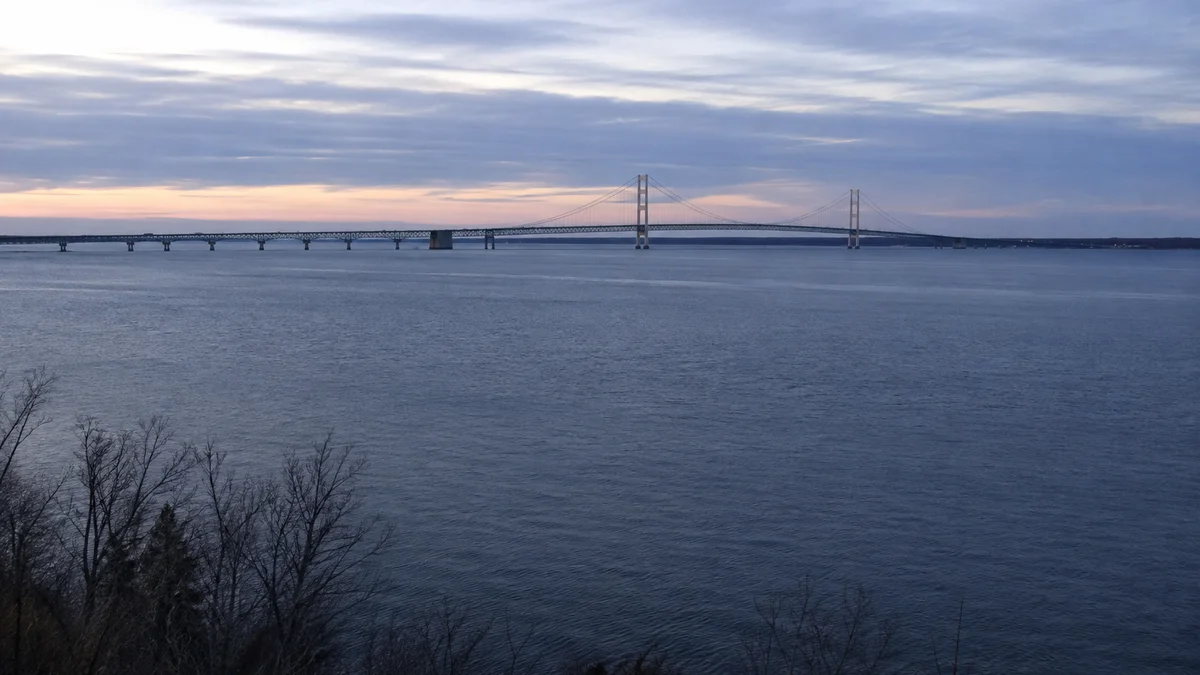
The companion article to this piece, “Single Point of Failure,” documented what Line 5 is and why it matters: a 73-year-old pipeline running along the bottom of the Straits of Mackinac, through U.S. jurisdiction, with no redundant Canadian route. That article documented what happens if the pipeline fails. This one documents what is happening to it right now.
The Legal Landscape
The legal risk to Line 5 is not a single proceeding. It is four independent tracks in different courts, under different legal theories, at different stages of resolution. Three directly threaten the operating pipeline. The fourth threatens the tunnel project designed to protect it. A favorable outcome for Enbridge on one does not resolve the others.
The Michigan Attorney General’s Suit
In June 2019, Michigan Attorney General Dana Nessel filed suit in Ingham County Circuit Court to void the 1953 easement that permits Line 5 to cross the Straits of Mackinac. [8] Enbridge removed the case to federal court, where it argued federal pipeline-safety law preempts Michigan’s authority. On April 22, 2026, the U.S. Supreme Court ruled unanimously that Enbridge’s removal was untimely: the company had filed 887 days after service, far beyond the 30-day statutory deadline under 28 U.S.C. §1446(b)(1). [9] The case returns to Michigan state court.
The ruling was procedural, not substantive. It did not address whether Michigan can void the easement. But it returned the case to the forum Enbridge had sought to leave.
The Easement Revocation
On November 13, 2020, Governor Gretchen Whitmer and the Michigan Department of Natural Resources revoked the 1953 easement, effective May 12, 2021. [10] Enbridge did not comply. It sued in federal court and continued operating the pipeline. In December 2025, U.S. District Judge Robert Jonker ruled that federal pipeline-safety law preempts Michigan’s revocation and that the state “lacks the power to interfere.” [11]
This is Enbridge’s strongest legal position. Federal preemption is a powerful shield, and if the Sixth Circuit affirms, Michigan would lose one of its principal mechanisms for forcing a shutdown. Whitmer appealed on January 6, 2026. [12] Canada and the U.S. Department of Justice both filed briefs at the Sixth Circuit in support of Line 5, citing the 1977 Transit Pipelines Treaty. [13] The appeal is pending. Even if Enbridge prevails here, the Bad River trespass, the Attorney General’s easement suit, and the tunnel permit challenge would remain unresolved.
The Bad River Band Trespass
Line 5 crosses approximately 12 miles of the Bad River Band of Lake Superior Chippewa’s reservation in Wisconsin. The easements expired in 2013. Enbridge continued operating. In 2023, U.S. District Judge William Conley found Enbridge trespassing, awarded the Band $5,151,668 in damages, and ordered the pipeline removed by June 2026. [14]
On July 30, 2026, the Seventh Circuit affirmed the trespass finding. The court stated that Enbridge must remove the pipeline, but voided the fixed June 2026 deadline, directing the district court to set a new removal schedule. [2] The opinion noted that a shutdown risked harming consumers, sparking international fallout with Canada, and violating the 1977 Transit Pipelines Treaty. [2]
Enbridge’s proposed solution is a $450 million, 41-mile reroute around the reservation. Construction is underway. State permits were upheld by a Wisconsin administrative law judge in February 2026, but the Band is challenging them in Iron County Circuit Court. [15] Completion is targeted for November 2027.
The Tunnel Permit
The tunnel was the mitigation plan. Enbridge proposed it in 2018 to replace the lakebed crossing with a pipeline encased in a tunnel bored beneath the Straits of Mackinac. The Michigan Public Service Commission granted the permit in December 2023. [16]
On July 31, 2026, the Michigan Supreme Court ruled 6-1 that the Commission had erred on three counts: it did not assess whether the tunnel would extend the pipeline’s lifetime and thereby cause additional environmental harm; it did not consistently compare alternatives; and it did not determine whether the project would impair public trust resources under the Michigan Environmental Protection Act. [3] The court vacated the permit and remanded for a fresh review.
The ruling did not say the tunnel can never be built. It ordered a more rigorous assessment. But the project’s original cost estimate of approximately $500 million has risen to between $750 million and $800 million. [17] The final federal permit from the Army Corps of Engineers remains pending, though the Corps designated the project an “emergency” under a Trump administration executive order and released its final environmental impact statement in February 2026. [18] Construction has not begun. Without the tunnel, the 73-year-old lakebed pipeline continues to operate as the sole crossing.
Each of these four tracks is independent. The first three threaten the pipeline’s continued operation; the fourth threatens the only project designed to reduce the environmental risk of that operation. A preemption victory on the Whitmer appeal does not resolve the Bad River trespass. A new tunnel permit does not address the Attorney General’s suit to void the easement. No single ruling ends the legal uncertainty.
What the Pipeline Carries
The volume figures are not contested. Enbridge states that Line 5 transports up to 540,000 barrels per day of light crude oil, light synthetic crude, and natural gas liquids. [4] The pipeline feeds all four operating Sarnia refineries, including Imperial Oil’s Sarnia facility and Suncor’s 85,000-barrel-per-day refinery. [5] It is the primary pipeline supply route for jet fuel to Toronto Pearson International Airport. [19]
From Sarnia, Line 9 carries Line 5 product east to Montreal and Lévis. Suncor’s Montreal refinery processes 137,000 barrels per day; the Valero refinery at Lévis handles the remainder of Quebec’s domestic refining. Together, these two facilities receive over 60% of their feedstock through this route, according to the Canadian Association of Petroleum Producers. [6] On the U.S. side, Line 5 supplies refineries in Michigan, Ohio, and Pennsylvania, and provides 55% of Michigan’s statewide propane needs. [20]
What would a shutdown mean? The estimates depend on who produced them, what methodology they used, and what type of shutdown they modeled.
The Consumer Energy Alliance commissioned a 2021 economic impact study that projected $20.8 billion in lost economic activity, 33,755 lost jobs, and an $8.3 billion reduction in gross state product across Michigan, Ohio, Indiana, and Pennsylvania. [21] Enbridge has estimated that replacing Line 5 volumes by truck and rail would require approximately 2,000 trucks or 800 rail cars per day. [4]
The strongest counter-evidence deserves full weight. A 2022 report by Environmental Defence, prepared by Meyers Energy Consulting, concluded that alternatives exist. According to the report, Line 78, which currently operates below capacity, could reduce the Sarnia supply shortfall to 255,000 barrels per day, or to 119,000 barrels per day with pumping upgrades. The remaining gap could be filled by two to three additional trains per day and roughly one additional marine tanker for Valero’s Quebec facility. The estimated gasoline price impact: approximately 1.8 cents per litre. [22]
If accurate, this substantially narrows the scale of disruption from a Line 5 shutdown. But the report’s analysis rests on a critical assumption: a planned, orderly transition with time to ramp up alternative capacity. The Seventh Circuit’s decision to vacate a fixed shutdown deadline and remand for a new schedule demonstrates that courts can account for transition costs. Whether any court-ordered timeline would provide sufficient time for the logistical requirements of replacing 540,000 barrels per day remains uncertain. The gap between the orderly phase-out that the Meyers analysis models and the timeline a court ultimately imposes is where the structural risk concentrates.
One alternative that readers might assume is available is not. The Portland-Montreal pipeline, with a capacity of approximately 223,000 barrels per day, has been effectively idle since January 2016, when the reversal of Line 9 made it redundant. [23] South Portland, Maine, banned the loading of crude oil onto marine vessels in 2014, an ordinance upheld by the First Circuit in 2018. [24] Montreal Pipe Line Ltd. withdrew its Quebec pumping-station permit application in 2024. [23] The Canada Energy Regulator calculated a $61.3 million abandonment cost estimate that same year. [23] This route is closed.
What Canada Has Done
The recorded federal response is real but narrow.
Canada’s primary legal instrument is the 1977 Agreement Concerning Transit Pipelines, which guarantees the uninterrupted transit of hydrocarbons between the two countries and prohibits either party from instituting measures to impede or divert them. [25] Line 5 qualifies: it carries western Canadian hydrocarbons to central Canada through U.S. territory.
Canada formally invoked the treaty’s dispute-settlement provision twice. Then-Foreign Minister Marc Garneau invoked Article IX(1) on October 4, 2021, in response to Michigan’s easement revocation. [26] Then-Foreign Minister Mélanie Joly invoked it a second time on August 29, 2022, in response to the Wisconsin Bad River case. [27] Under the treaty, if negotiations fail, Canada can request binding arbitration.
Negotiations have been described as ongoing. A documented session took place in Washington on April 14, 2023. [28] No resolution has been reached. The treaty has been invoked for nearly five years without producing a binding outcome.
Beyond the treaty, Canada has filed amicus briefs in U.S. federal court: the first on May 11, 2021, a second in the Wisconsin case in 2023, and a third at the Sixth Circuit in 2026, filed under the Carney government alongside the U.S. Department of Justice. [13] Natural Resources Minister Seamus O’Regan called keeping Line 5 open “non-negotiable” in March 2021. [29] The House of Commons Special Committee on the Economic Relationship Between Canada and the United States published an interim report on Line 5 that same year, recommending the government develop contingency plans, invoke the treaty, and file amicus briefs. [30] The treaty was invoked. The briefs were filed. The contingency plans were not.
Ontario’s government has engaged directly. Premier Doug Ford wrote to Governor Whitmer warning that a shutdown would put over 4,900 direct jobs at risk. [31] In November 2025, Ontario announced it was studying a new east-west energy corridor, and on July 6, 2026, Ford and Alberta Premier Danielle Smith unveiled the Northern Shield Energy Corridor proposal. [32]
Quebec depends on Line 5 via Line 9 for over 60% of its refinery receipts. [6] The documented record does not contain a recent standalone Quebec government statement on Line 5 risk. This is reported as a gap in the public record, not an inference about Quebec’s position.
The most significant gap is federal. A 2021 Transport Canada briefing states that “contingency planning and solutions in the event of a shutdown are being considered by both industry and government” and that alternatives “may involve increased use of rail, road and/or marine transportation modes.” [33] This is the strongest language in the documented record. It describes consideration, not a plan. No subsequent public document describes an executed federal contingency for a Line 5 shutdown. It is possible that contingency planning exists within cabinet confidence or departmental emergency documentation that is not publicly available. This article evaluates the documented public record.
The Leverage Question
Three documented facts, placed in sequence.
First: on July 29, 2026, the Prime Minister said he does not see the value of using Canadian energy as trade leverage, while noting that a reliable supplier has to “think really hard about not supplying.” [1] This statement was made in the context of U.S. tariff threats, with new 50% tariffs announced for August 19, and after several provincial premiers had publicly suggested energy exports should be on the negotiating table. [7] Alberta and Saskatchewan opposed the idea. New Brunswick, Quebec, and Ontario said everything should be considered. [7]
Second: under NAFTA, Article 605 contained a proportionality clause that prohibited Canada from reducing the share of energy exported to the United States without a proportional cut to domestic supply. Former Canada Energy Regulator CEO Gitane De Silva described the practical effect: what Canada sent on a good day, it also had to send on a bad day. [34] When CUSMA replaced NAFTA, Article 605 was removed. Global Affairs Canada characterized the removal as reaffirming Canada’s sovereignty over its energy resources. [35] The removal frees Canada to prioritize domestic supply in a crisis. It does not create any mechanism to compel the United States to keep a pipeline open on its territory.
Third: Canada depends on a single pipeline through U.S. jurisdiction for the petroleum that supplies over 60% of Ontario and Quebec refining capacity. Four U.S. legal proceedings can delay, constrain, or shut down that pipeline. Canada’s standing in those proceedings is limited to amicus briefs and treaty invocations that have not produced a resolution in five years. The pipeline continues to operate past a revoked easement, past a trespass finding, and past a shutdown order that was never enforced.
The structural observation follows from these facts without requiring any claim about what anyone intends. The Prime Minister discussed not using energy as trade leverage. The documented infrastructure record shows that the leverage in this relationship runs in the other direction: Canada’s energy supply to its most populated provinces is contingent on a U.S. asset, subject to U.S. courts, under U.S. jurisdiction, with no domestic alternative. The leverage Canada discussed not using may not be Canada’s to withhold.
The First Structural Response
On July 6, 2026, Ontario Premier Doug Ford and Alberta Premier Danielle Smith unveiled the Northern Shield Energy Corridor at a joint announcement in Calgary. [32] The proposal describes a 3,300-kilometre pipeline from Hardisty, Alberta, running near Regina and Winnipeg to Sarnia, Ontario, with an estimated initial capacity of 500,000 barrels per day and possible expansion to 800,000. A feasibility study is expected by the end of 2026.
If built, it would be the first east-west pipeline connecting western Canadian production to Ontario refineries through Canadian territory. It would provide the domestic redundancy that does not currently exist and structurally address the single point of failure that this article and its companion document.
It is a proposal. No price tag has been confirmed. No construction timeline has been set. No private investors have been announced. No shipper commitments have been secured. The only comparable recent precedent is the Trans Mountain pipeline expansion, which required 12 years from initial application to first oil and a federal Crown corporation purchase after the private proponent withdrew. [35]
The Northern Shield proposal is the development most likely to change the structural assessment described in this article. Whether it advances past a feasibility study to a funded, permitted project with private capital will determine whether Canada’s central provinces remain dependent on a single pipeline through U.S. jurisdiction into the 2030s.
What Would Change This Assessment
The following conditions, if met, would weaken or invalidate the findings in this article:
- Final, non-appealable rulings that resolve all four active legal proceedings in Enbridge’s favor, eliminating the credible risk of judicial interruption to Line 5 operations. The December 2025 Jonker ruling covers only the Whitmer easement case and is under appeal.
- A documented, executed federal contingency plan with alternative supply arrangements sufficient to replace Line 5 volumes in the event of a court-ordered shutdown.
- Northern Shield Energy Corridor or an equivalent east-west pipeline reaching a final investment decision with confirmed private capital and shipper commitments.
- Completion of the Bad River reroute, targeted for November 2027, and successful tunnel permit reapproval, which together would reduce the legal threat landscape.
- The 1977 Transit Pipelines Treaty producing a binding arbitration outcome or negotiated resolution that legally prevents a Michigan-ordered shutdown.