
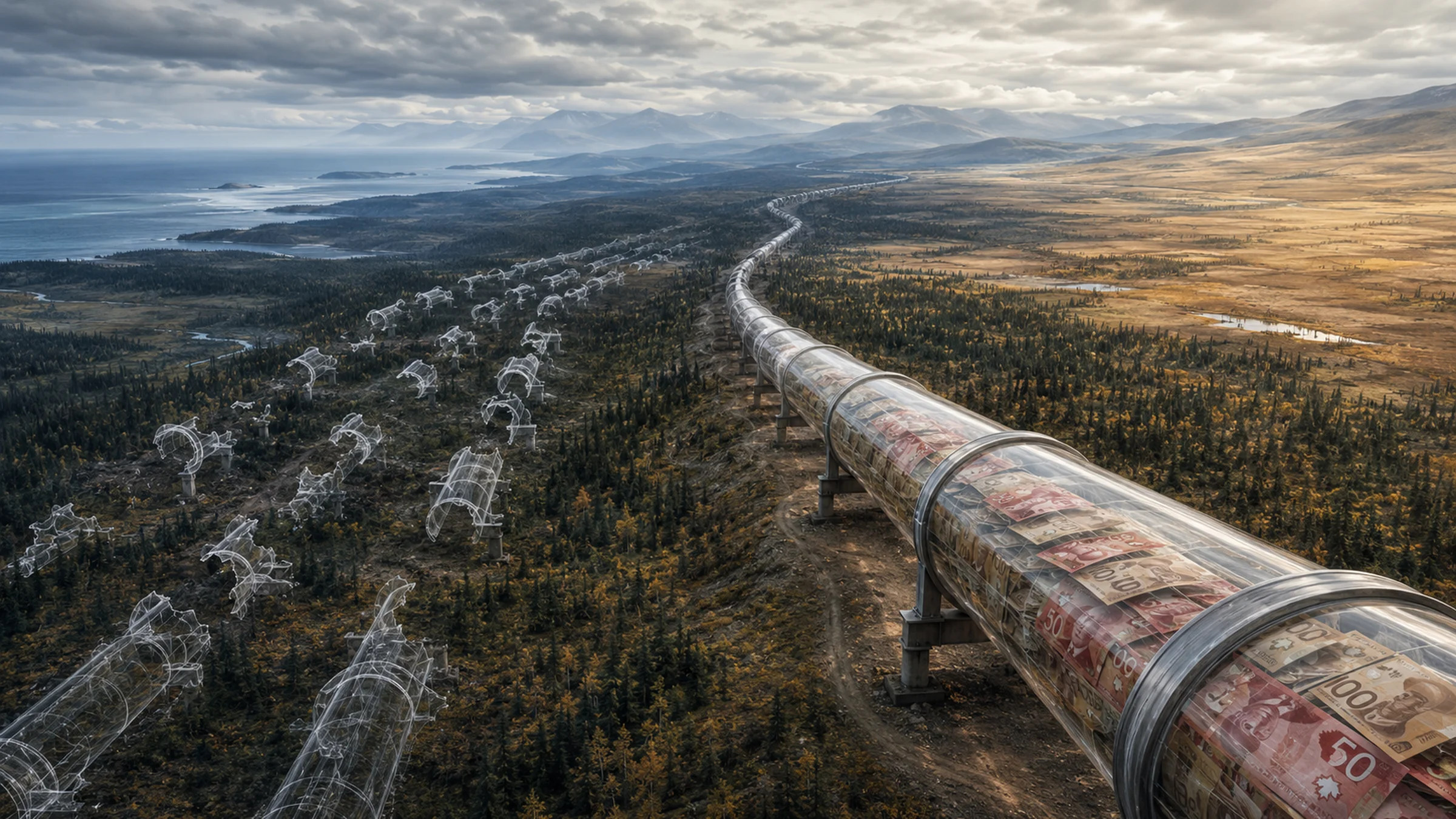
2.5 Million Barrels a Day of Private Pipeline Capacity
Before the federal government purchased Trans Mountain in 2018, private companies had proposed to build roughly 2.5 million barrels per day of new Canadian export pipeline capacity. The projects were distributed across three corridors, each backed by an identified corporate proponent willing to commit development capital and, in most cases, binding long-term transportation agreements. [1] [2] [3]
Northern Gateway, proposed by an Enbridge subsidiary, would have carried 525,000 barrels per day of crude from Bruderheim, Alberta, to a marine terminal at Kitimat, B.C., for export to Asian markets. The projected cost was C$7.9 billion. Enbridge and ten partner energy companies invested more than C$450 million developing the proposal. The NEB's Joint Review Panel recommended approval with 209 conditions in December 2013. [10]
Energy East, proposed by TransCanada (now TC Energy), would have transported 1.1 million barrels per day from Alberta and Saskatchewan to a marine terminal in New Brunswick, opening Atlantic and European export routes. The projected cost was approximately C$12 billion. By 2013, TransCanada reported that it had secured legally binding shipper commitments covering roughly 900,000 barrels per day. [14]
Keystone XL, also a TC Energy project, would have moved 830,000 barrels per day from Alberta to the U.S. Gulf Coast. The cost was reported at roughly US$8 billion. Shippers on the existing Keystone system committed to renewed 20-year contracts with a cost-sharing mechanism for any gap between estimated and actual project costs. [15]
A fourth project, the Trans Mountain Expansion, was proposed by Kinder Morgan to add approximately 590,000 barrels per day to the existing Trans Mountain system. The 2013 application estimated the cost at C$5.4 billion and identified 708,000 barrels per day of firm shipper commitments from thirteen companies. [24]
Collectively, private capital proposed to build more pipeline export capacity than the Canadian oil industry had ever requested at one time, across three compass points, with identified revenue structures. None of it was completed under private ownership.
Three Pipelines Cancelled. One Rescued. C$2.4 Billion in Private Capital Lost.
Northern Gateway was approved by the NEB in 2014. In June 2016, the Federal Court of Appeal overturned the approval on the grounds of insufficient Indigenous consultation. In November 2016, the federal government directed the NEB to dismiss the application and formally cancelled the project. The Northern Coast Tanker Ban, legislated in 2019, closed the Kitimat corridor to crude tanker traffic. Enbridge recorded a C$373 million impairment charge. [13]
Energy East was filed in October 2014. In August 2017, the NEB expanded the scope of its review to include assessments of upstream greenhouse gas emissions from production that would flow through the pipeline. TransCanada requested a 30-day suspension of the application in September 2017 and terminated the project the following month. The company recorded a C$954 million after-tax impairment charge. Its termination statement did not attribute the withdrawal to a single factor. [14]
Keystone XL followed a different path. President Obama rejected the presidential permit in 2015. President Trump reinstated it. President Biden revoked it on January 20, 2021. TC Energy terminated the project on June 9, 2021, and reported a net financial impact of approximately US$1.1 billion after recoveries, insurance, and Alberta government support. Unlike Northern Gateway and Energy East, Keystone XL was cancelled by a foreign government, not by Canadian regulatory or policy action. [15]
Trans Mountain followed a fourth pattern. After the Federal Court of Appeal quashed the project's approval in August 2018 on Indigenous consultation and environmental review grounds, Kinder Morgan announced it would not proceed without certainty. The federal government purchased the pipeline system and expansion project for C$4.5 billion in August 2018, stating it did not intend to be a permanent owner. The expansion entered commercial service in May 2024. The final all-in cost reached approximately C$34.2 billion, including capitalized carrying costs. That is 6.3 times the original 2013 estimate of C$5.4 billion. [6] [16]
Across the three cancelled projects, the conservative documentable tally of private capital destroyed is roughly C$2.4 billion: Enbridge's C$373 million Northern Gateway impairment, TC Energy's C$954 million Energy East impairment, and TC Energy's approximately US$1.1 billion net financial impact from Keystone XL. [13] [14] [15]
The cumulative effect of these outcomes on investor confidence is the same regardless of which jurisdiction cancelled each project. By 2026, no private company had been publicly identified as willing to take a majority stake in a new Canadian export pipeline. The regulatory environment had been specifically redesigned to remove the barriers the industry cited as deal-killers. Private capital still would not lead.
The West Coast Oil Pipeline: Government as Proponent
On July 2, 2026, Prime Minister Carney and Alberta Premier Smith announced that Alberta had submitted a proposal for the West Coast Oil Pipeline to the federal Major Projects Office. The pipeline would transport 1 million barrels per day along a route that largely follows the existing Trans Mountain corridor, from a receipt terminal near Bruderheim, Alberta, to a marine terminal on the southern B.C. coast. [1] [2]
The ownership structure places governments in the lead. Canada and Alberta will hold equal partnership in the project. Trans Mountain Corporation, the federal Crown entity that built and operates the expanded Trans Mountain system, will serve as lead proponent, construction manager, and eventual operator. The federal government has committed to pursuing designation of the pipeline as a project of national interest under the Building Canada Act by October 1, 2026, and to making best efforts to issue a conditions document by September 1, 2027, at which point construction could begin. [2] [4] [5]
Pembina Pipeline Corporation, the sole disclosed private participant, entered a non-binding Heads of Agreement on July 2. Its economic interest through construction will be 10 percent, with the opportunity for an additional 10 percent once the pipeline enters commercial operation. Pembina's own news release discloses the terms clearly: the structure includes protection for Pembina on cost overruns and returns; Pembina will have full discretion over any final investment decision; and Pembina "shall have no at-risk development capital prior to FID." Definitive agreements are targeted for September 2026. [12]
These terms are protective: Pembina preserves FID discretion, avoids at-risk development capital before FID, and retains cost-overrun and return protections. The disclosed structure places substantially all pre-FID downside risk on public entities, while the sole named private participant preserves optionality without committing capital. [12] [20]
The following items do not appear in any public document reviewed as of July 3, 2026: a final capital cost estimate, the names of committed shippers, committed shipper volumes, a toll framework, a break-even analysis, or an exit or divestiture strategy. [1] [2] [12] [18]
The Building Canada Act, which received Royal Assent on June 26, creates the regulatory mechanism for the project. For any project designated as being in the national interest, every determination required for a federal authorization is deemed to have been made "in favour of permitting the project." The designated minister then issues a single conditions document that replaces all other required federal authorizations. The Act also requires a public registry with detailed cost estimates and projected timelines. It preserves the duty to consult with Indigenous peoples but allows cabinet to exempt projects from certain statutes by regulation. [7] [8] [11] [19]
Separately, the Canada-British Columbia Cooperative Prosperity Agreement, signed on July 2, confirms that the federal North Coast tanker ban will remain in place and commits the parties to negotiate a "legally binding framework" under which B.C. will "share meaningfully in the economic upside of the project." Mechanisms discussed include an annual royalty payment to B.C. by the pipeline operator. As of July 3, neither the royalty rate, the terms of an environmental response fund, nor any enforceable remedies for non-compliance are defined. The deadline for negotiating financial commitments related to the pipeline is December 1, 2026. The southern route reduces but does not eliminate Indigenous consent risk: affected communities along the Trans Mountain and southern B.C. corridor have distinct rights, risk exposure, and negotiating positions that the North Coast resolution does not address. [3] [2]
C$39,000 Per Barrel Per Day
If the West Coast Oil Pipeline proceeds at the reported C$35 billion working estimate, total public capital committed to west-coast pipeline infrastructure since 2018 would reach approximately C$73.7 billion: C$4.5 billion for the Trans Mountain purchase, C$34.2 billion for the Trans Mountain Expansion, and C$35 billion for the new pipeline. That figure is illustrative because no official capital cost for the West Coast Oil Pipeline has been published. The C$35 billion estimate was reported by CBC News based on Alberta government documentation; the Alberta government's own public page states that cost estimates are still being reviewed. [18] [1]
Total capacity across both pipelines would be approximately 1.89 million barrels per day: 890,000 from Trans Mountain and 1 million from the proposed pipeline. That implies a capital intensity of roughly C$39,000 per barrel per day across the combined system. If the denominator is limited to incremental export capacity created by public decisions since 2018, the figures are 1.59 million barrels per day (the 590,000-barrel TMX expansion plus 1 million from the new pipeline) at roughly C$46,000 per incremental barrel per day. [6] [2]
Against U.S. comparators, the gap is large even after allowing for different geography, marine terminal requirements, inflation timing, and currency effects. Dakota Access Pipeline (DAPL) cost approximately US$3.78 billion and moves roughly 570,000 barrels per day, for a capital intensity of approximately US$6,600 per barrel per day. The original Keystone pipeline cost approximately US$5.2 billion for 591,000 barrels per day of nameplate capacity, or about US$8,800 per barrel per day. These are not equivalent projects. But the directional gap between roughly US$7,000 per barrel per day and C$39,000 or more is structurally significant. [15]
The differential narrowing argument does not close the gap. If the differential effect were US$3 per barrel, as CAPP reported in April 2026 for the existing Trans Mountain system, the gross annual value on 1 million barrels per day would be approximately US$1.1 billion before operating costs, utilization risk, and financing charges. On a C$35 billion capital base, the arithmetic yields a nominal simple payback of approximately 32 years, and that calculation excludes maintenance capital, taxes, and the assumption that the pipeline operates at or near full capacity for decades. [22]
The Parliamentary Budget Officer's 2024 valuation of the existing Trans Mountain system provides a benchmark. The PBO estimated the system's value at C$29.6 billion to C$33.4 billion depending on post-contract service assumptions, and stated explicitly that if the system were sold at either of those values, the government would record a loss. As of July 2026, no sale has been completed. The Canada Development Investment Corporation's 2025 annual report describes its stewardship of Trans Mountain Corporation as managing for "successful monetization in due course." [6] [17]
The only comparable Canadian crude pipeline megaproject completed in the period, Trans Mountain Expansion, finished at 6.3 times its original 2013 estimate. [6]
The 8-Million-Barrel Question
The pipeline's demand case rests on whether Canadian crude production will grow fast enough to fill 1 million barrels per day of new capacity. Premier Smith has stated publicly that Alberta's goal is to reach 8 million barrels per day of production over the next 10 to 15 years. She reiterated this target on July 2. [2] [21]
The major public forecasts reviewed do not support that figure on that timeline. The Canada Energy Regulator's Energy Futures 2026 report projects Canadian crude oil production reaching 5.8 million barrels per day by 2030 under its Current Measures scenario, rising from 5.5 million in 2024. Across all CER scenarios, the full range of projected production by 2050 is 4.8 to 6.5 million barrels per day. The CER's highest projection does not reach 8 million barrels per day at any point in its modelling horizon. [9]
The International Energy Agency's Oil 2025 report projects total Canadian liquids supply at 6.8 million barrels per day by 2030. That figure is broader than crude alone, including natural gas liquids and condensates, and it is still well below 8 million. CAPP's own data shows total Canadian oil production, including NGLs and condensates, averaged 6.1 million barrels per day in 2025. [22]
The pipeline also depends on a parallel commitment. The July 2 announcement describes construction of the West Coast Oil Pipeline and construction of the Pathways carbon capture project as "mutually dependent." The Implementation Agreement between Canada and Alberta, signed May 15, 2026, uses the same language. A tripartite agreement with the Oil Sands Alliance was announced on July 2, with a stated target of 16 million tonnes per year of emissions reductions. The capital cost, detailed timeline, and legal enforceability of the Pathways commitment are not publicly defined in the documents reviewed. The pipeline's risk is therefore not a single-project risk. It is a paired-project risk: the pipeline depends politically on Pathways, and Pathways depends on carbon pricing, public investment, and oil-sands participation that remain separately contested. [2] [4]