
What Was Announced
On January 16, 2026, Prime Minister Carney announced what his government called a “Preliminary Joint Arrangement” with China. [4] The deal had two sides. Canada would open a quota for Chinese-built electric vehicles at a 6.1% tariff, replacing the 100% surtax imposed in October 2024. In return, China would lower tariffs on Canadian canola, peas, lobster, and crab. [2]
The affordability framing was central. The Prime Minister said that within five years, more than half of the vehicles imported under the quota would have an import price below C$35,000. [4] The message to Canadian consumers was clear: cheaper electric vehicles were on the way. After eighteen months in which the surtax had made Chinese EVs effectively unavailable, the quota was presented as the mechanism that would finally bring affordable options to a market where the average EV transaction price sits near C$49,500. [7]
The announcement generated immediate consumer interest. Industry surveys showed 56% of Canadian respondents said they would consider purchasing a Chinese-built EV, with the strongest interest among adults aged 18 to 34. [8] That interest was driven by price expectations shaped by the announcement itself.
What the Regulations Actually Require
The deal was operationalized through an amendment to the Customs Tariff published in the Canada Gazette on March 11, 2026. [1] The regulatory text specifies a quota of 49,000 vehicles in the first year (March 1, 2026, to February 28, 2027), growing at 6.5% per year.
The affordability ramp is where the announcement and the regulation diverge. In year one, there is no requirement for any proportion of the quota to be affordable. The reserve for vehicles with a free-on-board price of C$35,000 or less does not begin until year two, starting at 10%. Media reporting describes the ramp as rising through 20% and 35% in years three and four, but these intermediate figures do not appear in the Canada Gazette or in any published regulatory document. [1] [9] What is specified: 10% in year two. 50% by year five. Everything in between is unreported.
In practical terms, those percentages translate to vehicle counts. In year two, 10% of an estimated 52,185-unit quota is roughly 5,200 vehicles. That is the number of affordable Chinese EVs available to a country of 41 million people, in a market that sells 1.8 million vehicles per year. It represents approximately 0.29% of annual vehicle sales. [1] [10]
Even at full maturity in year five, the affordable portion of the quota would be approximately 31,500 vehicles. That is larger, but still less than 2% of Canada’s annual vehicle market. [10]
What Actually Arrived
The quota opened on March 1, 2026. By May 29, Global Affairs Canada reported that 2,910 electric vehicles had been imported under the new system. Every one of them was classified in the tariff line for passenger EVs valued above C$35,000. [3]
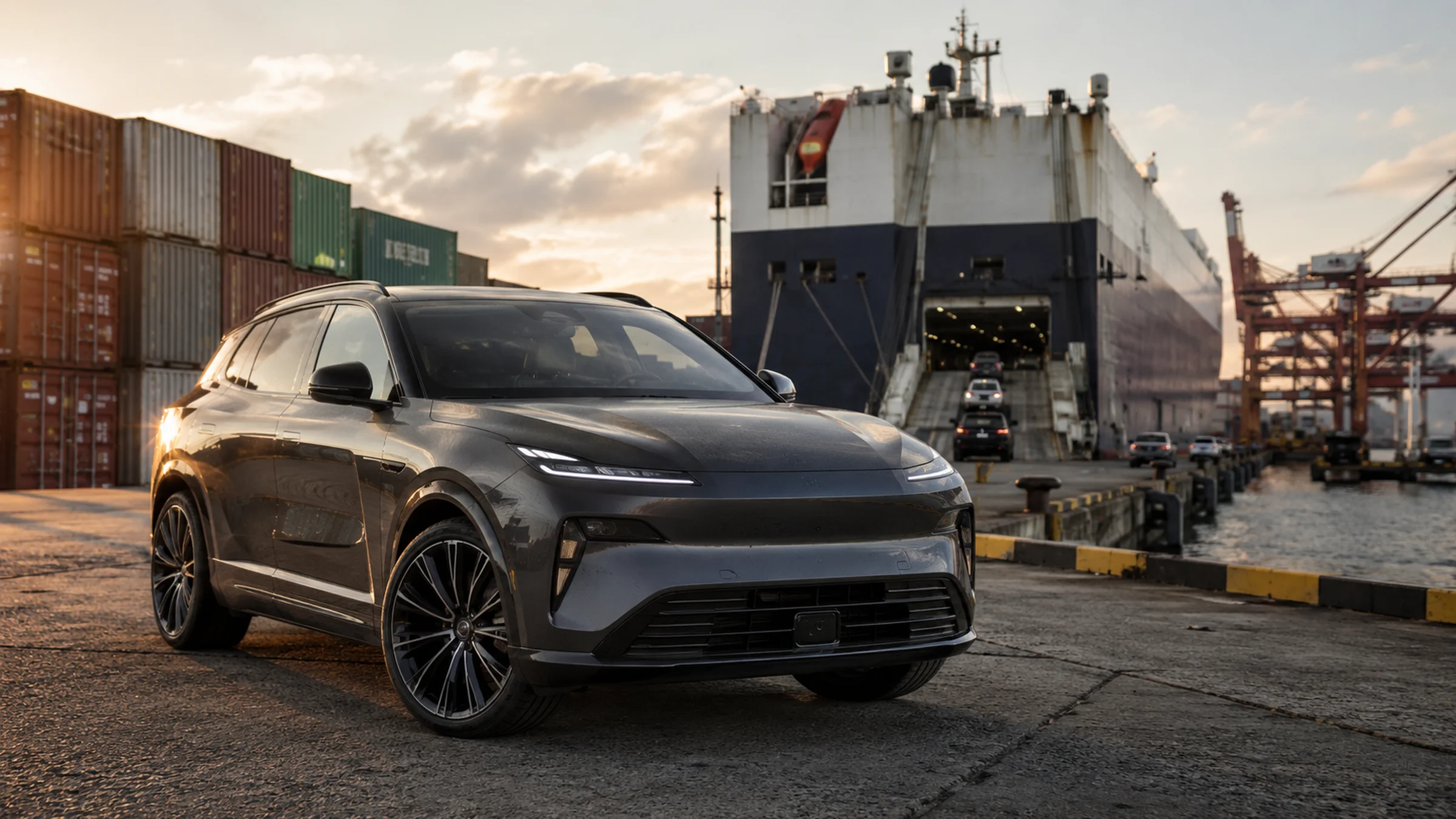
The majority were Tesla Model 3 sedans built at Tesla’s Gigafactory Shanghai, listed in Canada from approximately C$39,490. [11] All were classified by Global Affairs in the tariff line for passenger EVs valued above C$35,000 FOB. [3] The other notable arrival: 18 Lotus Eletre luxury SUVs, manufactured in Wuhan by Geely-owned Lotus, with a Canadian retail price starting at C$119,900. [12] A small number of Chery vehicles entered for certification and testing purposes. No other Chinese-brand EVs have entered the consumer market under the quota as of early July 2026. [13]
The Tesla figures are worth pausing on. An American company, manufacturing in China, is the primary beneficiary of a quota Canada opened for Chinese-built vehicles as part of an agricultural trade negotiation. Industry estimates suggest Tesla claimed between 7,000 and 10,000 of the roughly 24,500 permits available in the first half of the quota year. [11] The Model 3 at C$39,490 retail is a genuine price reduction from its previous Canadian price of C$79,990, and that reduction benefits buyers. [23] But the Model 3 sits above the C$35,000 FOB threshold the deal defined as “affordable.”
Other Chinese manufacturers are coming. BYD, Chery, and Geely are all reported to be building Canadian dealer networks for late 2026 or early 2027 entry. [13] But the vehicles most likely to fall below the C$35,000 FOB threshold, models like the BYD Seagull, face certification timelines and dealer infrastructure requirements. The government has signalled that future quota allocation may favour manufacturers that invest in Canadian production, but no binding joint-venture requirement has been published. [25] Global Affairs consulted on longer-term allocation rules in April 2026, including whether to introduce manufacturer sub-quotas or affordability-linked allocation, but no final policy has been released. [25] The affordable cars the announcement described are not here yet, and the regulations do not require them to be.
The Price of “Affordable”
The C$35,000 threshold deserves closer examination, because it does not mean what most readers would assume. It is defined in the Canada Gazette as the free-on-board value at the Chinese port of departure. [1] That is the price of the vehicle when it leaves China, before ocean shipping, before Canadian duties, before compliance costs, before dealer margins, and before taxes.
An illustrative landed-cost estimate shows how quickly FOB price and consumer price diverge. Consider a vehicle that enters Canada at exactly C$35,000 FOB. Ocean freight from Shanghai to Vancouver runs approximately C$2,000 per vehicle. [14] The 6.1% MFN tariff adds roughly C$2,135. Compliance and inspection fees add several hundred dollars. [15] Pre-delivery inspection and freight charges from port to dealer add another C$1,500 to C$2,500. Dealer margin on a new EV varies, but industry estimates range from 12% to 15%. [16] These are estimates, not audited figures, and actual costs will vary by manufacturer and port of entry. But even conservative assumptions place the pre-tax retail price of a vehicle at the “affordable” threshold in the range of C$47,000 to C$50,000. With Ontario’s 13% HST, the sticker price approaches C$53,000. [17]
That figure sits in the same range as the current average EV transaction price in Canada. [7] In other words, a vehicle that qualifies as “affordable” under the deal costs a Canadian buyer approximately what EVs already cost today.
The federal rebate makes the comparison worse. Transport Canada’s EVAP program provides a $5,000 incentive for eligible zero-emission vehicles, but only if they are manufactured in Canada or in a country with which Canada has a free trade agreement. [5] China does not have an FTA with Canada. No Chinese-manufactured vehicle has been approved for the rebate, and no application from a Chinese OEM is on record. [5]
Some provincial rebate programs, such as Quebec’s Roulez Vert, may apply to Chinese-built EVs regardless of country of manufacture. But the federal rebate is the largest single incentive, and its exclusion means a buyer considering a Chinese EV at roughly C$50,000 sticker price is comparing it against a South Korean, Japanese, or American EV at the same price with a $5,000 federal advantage. The deal’s own target vehicles carry a built-in price disadvantage created by a separate federal program.
The Currency Nobody Indexed
On January 16, 2026, when the deal was announced, one Canadian dollar bought approximately 5.01 Chinese yuan. By early July 2026, that figure had fallen to approximately 4.80 yuan. [6] A decline of roughly 4% in six months.
For a threshold set at C$35,000 FOB, the practical effect is straightforward. On announcement day, C$35,000 bought a vehicle worth approximately 175,000 yuan at the factory gate. Six months later, the same C$35,000 buys a vehicle worth approximately 168,000 yuan. That is 7,000 yuan less vehicle, with no policy adjustment to account for it. [6]
The threshold is nominal. No published document describes it as inflation-adjusted, currency-indexed, or subject to periodic revision. [1] If the Canadian dollar continues to weaken against the yuan, the threshold erodes automatically. A Chinese manufacturer targeting the C$35,000 FOB window has to build a cheaper car each quarter to stay below the line.
This is the same structural exposure documented in Built to Import: every affordable EV channel Canada has is denominated in foreign currency with no domestic hedge. The quota was supposed to be the alternative. Its own affordability threshold is subject to the same currency risk.
What Canada Got Back
The deal was bilateral. Canada opened a permanent, growing EV quota codified in domestic law. On the other side, China adjusted tariffs on several Canadian agricultural exports. The details of that exchange bear examination.
Canada’s commitments are codified in the Canada Gazette, enforced by the Canada Border Services Agency, and administered through a Global Affairs permit system. [1] [18] The quota has no sunset clause. It grows automatically at 6.5% per year.
China’s agricultural concessions take a different form. The canola seed tariff was reduced to a combined 14.9% (a 5.9% anti-dumping duty plus a 9% most-favoured-nation tariff). [19] Notably, the 5.9% rate was set by China’s Ministry of Commerce through its own anti-dumping investigation, not by the bilateral arrangement. MOFCOM can revise it through a separate administrative review without reference to the deal. [19]
The other agricultural concessions are temporary. China suspended tariffs on canola meal, peas, lobster, and crab through December 31, 2026. [2] [20] No public commitment to extend those suspensions has been made. Canola oil remains at a 100% tariff. Pork, on which China imposed a 25% retaliatory tariff in March 2025, was not addressed in the arrangement. [21] [22]
Canada’s concessions are permanent. Apart from canola seed, China’s agricultural concessions expire in December.
A subsequent article in this series will examine the deal’s structural architecture in detail.