
What Was Promised
Between 2020 and 2024, Canada’s federal government committed or structured more than $20 billion in support to build a domestic EV and battery manufacturing base. The commitments were spread across six anchor facilities. [1]
Ford’s Oakville Assembly Complex received $295 million in federal support for an EV retooling originally announced in 2020. Stellantis received up to $529 million for a transition at its Windsor and Brampton assembly plants. General Motors received $259 million for EV-related assembly at its Oshawa and Ingersoll operations, including the BrightDrop commercial van program. Honda’s Alliston plant received $132 million in 2022, followed by a far larger 2024 commitment of up to $2.5 billion federal for an integrated EV battery-and-vehicle package. [2] [3] [4]
Two battery manufacturing projects added to the total. Northvolt’s Quebec facility received up to $1.34 billion in direct and indirect support. The Stellantis-LGES battery plant in Windsor was structured at a level the federal government described as up to $15 billion over time, modelled on the U.S. Inflation Reduction Act framework. [5]
Ontario matched several of the flagship files. The province committed up to $513 million alongside the federal government for the Stellantis Windsor/Brampton transition and partnered in the Honda and Ford packages. Quebec contributed to the Northvolt file. [18]
The scale was not incremental. This was the largest industrial policy program directed toward a single manufacturing sector in modern Canadian history. The public record describes the objective as domestic EV and battery capacity capable of producing vehicles for the Canadian market and competing in export markets.
What Was Built
By mid-2026, one consumer battery-electric vehicle is assembled in Canada: the Dodge Charger Daytona, produced at Stellantis’ Windsor Assembly Plant in Ontario. The Scat Pack variant is in production, in both two-door and four-door configurations. Dodge Canada advertises the vehicle at $50,365, a figure that includes $8,000 in combined manufacturer incentives and government rebates. The pre-incentive starting price is approximately $58,000. [6]
The Charger Daytona R/T, a lower-priced electric variant originally scheduled for the 2026 model year, was postponed. Dodge CEO Matt McAlear stated that production was deferred as the company continued to assess the effects of U.S. tariff policies. The R/T is also absent from the 2027 model-year lineup. Stellantis said the postponement would not affect the plant’s approximately 4,500 jobs. [6]
Ford’s Oakville complex is not producing electric vehicles. The plant was originally slated for an EV retooling, but the timeline for its three-row EV slipped from 2025 to 2027. In July 2024, Ford pivoted the facility toward adding up to 100,000 units of F-Series Super Duty capacity. Unifor confirmed Super Duty production beginning in summer 2026. Ford Canada’s own site advertises the 2027 Super Duty as available in fall 2026. Oakville is reopening into the market as a truck plant, not a source of consumer EVs. [13] [14]
Honda’s Alliston package was announced as the largest single EV investment in Canadian history. It has since been postponed by approximately two years. [4] [31]
Northvolt’s Quebec battery plant, which received up to $1.34 billion in federal support, is no longer advancing on its original terms. The company entered creditor protection. [5] [32]
The Stellantis-LGES battery plant in Windsor, originally targeted for early 2024 operation, has undergone a change of control. LG Energy Solution acquired Stellantis’ 49% stake in the NextStar Energy joint venture for a nominal $100 and is pivoting the facility toward energy storage while continuing to supply EV batteries. [33]
GM’s CAMI facility in Ingersoll produces BrightDrop ZEVO commercial vans, which began rolling off the line in January 2023. It is not a consumer vehicle program. [19]
Windsor also assembles the Chrysler Pacifica family, including plug-in hybrid trims that qualify for EVAP. Canada is not at zero electrified vehicle assembly. But the Pacifica PHEV is not a mass-market affordable battery-electric vehicle. And the Charger Daytona, at approximately $58,000 pre-incentive, is not an affordability answer.
Separately, Reuters reported in 2026 that Stellantis is in early talks to build Leapmotor EVs at its Brampton facility. No final decision has been announced. [36]
The subsidy-to-output record in mid-2026: more than $20 billion committed or structured, one consumer BEV in production at approximately $58,000 pre-incentive, one major investment postponed by two years, one battery plant in creditor protection, and one battery plant under new ownership and pivoting scope. No Canadian-assembled battery-electric vehicle is available at a price that competes with the imported alternatives documented in the next section.
The Floor
As of July 2026, two new battery-electric vehicles are available in Canada with a base MSRP under $40,000: the Kia EV4 Light at $38,995, assembled in South Korea, and the Fiat 500e at $39,995, assembled in Turin, Italy. Both qualify for Canada’s $5,000 federal EVAP rebate, bringing effective MSRP-minus-rebate prices to approximately $34,000 and $35,000 respectively. [7] [8] [10]
Those are the MSRP figures. On an all-in basis, once freight, pre-delivery inspection, and AC tax are added, both vehicles exceed $40,000 before the rebate is applied. The Kia EV4 reaches $41,245 to $42,185 all-in. The Fiat 500e reaches $42,290. The “under $40,000” claim applies to base MSRP only, not to the drive-away price. [7] [8]
After those two, the price ladder climbs quickly.
| Vehicle | MSRP | All-in | Assembled | EVAP |
|---|---|---|---|---|
| Kia EV4 Light | $38,995 | $41,245–$42,185 | South Korea | Yes |
| Fiat 500e | $39,995 | $42,290 | Italy | Yes |
| Subaru Uncharted | $42,995 | $45,852 | Japan | Yes |
| Hyundai Kona Electric | $43,999 | ~$46,966 | South Korea | Yes |
| Volvo EX30 | $44,000 | $47,919 | Belgium* | Yes |
| Ford Mustang Mach-E | $44,995 | ~$48,490 | Mexico | Yes |
| Nissan Leaf (3rd gen) | $44,998 | $47,846 | Japan | Yes |
| VW ID.4 | ~$45,995 | ~$47,336 | USA | Yes |
| Toyota bZ | $45,990 | ~$48,746 | Japan | Yes |
| Chevrolet Equinox EV | $49,642** | ~$49,643 | Mexico | Yes |
| Tesla Model Y (RWD-B) | $49,990 (all-in) | Germany | Yes | |
| Dodge Charger Daytona | ~$58,000*** | $50,365 (after $8K incentives) | Canada | Yes (no cap) |
| * Volvo EX30: early Canadian units assembled in China; 2025-onward supply from Ghent, Belgium. EVAP eligibility may depend on specific unit sourcing. ** Equinox EV: chevrolet.ca observed July 2, 2026. *** Charger Daytona: dodge.ca advertises $50,365 including $8,000 in FCA incentives and government rebates; pre-incentive MSRP approximately $58,000. Verified dodge.ca July 3, 2026. Sources: [7] [8] [20] [21] [22] [23] [29] [30] [6] | ||||
Secondary sources consistently understated these prices throughout early 2026. The Equinox EV was widely cited at approximately $37,500; Chevrolet Canada’s own site shows $49,642. The Leaf was cited at $38,000 to $40,000; Nissan Canada’s press release shows $44,998 MSRP and $47,846 selling price. In every case where we checked the OEM’s Canadian site against a third-party figure, the real price was $5,000 to $12,000 higher. [22] [23]
The 2027 Chevrolet Bolt, priced at $39,999 in GM’s Canadian launch material, would become the third sub-$40,000 new BEV in Canada when it goes on sale. It is assembled in Fairfax, Kansas. It would be EVAP-eligible. It would also be an import, priced through a USD-denominated supply chain. [22]
Assembly countries for the twelve vehicles in the table above: South Korea, Italy, Japan, Mexico, the United States, Germany, Belgium, and Canada. Of those twelve, one is assembled in Canada. It starts at approximately $58,000 pre-incentive. Not one vehicle under $50,000 is Canadian-assembled. Provincial incentive programs in Quebec, British Columbia, and other provinces can reduce the buyer’s out-of-pocket cost further, but they do not change where the vehicle is assembled or what currency its production costs are denominated in.
The Quota
In January 2026, Canada replaced its 100% surtax on Chinese-made electric vehicles with a temporary remission framework. Under the new arrangement, up to 49,000 Chinese-built EVs may enter Canada annually at the ordinary 6.1% most-favoured-nation tariff rate. The quota rises to 70,000 units per year by 2030, and at least half of the imported vehicles must be priced at $35,000 CAD or less. [9]
In exchange, China reduced tariffs on Canadian agricultural exports, covering canola oil, canola meal, peas, pork, lobster, and snow crab. [24]
The first Chinese-made vehicle to arrive under the quota is the Lotus Eletre, a Geely-owned SUV built in Wuhan, priced at approximately $120,000 CAD. Reuters reported Lotus EVs were expected in Canada in July 2026 under the arrangement. [34]
Tesla is also positioned as an early beneficiary. Shanghai-built Teslas could enter Canada under the quota framework, potentially including a Chinese-made Model 3 at a reported price near $40,000 CAD. [35]
Neither the Lotus nor the Tesla represents the affordable disruption the quota was publicly framed around. The vehicles arriving first are premium products for buyers who are not constrained by the affordability floor this article documents.
BYD confirmed its intention to enter the Canadian market in mid-2026, with sales expected by late 2026. BYD is the most-discussed potential source of affordable Chinese EVs in Canada, with its global lineup including the Seagull, a city car sold internationally for the equivalent of approximately $10,000–$15,000 USD. [25]
Projected Canadian pricing for the Seagull, derived from global pricing and exchange-rate conversion rather than a confirmed Canadian MSRP, has been estimated at $22,000 to $25,000 CAD. That estimate was built on exchange rates from early 2026. BYD has not confirmed which models will be sold in Canada first, but the company is expected to prioritize higher-margin vehicles for its initial wave: the Atto 3 compact SUV and the Seal midsize sedan, both estimated above $40,000 in Canada. The Seagull, with the thinnest margin and the lowest price, is logically last to arrive. [25]
Three structural constraints limit the quota’s affordability impact before a single affordable vehicle reaches a Canadian driveway.
First, EVAP eligibility. The federal program requires vehicles to be assembled in Canada or a country with which Canada has a free-trade agreement. China does not have an FTA with Canada. Every Chinese-built EV entering under the quota is excluded from the $5,000 rebate. In a market where every allied-chain competitor receives that subsidy, the effective price gap is $5,000 before any other factor is considered. [10]
Second, supply. The 49,000-unit quota is shared across every Chinese manufacturer and every Chinese-built vehicle, including Lotus, Tesla Shanghai, BYD, Chery, Geely, and any other entrant. In the first year, supply will be constrained by design, and premium vehicles from established brands will absorb quota units that might otherwise have gone to affordable models. [9]
Third, the exchange rate.
The Rate
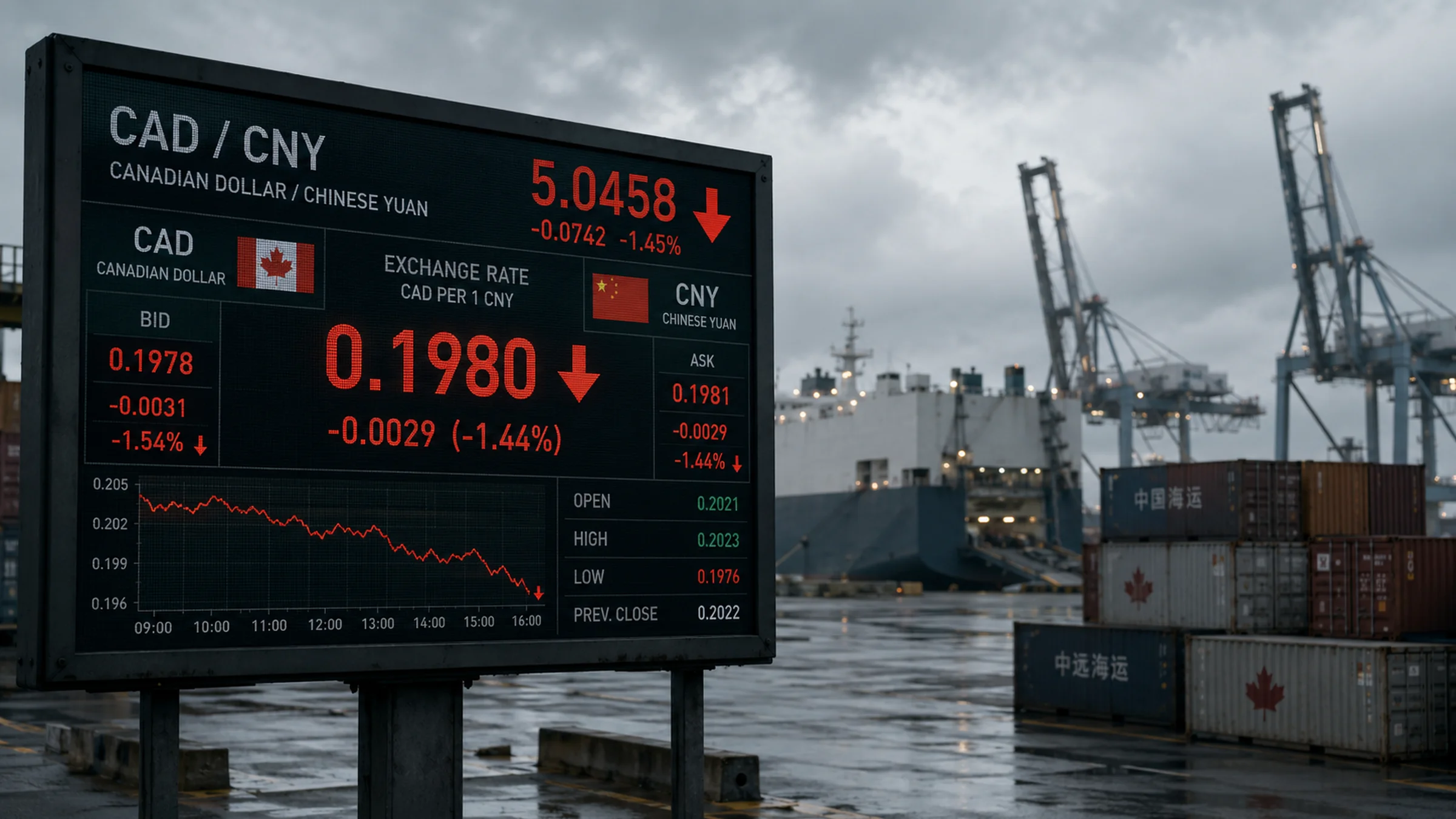
Most projections for Chinese EV pricing in Canada were built on exchange rate assumptions from early 2026, when the Canadian dollar traded at approximately 5.06 renminbi. By late June 2026, the rate had fallen to approximately 4.82 renminbi per Canadian dollar, a decline of 8.55% over twelve months. [11] [16]
For a vehicle with a factory-gate price of 100,000 CNY, the difference between the January rate and the June rate adds roughly $750 CAD to the landed cost before tariff, shipping, certification, or dealer markup. For a vehicle priced at 200,000 CNY, the gap is approximately $1,500. These are direct costs that compound through every layer of the price stack. [11]
Applied to the Seagull, the most-discussed affordable Chinese EV, the math moves the projected Canadian price from the widely cited $22,000–$25,000 range toward $27,000–$29,000 at late-June exchange rates. Before dealer markup. Before delivery and destination fees. And without the $5,000 EVAP rebate that a Korean, Japanese, or European competitor at a similar price point would receive. The exchange-rate effect applies to every vehicle entering under the quota, not only the Seagull. [10]
The loonie’s weakness is not a single-cause event. Reuters reporting from late June 2026 tied the decline to a widening gap between Canadian and U.S. bond yields. The Bank of Canada’s policy rate stood at 2.25% after its June 10 decision; the U.S. Federal Reserve’s target range sat at 3.50% to 3.75%, a spread of approximately 137.5 basis points favouring the U.S. dollar. That spread incentivizes capital flows away from Canadian-dollar assets and creates persistent downward pressure on the currency. [17] [26] [27]
In the coverage reviewed for this article, FX risk is usually secondary to tariff and quota analysis. The official remission framework describes tariff rates, unit caps, and price thresholds. Media coverage of the quota largely treats those price ceilings as fixed. Reuters has noted Canada’s smaller market and unfavourable exchange rate as factors limiting Chinese automaker profitability, but the connection between currency movement and the consumer affordability projections that drive public discussion remains inconsistently drawn. [9] [27]
The Missing Hedge
Every new battery-electric vehicle in the affordable range of the Canadian market is assembled outside the country. The Kia EV4 is built in South Korea and priced in won. The Fiat 500e is built in Italy and priced in euros. The Equinox EV is built in Mexico with a Chinese drive unit and a Korean motor. The Nissan Leaf is built in Japan. The Mustang Mach-E is built in Mexico. Chinese-quota vehicles will be priced in renminbi. [7] [8] [22] [23]
Domestic assembly would not eliminate currency exposure. Batteries, motors, semiconductors, electronics, critical minerals, tooling, and platform licensing can still be priced through foreign supply chains. But a Canadian-assembled affordable BEV would create a partial hedge that imported vehicles cannot provide: more labour, overhead, logistics, and assembly value would be denominated in Canadian dollars, reducing the direct pass-through from exchange-rate movement to landed vehicle cost.
That partial hedge is the structural by-product of the manufacturing capacity the subsidy program was directed toward building. More than $20 billion in federal commitments were directed at EV and battery facilities on Canadian soil. By mid-2026, the largest single investment has been postponed by two years, one battery supplier has entered creditor protection, another has changed ownership, and the one consumer BEV in production starts at approximately $58,000 pre-incentive. Its own manufacturer labels it “assembled in Canada using international parts.” [6]
The Canadian dollar does not need to fall further for the exposure to be real. It just needs to not recover. And a stronger Canadian dollar, if it comes, would reduce landed-cost pressure on imports. It would not create a Canadian-built affordable BEV. The architecture has no domestic floor under it at affordable price points, because the channel that would provide that floor does not yet exist.
The conditions creating the current weakness are not disconnected from the affordability problem the quota was designed to address. Trade uncertainty weighs on the dollar. Rate divergence weighs on the dollar. Commodity dependence weighs on the dollar. These are the same conditions squeezing the household purchasing power that makes affordable EVs necessary. The macro setting that creates the demand for cheaper vehicles is the same one that makes imported vehicles more expensive on arrival.
That is not a forecast. It is the structural condition as it stands in mid-2026.