
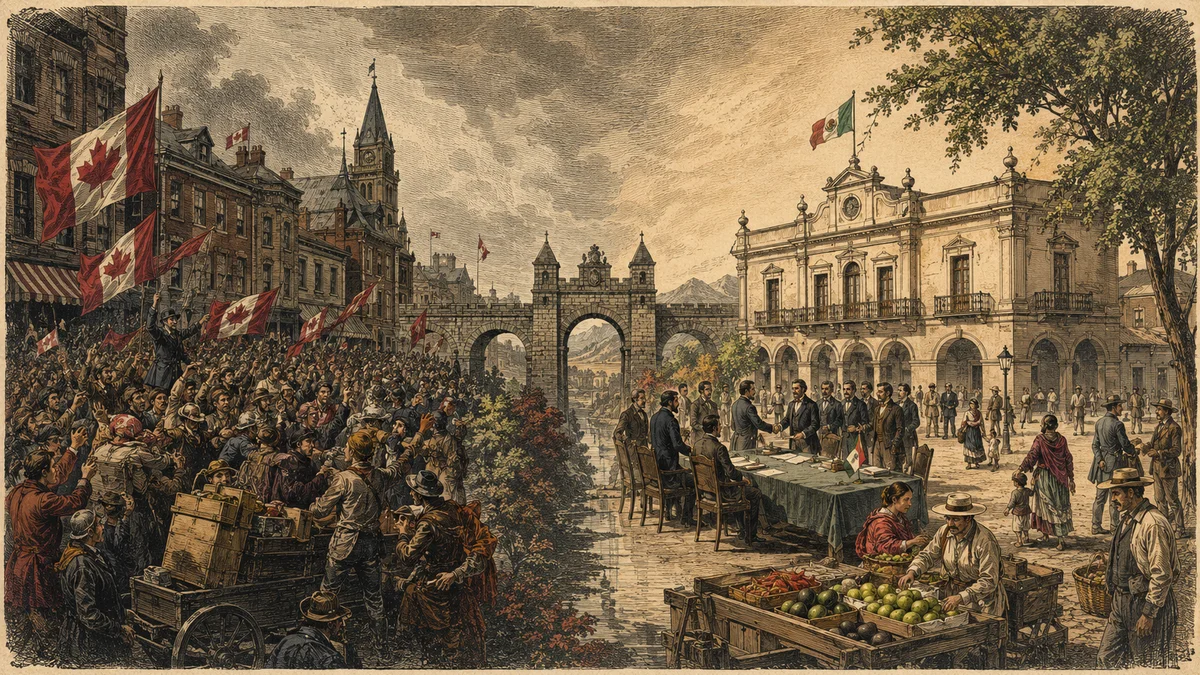
The Receipt
Canada and Mexico are in the same trade agreement with the United States. Both faced the same July 1, 2026 review deadline. Both wanted to renew. The U.S. said no to both.
From there, everything split. Canada’s Prime Minister Mark Carney told Canadians the relationship with America was “over” and called the tariff conflict “the American betrayal.” His campaign slogan was “elbows up.” His government imposed retaliatory tariffs, then quietly removed most of them without getting any American tariffs lifted in return.[1] Mexico’s President Claudia Sheinbaum told her country to keep “a cool head.”[2] Her government never enacted retaliatory tariffs.[3] Instead, Mexico delivered on the things the Trump administration cared about most: it cut migration encounters from over two million to under 240,000, cooperated on fentanyl enforcement, and imposed 50 per cent tariffs on Chinese imports.[4][5]
Eighteen months later, Mexico has completed three formal rounds of bilateral trade negotiations with Washington and has a fourth scheduled for September.[6] Canada has not begun substantive text-based bilateral rounds.[7] New 50 per cent U.S. tariffs on Canadian goods take effect August 19, 2026. Mexico was not targeted.[8] U.S. Trade Representative Jamieson Greer explained the asymmetry: only two countries in the world have retaliated against the United States. China and Canada.[9]
Two countries. Same agreement. Same counterparty. Same deadline. Same outcome on July 1, when Washington declined to renew for either of them. The question is narrow: why has Mexico completed three formal rounds of USMCA-review negotiations with Washington while Canada has not started any?
This is not an economic comparison. Both economies are under pressure from trade uncertainty, and neither has escaped the costs. What diverged is the political room each government has to manoeuvre. Mexico’s leader used rhetoric that preserved her ability to make concessions without domestic backlash. Canada’s leader used rhetoric that made each subsequent concession harder to defend at home.
Two earlier articles documented the Canadian side of this pattern. The 30-Day Deal tracked four policy concessions Canada made between June 2025 and July 2026, none of which produced reciprocal U.S. tariff relief.[1] Many Canadians Are Holding an Emotional Position Against America That Their Own Government Has Already Abandoned documented the gap between what Canadians were told about the relationship and what the government actually did.[10] This article adds the comparison that makes the pattern visible: the country that went through the same process and came out in a different position.
What Mexico Did
On the day U.S. tariffs hit both countries in March 2025, Sheinbaum filled Mexico City’s central square, the Zócalo, with a crowd the city government estimated at 350,000. She had ordered retaliatory tariffs and planned to announce a target list. But after Trump paused, she held back. The list was never published. No retaliatory tariffs took effect.[11][3]
Instead, Sheinbaum cast the outcome as a win. “Dialogue has prevailed and, especially, respect between our nations,” she told the crowd.[11] This was a choice, and it carried real risk. A Pew Research Center survey found Mexican favorability toward the United States dropped from 61 per cent in 2024 to 29 per cent in 2025, the steepest decline of any of the 24 countries surveyed.[12] An El Financiero poll in January 2026 found 81 per cent of Mexicans held a negative opinion of Trump.[13] The raw hostility was comparable to Canada’s.
But Sheinbaum directed it differently.[30] Where Carney pointed public anger at the counterparty, Sheinbaum pointed it at a celebration of Mexico’s negotiating success. Where Carney told Canadians the relationship was over, Sheinbaum told Mexicans it could be managed. Her self-described strategy was cabeza fría, cool head.[2] At a press conference in May 2026, she pre-empted charges of weakness: “Those who think the president kneels are destined for defeat.”[14]
The concessions Mexico made were substantial. The government deployed 10,000 National Guard troops to the border and transferred approximately 92 cartel figures to U.S. custody by January 2026. Migration encounters at the U.S. southern border fell from over two million in 2022 to 237,538 in 2025. U.S. fentanyl deaths were halved over the same period.[4] Mexico also imposed tariffs of up to 50 per cent on more than 1,400 product lines from China and other countries without free trade agreements, directly aligning with Washington’s concerns about Chinese goods entering North America through its partners.[5] And it continued cooperating with 23 U.S.-initiated labour enforcement cases under CUSMA’s Rapid Response Mechanism, affecting over 42,000 Mexican workers.[6]
Each of these concessions addressed something Washington had specifically demanded. And each was domestically defensible because Sheinbaum’s rhetoric had never framed cooperation as capitulation. Her approval stayed between 67 and 72 per cent.[13] Two-thirds of Mexicans across all partisan affiliations told the Chicago Council on Global Affairs that the trade agreement was good for Mexico’s economy.[15] A Pew Research Center survey in spring 2026 found 55 per cent approved of how she was handling the relationship with the United States, even while 81 per cent held a negative view of Trump personally.[13][26]
The access those concessions bought was concrete. The United States and Mexico completed three formal bilateral negotiating rounds between May and July 2026, covering economic security, rules of origin, agriculture, and labour. After the third round, both sides announced a fourth for September.[6] At every stage, Greer praised Sheinbaum’s “strong leadership” and Secretary of Economy Marcelo Ebrard’s “active and constructive engagement.”[16] Mexico was, by Washington’s own public statements, the preferred negotiating partner.
What Canada Did
Canada’s approach diverged from Mexico’s on nearly every dimension that shaped the outcome.
Carney entered office having told Canadians the relationship was “over,” that Trump had perpetrated “the American betrayal,” and that “there will be no turning back.”[17][18] His campaign slogan, “elbows up,” borrowed the hockey term for aggressive, physical play. The rhetoric landed. Canadians boycotted American goods, provinces pulled U.S. alcohol from shelves, cross-border travel fell. A Pew Research Center survey found 59 per cent of Canadians named the United States as their country’s greatest threat, up from 20 per cent in 2019.[19] Forty-three per cent told Ipsos they would personally fight to resist a U.S. invasion.[20]
The government imposed 25 per cent retaliatory tariffs on U.S. goods in March 2025. Five months later, it reversed course and removed most of them unilaterally while U.S. tariffs on Canadian steel, aluminum, and automobiles stayed in place. A CBC investigation found the rollback was broader than what Carney had publicly described.[1] Between June 2025 and July 2026, Canada made four policy concessions sought by Washington: rescinding its digital services tax, dropping the counter-tariffs, moving to eliminate streaming content charges, and agreeing to split toll revenue on a bridge Canada had fully paid for. None produced documented reciprocal U.S. tariff relief. The full pattern and sources are documented in The 30-Day Deal.[1]
The population, meanwhile, held the line the government had drawn. Abacus Data polling from August 7–12, 2026, asked 1,499 Canadians how the government should respond if the new tariffs take effect. Only 18 per cent said Canada should “offer concessions to the US, such as ending bans on American alcohol and easing dairy restrictions, if that gets the tariffs removed.” Thirty-six per cent wanted counter-tariffs. Thirty per cent wanted to keep negotiating without concessions.[21] An Angus Reid Institute poll from the same period found the concession-willing share even lower, at 7 per cent.[22] Seventy-four per cent told Abacus the trade war had already hit their household finances. They were absorbing the cost and refusing to fold.[21]
As of mid-August 2026, Canada had not entered formal bilateral USMCA-review negotiating rounds with the United States.[7] Canadian officials were conducting intensive bilateral tariff negotiations in Washington ahead of the August 19 deadline, working to prevent the new 50 per cent tariffs from taking effect. But these are tariff-specific discussions, separate from the structured USMCA-review process Mexico entered in May.[23] The formal multi-round review negotiations Mexico completed have no Canadian equivalent.
The China Factor
The divergence in how each country positioned itself relative to China directly shaped how Washington treated them.
In late 2025, Mexico’s Congress approved tariffs of up to 50 per cent on more than 1,400 product lines from countries without free trade agreements, effective January 1, 2026. The primary target was Chinese manufacturing. The move aligned Mexico with Washington’s central concern: preventing Chinese goods from entering the North American market through its partners.[5]
Canada went the other way. In January 2026, the Carney government announced a preliminary deal with China: Beijing would cut canola tariffs from approximately 84 per cent to a combined 14.9 per cent and lift restrictions on peas, lobster, and crab. In return, Canada would admit 49,000 Chinese electric vehicles at a tariff rate of 6.1 per cent, down from the 100 per cent rate the previous government had imposed.[24]
U.S. officials noticed. At the Aspen Security Forum in July 2026, Greer said: “I’ve got two countries in the world that have retaliated against the United States: the People’s Republic of China and Canada.”[9] That was not rhetoric. It was the policy rationale for what came next.
The three executive orders Trump signed to authorize the new 50 per cent Section 338 tariffs cite three Canadian actions: provincial boycotts of American alcohol, retaliatory tariffs on U.S. vehicles and auto parts, and dairy import quotas under supply management.[8] None of those have Mexican equivalents. The surface area for escalation existed because Canada’s earlier actions created it. Mexico’s approach removed it.
Why This Comparison Has Limits
The strongest case against this comparison is that the two countries were not playing the same hand.
Sheinbaum had cards Canada did not hold. Mexico shares a land border with Central America and is the primary corridor for migration into the United States. That gave Sheinbaum something concrete to deliver on Trump’s highest personal priority. Canada has no equivalent lever. Mexico’s cooperation on fentanyl enforcement addressed another of Trump’s signature concerns. The halving of U.S. fentanyl deaths during this period gave Washington a measurable result it could point to. Canada’s deliverables on continental defence, F-35 payments, and border security did not register on Trump’s personal scoreboard the same way.
The political context also matters. Trump repeatedly called Canada the “51st state” and floated annexation. He never directed equivalent rhetoric at Mexico. Carney was responding to a sovereignty threat that had no Mexican parallel. The “elbows up” posture may have been the only viable electoral response to a U.S. president who was publicly questioning whether Canada should exist as an independent country.
That context produced real constraints before any rhetorical choice was made. By the time Carney took office, 69 per cent of Canadians told Abacus they wanted Ottawa to “hold firm even if it takes longer.”[25] His rhetoric did not create the hostility from scratch. It channelled a reaction that was already forming. The population was moving against the United States before he spoke, and any leader who positioned differently would have faced the same current.
There is another limit. Mexico’s three negotiating rounds have not yet produced the central thing the article documents Canada failing to obtain: reciprocal tariff relief. The U.S. sectoral tariffs Mexico wants removed remain in place. Access to a formal process is not the same as a resolved outcome. Three rounds versus zero is evidence of differential access. It is not yet evidence that Mexico’s approach produced a better trade result.
All of this deserves its full weight. And it does not undo the finding. The structural positions differed, but the rhetorical choices were not fully determined by them. Canada could have mobilized behind a deal rather than against the counterparty. Carney could have framed tariff resistance without declaring the relationship “over.” Mexico’s population was just as angry at the United States. Favorability cratered to 29 per cent, comparable to Canadian levels.[12] But Sheinbaum turned that anger toward a rally celebrating negotiation rather than a boycott punishing American businesses. The sentiment was similar. The direction was different. And the direction shaped the domestic constraints each government now faces.
What Follows
The divergence is now self-reinforcing.
In Mexico, the cool-head approach produced negotiating access, which produced procedural progress, which reinforced the domestic argument that cooperation works. Sheinbaum can continue negotiating through annual USMCA reviews without contradicting anything she told her population. She can make further concessions without triggering backlash, because her rhetoric framed them as smart diplomacy rather than surrender. By 2026, Pew found Mexican favorability toward the U.S. had partly recovered, climbing from 29 to 40 per cent.[26]
In Canada, the elbows-up approach produced a population that views concessions as betrayal. The four concessions Canada already made each contradicted the mandate.[1] A commentary class has begun building frameworks for walking away from CUSMA altogether. The Hill Times published “Losing CUSMA could make Canada stronger” on August 10, 2026.[27] The Walrus ran “Stop Panicking about CUSMA” in June and “Canada Should Call Trump’s Bluff” in May.[28][29] These are not arguments that CUSMA does not matter economically. The institutional economists at RBC, the Bank of Canada, and Oxford Economics still say it does. They are arguments that conceding is worse than losing. Some may reflect genuine analytical reassessment of CUSMA’s value under an administration willing to tariff around it. But their emergence in the same months that public willingness to concede fell to 18 per cent is notable.
None of this required intent by either leader. Sheinbaum did not necessarily set out to preserve optionality. Carney did not necessarily set out to constrain it. The rhetoric each chose was shaped by the threats they faced, the elections they needed to win, and the populations they were speaking to. But the downstream positions are different: one leader’s words left room for what came next. The other’s made each subsequent concession harder to defend.
What remains to be seen is whether the constraint can be reversed. A population told the relationship was over can, in principle, be told it has been rebuilt. But no such message has been delivered.[10] Every week the constraint holds, the negotiating position weakens, because the concessions available to offer shrink while the demands from Washington do not.
What Would Change This Assessment
Three conditions would materially alter this analysis:
- USTR publicly designates a Canada-U.S. meeting as a bilateral negotiating round related to the Joint Review of the USMCA, and Canada completes three such rounds or reaches an equivalent formal negotiating milestone by the end of 2026. This would close the negotiating-access gap that anchors the comparison.
- Canada obtains documented reciprocal U.S. trade relief that the two governments explicitly connect to a Canadian concession. This would break the pattern documented here and in The 30-Day Deal: that Canadian concessions produce no reciprocal relief.
- Mexico faces equivalent punitive tariffs, a breakdown in its bilateral negotiating process, or completes formal rounds without obtaining any meaningful tariff or negotiating advantage while Canada obtains comparable or greater relief through its separate bilateral process. Any of these would narrow the asymmetry and reduce the comparative force of the analysis.