
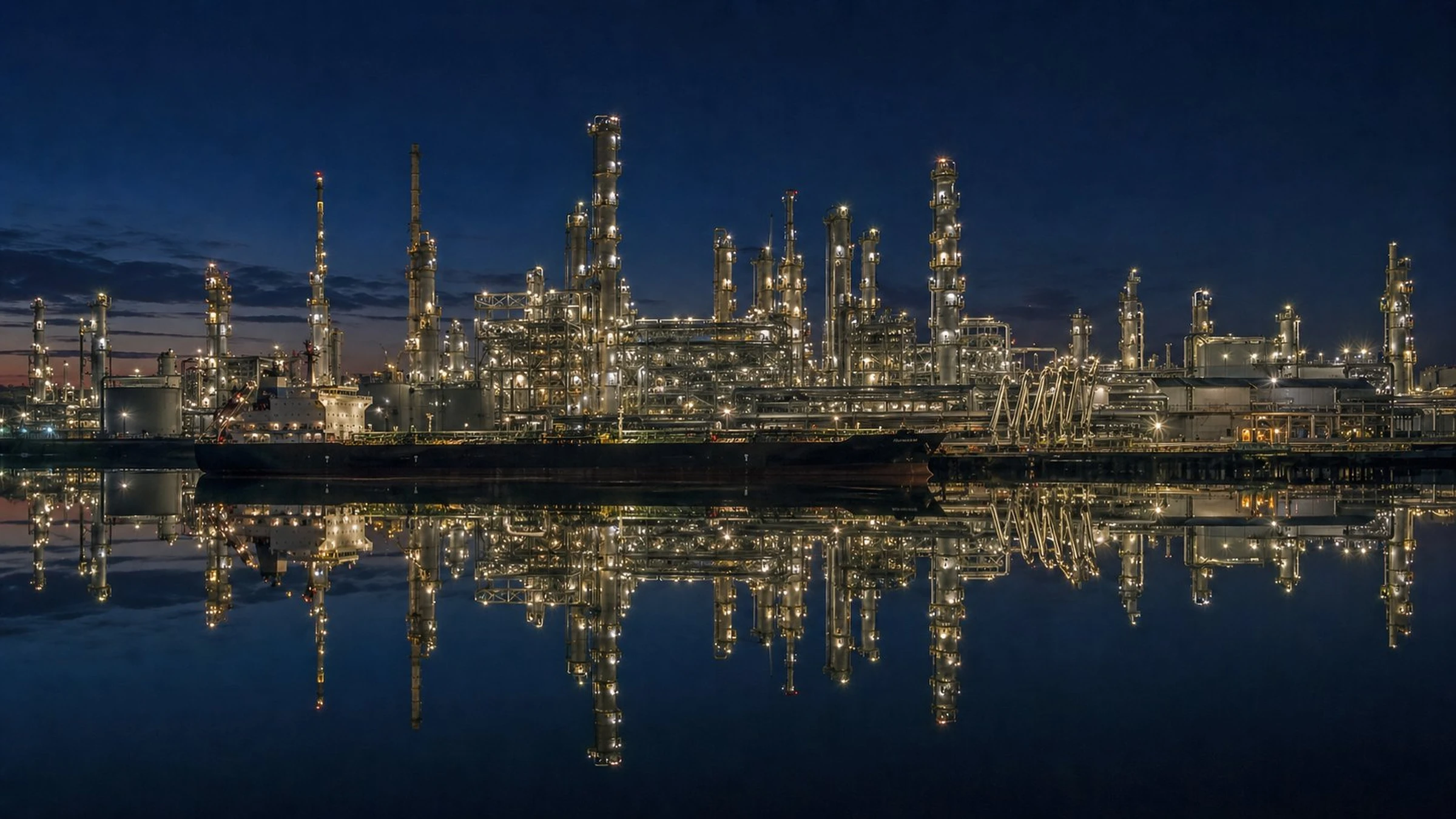
The Grade That Matters
When people talk about "oil," they tend to treat it as a single commodity. It isn't. Crude oil varies by density (measured in API gravity) and sulphur content. Light, sweet crudes like West Texas Intermediate are easier to refine into gasoline. Heavy, sour crudes like Western Canadian Select, at roughly 21° API gravity and 3.4% sulphur, require more complex processing but yield different products, including the vacuum gas oil and naphtha that serve as feedstock for petrochemical production. [10]
This distinction matters because the energy transition is not hitting all grades equally. Electric vehicles displace gasoline, which comes predominantly from lighter crudes. But plastics, synthetic fibres, fertilizers, and industrial chemicals come from heavier processing streams. The IEA's own data shows Chinese gasoline demand peaked in 2021 due to EV adoption. [1] Petrochemical feedstock demand, meanwhile, is still climbing.
That does not mean petrochemical demand translates one-for-one into demand for Canadian heavy crude. Roughly half of projected feedstock growth comes from LPG and ethane, which can bypass heavy crude processing entirely. But the naphtha-linked share, combined with Asian investment in coking and upgrading capacity, gives Canadian heavy crude a more durable market position than the simple "sunset industry" framing implies.
The Petrochemical Pivot
The International Energy Agency's Oil 2025 report, released in June 2025, identifies a structural shift in what the world uses oil for. Transport fuels are plateauing. Petrochemical feedstocks are growing. By 2030, the IEA projects that naphtha and LPG/ethane demand for petrochemicals will increase by approximately 2.1 million barrels per day, split roughly evenly between naphtha and gas liquids. [2]
The total scale is significant. The IEA projects that producing plastics and synthetic fibres will require 18.4 million barrels of oil per day by 2030, or more than one in every six barrels consumed globally. [1] From 2019 to 2024, more than 95% of net global oil demand growth came from petrochemicals. [2]
The infrastructure to meet this demand is concentrated in Asia. Industry estimates from GlobalData suggest that more than 800 new petrochemical projects (including both new builds and expansions) are expected across Asia by 2030, representing roughly 60% of global petrochemical construction. China accounts for the majority. India is projected to add approximately 27 million tonnes per year of plastics capacity between 2026 and 2030. [9] Separately, Asia is adding an estimated 880,000 barrels per day of new coking capacity from 2023 to 2027, roughly half of global additions. [9] Coking units are specifically designed to process heavy, high-sulphur crudes.
Whether that demand reaches Canadian producers depends on whether Canadian crude can reach those refineries.
TMX: The First Market Test
For decades, Canadian heavy crude was functionally captive to a single customer. More than 96% of Canada's crude oil exports went to the United States in 2024. The country's oil is landlocked in Alberta and Saskatchewan, with over 90% flowing through U.S.-linked pipelines. While 76% of global oil moves by marine transport, only 8% of Canadian oil did. [11]
The Trans Mountain Expansion changed this. When it entered commercial service in May 2024, it tripled pipeline capacity from 300,000 to 890,000 barrels per day, connecting Alberta's oil sands to the Port of Vancouver. Within its first month, the combined system was transporting 704,000 barrels per day. [3]
Asian buyers responded quickly. Between May 2024 and September 2025, crude oil exports to Indo-Pacific markets went from virtually zero to an average of C$571 million per month. China became Canada's second-largest crude customer, with C$5.9 billion exported in that period. Other buyers included Singapore (C$1.6 billion), Hong Kong (C$1.5 billion), South Korea (C$411 million), and India (C$158 million). [11]
By late 2025, the export split had shifted decisively. Three-quarters of the 375,000 barrels per day of heavy crude shipped from Vancouver went to Asia-Pacific, up from roughly 60/40 in the second half of 2024. U.S. West Coast purchases of Canadian heavy actually declined despite higher total export volumes. [5]
Pricing shifted too. The Alberta WCS discount to WTI at Hardisty, which had averaged roughly $17 per barrel over the previous decade and spiked to $46 during the 2018 pipeline crisis, narrowed to $12.60 in Q1 2025 and briefly fell below $10 in March 2025. [7] That narrowing represents billions of dollars in additional revenue that Canadian producers had been forgoing because they had only one customer.
None of this constitutes proof of durable long-term demand or bankable economics for new pipelines. Trans Mountain's 380 vessels and 57% Asia-bound rate (by vessel count) represent early commercial interest, not contracted permanence. [6] But as a first test of whether non-U.S. buyers would actually take Canadian heavy at competitive prices, the results are difficult to dismiss.
The Buyers
Asian interest in Canadian heavy crude is visible in refinery investment patterns. The region's new coking capacity additions are designed to process heavy, high-sulphur crudes like WCS. China and India account for about 60% of the investment. [9]
The refineries buying Canadian crude already have commercial experience with it. PetroChina and Sinopec have both processed Canadian heavy. South Korea's Ulsan complex received large shipments of Cold Lake and Alberta heavy blends in late 2024 and 2025. Thailand's PTT has explicitly requested more Canadian heavy crude in 2026 contracts. Japanese refiners including ENEOS have indicated they would increase purchases if pricing remains competitive. [5]
Trans Mountain's Q3 2025 results show 25 terminals across Asia receiving shipments from the Westridge Marine Terminal. [6]
China, which currently sources only about 1% of its crude imports from Canada, represents the largest room for growth. Chinese refineries are bringing increasingly advanced cracking units online specifically to improve petrochemical yields from heavy feedstocks, at the same time that EV adoption is reducing their need for gasoline-oriented refining. [5]
The Suppliers Who Aren't (and One Who Might Be)
Canada's competitive position depends not just on demand, but on who else can supply heavy crude. Several major producers are constrained or declining.
Venezuela's Orinoco Belt holds among the world's largest heavy crude reserves. Production has collapsed from roughly 3 million barrels per day in 2015 to under 700,000 barrels per day under the weight of sanctions and chronic underinvestment. [5] Mexico's giant Maya heavy fields are mature and in year-on-year decline. Saudi Arabia has actually reduced its heavy crude exports in the near term, with Arab Heavy shipments falling roughly 280,000 barrels per day to approximately 560,000 barrels per day in 2025 as the kingdom kept supply in-country for its own refining expansion. [5]
But Saudi Arabia is not simply disappearing as a heavy crude supplier. Major upstream projects such as Zuluf could add substantial Arabian Heavy capacity later this decade. The near-term question is whether those barrels are exported into the same competitive market or absorbed by Saudi Arabia's own refining and petrochemical expansion. [9]
Russian medium-sour crude, which once supplied 20-25% of European oil imports, has been largely rerouted to Asian buyers since 2022. This has created a cascading substitution effect: European refineries replaced Russian crude with Iraqi Basrah grades, tightening the Middle Eastern heavy supply available for Asian buyers who were already competing for it. [12]
Against this backdrop, Canadian heavy production is rising. Alberta's oil sands output hit record levels in 2024, up 4% year-on-year. [8] Among the major heavy crude producers, Canada is the only one simultaneously increasing output and expanding its route to tidewater.
The Atlantic Question
TMX provided the first market test on the Pacific side. The Atlantic market remains untested.
Irving Oil's Saint John refinery, Canada's largest at 320,000 barrels per day, has historically sourced 80-85% of its crude from Saudi Arabia. [13] When the Hormuz crisis disrupted Middle Eastern supply in early 2026, Irving pivoted, securing approval to source 650,000 to 680,000 barrels of crude from Newfoundland and Labrador for the first time since 2020. [14]
This was an emergency measure, not a structural shift. But it demonstrated something important: Canada's largest refinery is configured to process heavy crude, is vulnerable to Middle Eastern supply disruption, and has no pipeline access to Canadian heavy from the west.
The Energy East pipeline, proposed in 2013 at 1.1 million barrels per day from Alberta to Saint John, would have served exactly this function. Irving Oil was a joint venture partner in the marine terminal component. The project was cancelled in 2017. [15] No private company has revived the concept, with regulatory and political risk cited as the primary deterrent.
An Atlantic route would do double duty. It would open a new export market for Canadian heavy crude, but it would also address a national security vulnerability: Canada's near-total dependence on U.S.-linked pipelines for crude export, and Eastern Canada's dependence on Middle Eastern supply for its own refining. The Hormuz crisis exposed both sides of this at once. Irving couldn't get Saudi crude in, and Alberta producers had no way to send Canadian crude east to replace it.
The potential market extends beyond Irving. European refineries that replaced Russian heavy crude with Iraqi and Saudi grades after 2022 remain exposed to the same Middle Eastern supply risks that forced Irving's pivot. An Atlantic export route would give Canadian heavy crude access to Mediterranean and Northwestern European refineries with coking capacity, many of which currently compete with Asian buyers for constrained heavy supply. [12]
An Atlantic route would not avoid the consent and approval challenges described below. It would relocate them. Energy East-style infrastructure would cross different provinces, watersheds, and Indigenous territories, creating a separate consultation process rather than a shortcut around the West Coast impasse.
The Consent Landscape
New pipeline infrastructure in Canada requires more than market demand and private capital. It requires navigating a consent landscape that has defeated previous projects.
Alberta announced in October 2025 its intention to develop a proposal for a new crude oil pipeline to the northwest Pacific coast, committing $14 million in public funds and planning a submission to the federal Major Projects Office by July 2026. The proposal features Indigenous co-ownership as a central element. [16]
The Coastal First Nations alliance, representing eight nations along the BC coast, has stated its opposition to oil tanker traffic in its territories. Following a meeting with Prime Minister Carney in January 2026, Coastal First Nations president Marilyn Slett said Carney had confirmed his government would seek free, prior and informed consent for any proposed projects. [17]
The Haisla Nation, which is not a member of the Coastal First Nations alliance and has invested heavily in LNG development through the Cedar LNG project, has also opposed oil tanker traffic through its coastal waters. Chief Councillor Nyce described oil tankers as a line the Haisla would not cross, citing the potential damage to fishing livelihoods. [18]
This is a structural feature of how major projects get built in Canada, and the courts have consistently upheld it. Both the Northern Gateway and Trans Mountain projects had federal approvals overturned at least once due to inadequate Indigenous consultation. Any credible assessment of Canada's oil export capacity must account for the time, cost, and genuine uncertainty this process introduces. [19]