
What an ISBN Is and Why It Matters
An ISBN — International Standard Book Number — is a 13-digit identifier assigned to every edition of every book. It's how bookstores, libraries, distributors, and online retailers find, catalog, and sell publications. Without one, a book doesn't exist in the supply chain. [5]
In Canada, publisher-controlled ISBNs are issued exclusively by ISBN Canada, an agency within Library and Archives Canada. Every Canadian publisher or self-publisher who wants to distribute through bookstores, libraries, and broad retail channels must register for an account and receive ISBNs through this single federal gateway. [6]
Amazon KDP offers free platform-assigned ISBNs for paperback and hardcover, but these can only be used within KDP and do not function as publisher-controlled identifiers usable across other retailers, libraries, printers, or distributors. For English-language Canadian publishers seeking broad distribution under their own imprint, ISBN Canada is the only route.
The Timeline: From Days to Months
The deterioration is documented across multiple sources, each with a different snapshot.
As recently as mid-2024, non-government publishing guides for Canadian self-publishers described the ISBN account review process as taking "up to ten business days." [9] By late 2025, industry sources were reporting the wait had stretched to "up to 20 days, up from 7–10 days." [3] These figures come from public-facing industry guidance, not official LAC processing history — no LAC page documenting previous processing standards was located for this review.
At some point before October 2025, LAC updated its official Canada.ca page to state that account requests would be reviewed "within 30 working days" — roughly six calendar weeks. [2]
By May 2026, that 30-day window was no longer operational. The agency's own auto-reply confirms it is still processing applications received in February 2026. For anyone who applied in March or later, the wait is already beyond the stated timeframe with no end date communicated. [1]
So what does this mean for someone trying to publish a book? It means the registration step alone — before any ISBN is even assigned — could delay publication by three months or more. And the agency has explicitly said it cannot tell you when your turn will come.
What Broke: The 2024 System Failure
In late April 2024, LAC announced it had taken the ISBN application offline after a user reported a technical issue. Investigation revealed that "a small set of ISBN Canada accounts were experiencing the same issue." LAC performed what it called a "preventive shutdown" and found "application deficiencies" it was "currently working to correct." [4]
The notice assured users that no "wrongful access to protected information" had been found, but did not disclose the nature of the deficiencies, the duration of the outage, or how many applicants were affected. During the shutdown, LAC directed all ISBN requests to a single email address. [4]
The system came back online, but the shutdown plausibly added load to an already growing queue. LAC has not published enough data to quantify the outage's effect on the current backlog, but every application that stacked up during the shutdown period added to the processing load of a team that was already handling rising demand.
The Demand Side: Free ISBNs in a Self-Publishing Boom
Canada's free ISBN system is unusual internationally. In the United States, a single ISBN costs $125 from Bowker, the sole authorized agency. A block of ten costs $295. [17] In Canada, ISBNs are free — provided by a federal agency as a public service. [5]
That's a meaningful structural difference. It removes a cost barrier that in other countries limits casual or speculative registrations. And it makes Canada's ISBN system a magnet for every self-publisher in the country at a time when self-publishing volume is growing rapidly. For context, globally, self-published titles with ISBNs exceeded 2.6 million in 2023, a 7.2% increase over the prior year. [10]
At the same time, the Canadian book publishing industry generated $1.7 billion in operating revenue in 2024, and BookNet Canada tracked nearly 878,000 unique ISBNs associated with books sold in the country that year. [11] [12]
The public record does not disclose Canadian ISBN application volumes. The available context — global self-publishing growth, Canadian book-market scale, and lengthening reported wait times — is consistent with rising demand, but the processing team has no published plan to scale capacity to match.
The Broader Pattern: LAC Under Strain
The ISBN backlog appears within an institution that has documented serious capacity problems in other public-facing service lines. ATIP (access to information and privacy) is a different division from ISBN, with different staff and statutory obligations — this article does not assume the same team handles both. The relevance is institutional pattern, not direct evidence of ISBN staffing.
In 2022, the Information Commissioner of Canada issued a special report finding that nearly 80% of access to information requests completed by LAC did not comply with legislated timelines. The Commissioner described a "somewhat alarming picture" and made ten recommendations for reform. [13]
In a separate 2025 order, the Commissioner found LAC had failed to demonstrate that its claimed processing extensions were reasonable. The Minister of Canadian Heritage gave notice that she would not implement the Commissioner's order. [14]
In March 2026, reporting indicated LAC was planning to eliminate 87 full-time positions from its access to information division over three years, with the department's own documents acknowledging this "may impact the ability to fully comply with legislated requirements." [15]
LAC's own December 2025 progress report acknowledged that "the demand for access to information continues to grow annually" and that "sustainable investment is essential" for the institution to address its backlog and modernize infrastructure. [16]
So what does this mean for ISBN applicants? It means the agency responsible for their registrations has documented resource gaps in at least one other major public-facing service line, and in that service line, the reported trajectory is toward fewer staff, not more.
"Unable to Process Urgent Requests"
The most striking line in ISBN Canada's auto-reply is bolded in the original: "At this time, we are unable to process urgent requests or provide individual status updates on applications." [1]
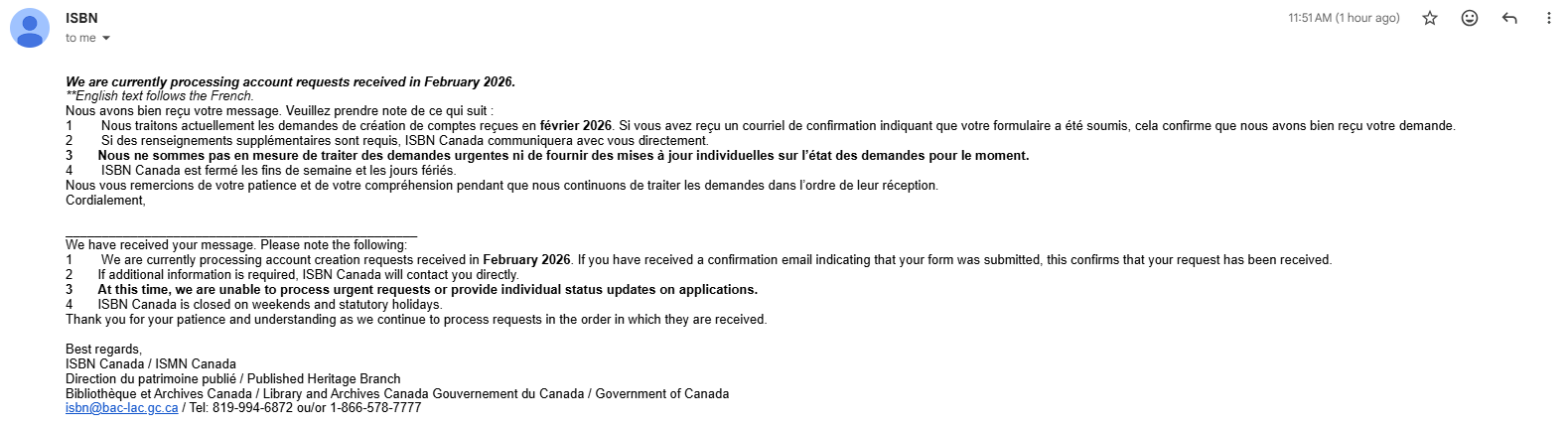
Consider what this means in practice. An author with a book tied to a current event, an election, a legal case, a seasonal market, or a contractual deadline has no mechanism to escalate. A publisher coordinating a multi-title release schedule cannot get a status check on a pending registration. An academic with a tenure-review deadline cannot expedite.
The system is first-in, first-out, with no exceptions, no visibility into queue position, and no communication until the account is approved.
The absence of an urgent-request pathway is a feature of the system's design, not a temporary malfunction. When processing took days, it was invisible. At three months, it becomes a material barrier to economic activity.
This article is based on the author's direct application experience and ISBN Canada's auto-reply, which describes the queue status for all account-creation applicants. We have not independently surveyed other applicants.