
The export collapse
Canada has been a net electricity exporter for as long as most Canadians have been alive. The country’s vast hydroelectric capacity — over 57% of total generation — produced more power than the domestic economy consumed, and the surplus flowed south across interconnections to American utilities willing to pay for it. In a good year, those exports exceeded 49 TWh. They represented revenue, reliability margin, and a structural advantage that made Canadian electricity policy the envy of jurisdictions still burning coal. [1]
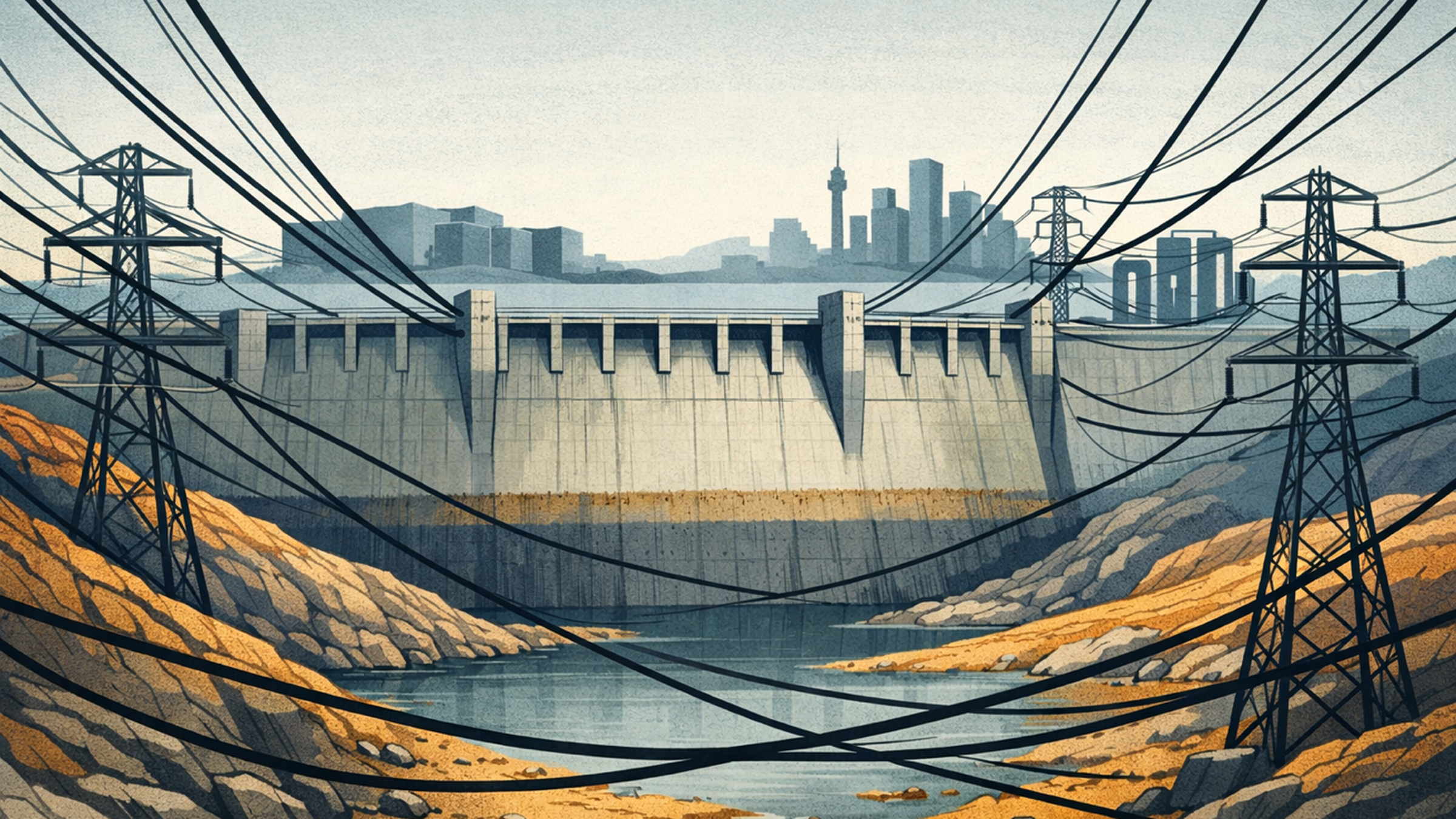
In 2024, that surplus contracted sharply. The Canada Energy Regulator’s annual trade summary shows electricity exports fell to 35.64 TWh — a 28% decline from 2023 and the lowest export total since 2004. The CER identifies three converging causes: drought reduced hydroelectric output across multiple provinces, domestic demand grew, and American utilities produced more of their own power from cheap natural gas and expanding renewables, reducing their need for Canadian imports. [1]
Statistics Canada’s monthly data makes the shift visible at a finer resolution. In February, March, and April of 2024, and again in March, October, and November of 2025, Canada was a net electricity importer — buying more power from the United States than it sold. Six net-import months since Statistics Canada redesigned the series in 2016, with October and November marking the first consecutive pair, and the pattern has persisted: every month since June 2025 has shown year-over-year declines in hydroelectric generation due to prolonged dry conditions. [2] [3] [4]
The integrated North American grid makes this possible — Canada can buy U.S. power when it needs to. But the direction of flow tells you something about surplus. When it reverses for six months in two years, the planning assumption underneath federal electrification policy has changed.
Province by province: the same story, told independently
What makes the 2024–2025 data particularly significant is that every major hydro province arrived at the same conclusion through its own planning process, using its own data, without coordinating the message.
Québec. Hydro-Québec’s 2024 annual report shows external sales fell from 23.0 TWh in 2023 to 15.1 TWh in 2024 — a 34% decline. The utility attributes this to “low runoff levels that have persisted for several months” and says it “significantly limited its exports during the year” to manage reservoirs prudently. [5] Hydro-Québec insists the drought had no impact on domestic supply or long-term commitments. But its own strategic documents tell a different structural story: the 2022–2026 Strategic Plan explicitly states that Québec now has “tighter energy and capacity balances” as electrification raises demand. [15] The Action Plan 2035 projects electricity consumption doubling by 2050 and targets 60 TWh of new supply — 8,000 to 9,000 MW — by 2035 to keep pace. [6]
British Columbia. BC Hydro’s data is the most striking single number in this article. Freshet surplus energy — the excess power generated during spring snowmelt when reservoirs overflow — fell from 2,209 GWh in fiscal 2021 to 225 GWh in fiscal 2024 to zero in fiscal 2025. Severe drought conditions eliminated it entirely. [9]
BC Hydro’s Integrated Resource Plan, updated in 2023, projects that the system transitions from surplus to deficit around fiscal 2029 for energy and fiscal 2032 for capacity, assuming only existing and committed resources. [8] Meanwhile, BC Hydro reports “unprecedented growth in interconnection requests” from large industrial customers, with AI and data centres identified as a major new source of demand. [19]
Manitoba. Manitoba Hydro’s 73rd annual report shows 2023–24 results driven by lower net exports related to drought and unprecedented congestion at U.S. trading hubs. [10] The utility’s quarterly report for the six months ending September 2025 says drought conditions continued, with record-low summer precipitation and low opening reservoir storage. [24] Wholesale exports still account for roughly 30% of Manitoba Hydro’s electric revenue — meaning drought directly hits the utility’s bottom line, not just its surplus position. [11]
Ontario. Ontario is not a hydro-surplus province in the same way — its grid runs on a mix of nuclear, hydro, gas, wind, and solar. But the IESO’s 2025 Annual Planning Outlook contains the single most direct institutional admission of supply-demand tension in any Canadian planning document: in the base case, “unserved energy begins to grow around 2030” and by 2050 occurs “in all hours of the year.” [7] Ontario now expects to call on Hydro-Québec import capacity in summer 2027. A 2024 agreement provides for Ontario to supply Québec at least 600 MW in winter and Québec to provide Ontario up to 600 MW in summer — two provinces that once exported independently now sharing capacity to avoid shortfalls. [22]
Alberta. Alberta’s grid is gas-dominated, not hydro. But the AESO’s March 2025 data centre update says requested new data-centre load is “fast approaching Alberta’s peak demand, an amount that the grid cannot immediately serve.” The AESO set an interim limit of 1,200 MW for large-load integration in 2027–2028 — acknowledging that the transmission system cannot absorb what is being requested. [12] [13]
Five provinces. Five independent assessments. The same conclusion: the margin is thinning, the demand is rising, and the supply is not keeping pace.
What’s eating the surplus: the demand collision
The drought explains why the surplus shrank in 2024. It does not explain why it was already under pressure before the drought. That requires looking at what is consuming the electricity Canada used to export.
Data centres and AI. The IESO projects Ontario data-centre demand growing from 2.5 TWh in 2026 to 14 TWh by 2050. [14] That is a five-fold increase from a sector that barely registered in Ontario’s planning five years ago. Ontario currently has 104 data centres, mostly under 10 MW each. The new AI-scale facilities being proposed consume hundreds of megawatts — up to a gigawatt per site. [16] BC Hydro says data centres are “contributing significantly to the growth in electricity demand” in its 2026 Call for Demand. [18] In Alberta, the AESO says data-centre applications are arriving at a pace and scale the grid cannot immediately absorb. [12] Globally, the IEA projects data-centre electricity consumption more than doubling to roughly 945 TWh by 2030, growing at approximately 15% per year. [27] The CER’s March 2026 national outlook assumes Canada adds 1.5 GW of data-centre load by 2030 and 3.5 GW by 2050 — and explicitly acknowledges that data centres “pose a challenge for outlooks because they can be large and quite uncertain.” [29]
Electric vehicles. The federal EV Availability Standard set sales targets starting at 20% in 2026 and reaching 100% by 2035. [17] The federal government announced a review and waived the 2026 requirements in early 2026, but provincial targets and market adoption continue. The IESO projects 11.6 million EVs in Ontario by 2050, consuming over 42 TWh per year in charging demand alone. [20] For context, that single demand source in one province would exceed Canada’s entire 2024 export volume to the United States.
Population growth. Canada added approximately 1.3 million people in 2023 and 744,000 in 2024. [25] [26] Every person added needs lighting, heating, cooling, and — under electrification policy — increasingly electric transportation and home heating. No Canadian electricity planning document from before 2022 anticipated population growth at this rate.
Industrial electrification. The IESO projects Ontario industrial demand rising from 44.5 TWh in 2026 to 72.8 TWh in 2050, driven by EV battery supply chain projects, primary metals decarbonization, and chemical-sector expansion. [14] The total Ontario demand picture: from 156.7 TWh in 2026 to 262.5 TWh in 2050 — a 67% increase. [14]
The national picture. The CER’s Energy Future 2026 report, published March 17, projects Canadian end-use electricity demand growing 44% from 2023 to 2050 under current policies, with total generation capacity needing to nearly double from 160 GW to 310 GW. Interprovincial electricity flows more than double in all scenarios — confirming that provinces are increasingly relying on each other to balance supply and demand rather than managing independently from surplus. [29]
Each of these demand sources was planned largely in isolation — and all of them assumed the surplus would absorb the load.
The supply gap: what isn’t being built fast enough
On the supply side, three constraints are compounding the demand growth.
Coal phase-out. Federal regulations require coal-fired units to meet an emissions standard of 420 tonnes of CO2 per GWh by 2030. [23] SaskPower operates three coal stations and is planning for the transition. NB Power is converting its Belledune station with federal funding. [28] These are necessary retirements, but each MW retired must be replaced before it can contribute to the surplus.
New generation timelines. Ontario Power Generation received a licence to construct one 300 MW small modular reactor at Darlington in April 2025, with a target in-service date of late 2030. [21] That is one reactor, five years from now, delivering 300 MW into a province that the IESO says needs 14 TWh of additional annual generation and 1,600 MW of new capacity by 2034. NB Power is seeking a 10-year licence to prepare a site for an ARC-100 SMR — a licence to prepare, not to build. [23]
Hydro variability. The drought that reduced exports in 2024 is not a one-year anomaly. Manitoba Hydro reports record-low summer precipitation continuing into 2025. [24] BC Hydro’s freshet surplus went to zero. Statistics Canada says every month since June 2025 has shown year-over-year declines in hydroelectric generation due to prolonged dry conditions. [4] Climate science projects increased hydrological variability in the decades ahead — meaning the hydro generation that Canada’s surplus depends on is becoming less predictable, not more.
The utilities are aware of this and responding: Hydro-Québec has outlined 60 TWh of new generation, Ontario is running competitive procurements, and BC Hydro launched a 2026 Call for Demand. The question is whether those responses arrive at the scale and speed the demand trajectory requires.
The policy collision — and the surplus already spoken for
The federal government’s own Clean Electricity Regulations analysis projects demand growing by approximately 50%. [22] The policy stack built on that projection — electrification mandates, net-zero generation by 2035, clean energy investment tax credits — was designed when the surplus was assumed to exist.
Meanwhile, a significant portion of whatever surplus remains is already contractually committed. The Champlain Hudson Power Express — a 1,250 MW line from Québec to New York City — is anticipated to begin full operation in spring 2026. The New England Clean Energy Connect adds another 1,200 MW under a 20-year contract delivering 9.45 TWh annually. [5] [6] Manitoba Hydro’s contract with Minnesota Power commits 250 MW through 2035. [11] Hydro-Québec says the drought did not affect its long-term commitments — meaning it intends to honour these contracts regardless of domestic balance conditions. The surplus is not just smaller. It is spoken for.
The Ontario–Québec relationship has already shifted accordingly. A 2024 capacity-sharing agreement provides for Ontario to supply Québec 600 MW in winter and Québec to supply Ontario 600 MW in summer — two provinces that once exported independently now managing scarcity together. [7]
The Clean Electricity ITC offers a 15% refundable credit for eligible generation, storage, and interprovincial transmission. [22] What the federal government has not published is a supply adequacy assessment demonstrating that the generation incentivized by the ITC, combined with provincial procurement plans, will exceed the projected demand growth. The incentive exists. The accounting of whether it is sufficient does not.