
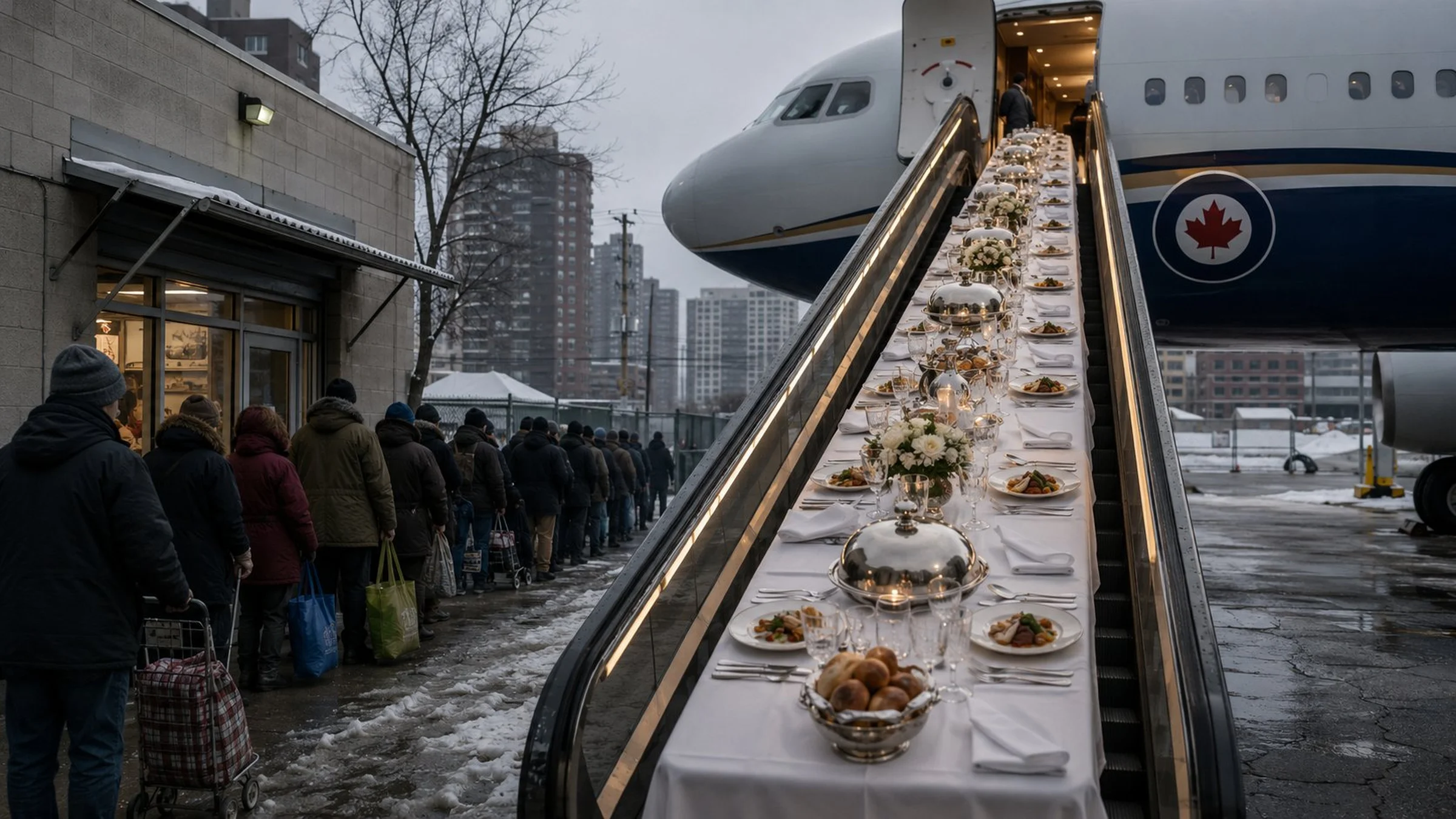
The Tab
The numbers come from order paper questions filed in the House of Commons, the parliamentary mechanism that compels government departments to disclose spending data on the public record. Conservative MP Philip Lawrence asked about PM international travel costs; Conservative MP Laila Goodridge asked about aircraft use, passenger counts, and fuel spending. The Department of National Defence answered both. The figures cover the period from March 2025 to February 2026, Prime Minister Mark Carney's first full year in office. [1] [2]
Total in-flight catering across 28 trips: $524,815.04. [2]
The costliest single trip was the combined visit to Abu Dhabi and the G20 Leaders' Summit in Johannesburg in November 2025, at $158,986.43. Fifty-five people were aboard, including Foreign Affairs Minister Anita Anand, PMO and Privy Council Office staffers, official photographers, and two external advisors. No members of the Parliamentary Press Gallery were listed on the manifest for that trip. [2] [4]
Attending Pope Leo XIV's inaugural mass at the Vatican in May 2025 cost $93,780.18 in catering. Carney was accompanied by a delegation that included Catholic MPs and Indigenous leaders. [2]
The PM's first international trip, a visit to Paris and London just days after being sworn in, included a meeting with French President Emmanuel Macron, a 30-minute audience with King Charles, and a sit-down with UK Prime Minister Keir Starmer. The catering bill for the trip was $60,268.31. A trip to Brussels for the 20th Canada-EU Leaders' Summit cost $49,043.76. A trade mission to Mexico City cost $33,903.37. [2]
Then there are the Washington trips. The first, on May 5, 2025, was Carney's inaugural meeting with President Donald Trump. Ottawa to Washington is roughly a one-hour-and-45-minute flight. The catering bill was $21,158.60, and no passenger manifest was disclosed. The second Washington trip, in October, carried 55 people including cabinet ministers, PMO staff, and members of the press gallery. The catering tab was $16,824.65, which the Toronto Sun reported was nearly 11 times what the RCAF spent on fuel for the same journey. [2]
Here is what the $524,815 does not include: hotel meals during official visits, ground-level catering at summits and bilateral meetings, state dinners hosted or attended, the separate "meals and incidentals" line in government travel disclosures, or any catering associated with official entertaining at the PM's residence. No single federal disclosure consolidates the total annual food cost of the Prime Minister's Office. The $524,815 exists on the public record only because MPs filed the right questions. It is the floor, not the ceiling.
The Pattern
This is not the first time Canadians have learned what it costs to feed a government delegation at altitude. It is the third time in four years. The public controversies have grown in headline scale, though the units differ: Simon's figure was one eight-day trip, Trudeau's was one six-day trip, Carney's is a full year across 28 flights. The per-trip comparison is not equivalent. What is equivalent is the underlying system: we found no published government-wide per-trip cap, automatic audit trigger, or standing menu-disclosure requirement constraining any of them.
In June 2022, an order paper question from Conservative MP Michael Barrett revealed that Governor General Mary Simon's eight-day trip to the Middle East, with stops in London, the UAE, Qatar, and Kuwait, had run up a $93,117.89 catering bill for 30 passengers and 17 crew aboard the CC-150 Polaris. [5]
The details that followed made it worse. Access-to-information requests by the Canadian Taxpayers Federation and the National Post produced the actual receipts: gourmet meals plated on china, orders of beef wellington and carpaccio for 50, and $230 in flower arrangements from an Ottawa florist. [11]
Rideau Hall issued a statement saying the Governor General "shares the public's concern." DND subsequently revised the figure down to $80,367.19, noting that the original number had included some costs outside the trip. A parliamentary committee summoned officials to explain. The chief of protocol told MPs the overall costs were "similar" to past high-level visits. DND said it would try to reduce catering expenses. [5] [6] [12]
We found no published government-wide per-trip cap, automatic audit trigger, or standing menu-disclosure requirement resulting from those 2022 hearings. The committee produced a report with recommendations, and DND stated its intention to reduce costs. But we have not identified a formal, published policy change that constrains future spending.
Two years later, the pattern repeated. In 2024, government records revealed that Prime Minister Trudeau's six-day trip to the Indo-Pacific in September 2023, with stops in Indonesia, Singapore, and the G20 Summit in India, had generated significant in-flight catering costs. Two disclosures produced different figures: a CTF access-to-information request cited $190,000 in in-flight catering, while a House of Commons sessional paper reported by Daily Hive and the National Post cited $223,234. We treat $223,234 as the highest published trip-specific figure but note the discrepancy. A separate $22,000 in meals and incidentals was billed on top of the in-flight catering. Between 37 and 54 passengers accompanied the PM on various legs. [7] [8]
The CTF used the same framing it would use again two years later. Franco Terrazzano, the federation's federal director, told the Daily Hive that Canadians had "every right to be furious." [7]
Now the third cycle. Carney's first year: $524,815 across 28 flights. The system that produced the Governor General's beef wellington is the same system that produced the Prime Minister's undisclosed menus. In 2022, access-to-information requests later produced itemized receipts showing what was served. In 2026, menu details were withheld from the OPQ responses on security grounds. The OPQ-level disclosure is less granular than the later Simon-era ATIP disclosures; whether equivalent Carney-era ATIP records would provide similar detail remains untested. [2]
So what does this pattern tell us? Not that each successive leader has more expensive taste. The system has no published ceiling. There is no mechanism that triggers review when costs cross a threshold, no benchmark that defines what "reasonable" looks like, and no disclosure requirement that lets the public see what the money bought. Three rounds of outrage. No published spending controls.
The Other Table
While government aircraft were running five-figure catering tabs across 28 flights, something else was being measured at ground level.
In March 2025, food banks across Canada recorded nearly 2.2 million visits in a single month. That was the highest figure ever documented and double the monthly total from just six years earlier. It took decades for food bank visits to reach one million a month. It took half a decade to double that. [9]
Behind the topline number: 712,000 of those monthly visits were by children, an increase of 340,000 since 2019. One in five food bank clients, 19.4%, reported being employed, up from 12% six years ago. Seniors accounted for 8.3% of clients, up from 6.8%. Nearly 70% of food bank users lived in market-rent housing. [9]
The annual grocery bill tells the same story from a different angle. Canada's Food Price Report 2026, produced by researchers at eight universities led by Dalhousie, projects that a family of four will spend $17,571.79 on food this year, an increase of up to $994.63 from 2025. Food prices are 27% higher than five years ago. One quarter of Canadian households are now considered food insecure. [10]
Place the PM's in-flight catering bill next to the family grocery benchmark and the arithmetic is plain: $524,815 divided by $17,571.79 equals nearly 30 years. Government aircraft catering for PM travel consumed more in twelve months than the average Canadian family will spend on groceries in nearly three decades. And that is only the in-flight portion. Hotel meals, ground catering, and official entertaining are not in the number.
This is not a claim that cutting aircraft catering would materially fund food relief; the amounts are not comparable to the government's $3.1-billion first-year affordability package. The issue is symbolic accountability and the absence of visible cost controls. The arithmetic is factual; the choice to place these figures side by side is editorial, but the relevance is structural: both datasets describe food costs borne or documented by the same federal government.
The Grocery Government
In January 2026, Prime Minister Carney announced a package of measures aimed at lowering the cost of food and essentials for low-income Canadians. The centerpiece was a rebranding: the existing GST credit became the Canada Groceries and Essentials Benefit, with a 25% boost for five years starting July 2026 and a one-time 50% top-up for eligible recipients. The government said more than 12 million Canadians would benefit. [13]
The branding was deliberate. The word "groceries" was in the name. The announcement framed the government around food affordability as a defining mission. [13]
The same twelve-month window that produced the $524,815 in-flight catering bill also produced the Canada Groceries and Essentials Benefit. A government that names its flagship benefit after groceries operates a catering system with no published cost controls. A government that spends billions to ease food costs for 12 million Canadians simultaneously runs an aircraft catering tab that, per flight, averages $18,743.
The per-flight average is the number that resists easy dismissal. It accounts for short hops and long-haul trips alike, for large delegations and small ones. Eighteen thousand, seven hundred and forty-three dollars per flight, 28 times, in a year when the government told Canadians it understood the pressure they faced at the grocery store.
What "Catering" Actually Means
The Department of National Defence attaches a note to the order paper question responses that deserves to be taken seriously. Catering costs, DND says, "include the cost of food, non-alcoholic beverages, and associated fees, including catering handling and delivery, storage, cleaning and disposal of international waste, airport taxes, administrative fees, security charges, and local taxes." [2] [3]
This is not a trivial caveat. International waste disposal can require specialized handling, and airport catering logistics vary significantly by destination. A catering delivery in Abu Dhabi carries different logistics costs than one in Washington.
The honest question is what share of the $524,815 is food and what share is logistics. DND does not break this out. No published breakdown separates the cost of what was served from the cost of getting it to the aircraft, storing it, cleaning up after it, and disposing of it in compliance with international regulations.
Even so, the logistics caveat does not resolve the structural problem. If half the cost is logistics, the food share alone, roughly $262,000, still exceeds 14 years of family groceries. And the absence of a breakdown is itself a transparency gap. When the Simon scandal broke in 2022, subsequent access-to-information requests produced itemized receipts. When the Carney figures were released, menu details were withheld on security grounds. The public is left with a number large enough to generate outrage but not granular enough to evaluate.
The question this raises is whether better disclosure would defuse or deepen the concern. If DND published a food-only figure and it showed $40-per-person meals with the rest consumed by logistics, the political temperature would drop. If it showed $200-per-person meals with logistics as a modest add-on, the temperature would rise. The government's choice not to provide this breakdown leaves the public to draw its own conclusions.