
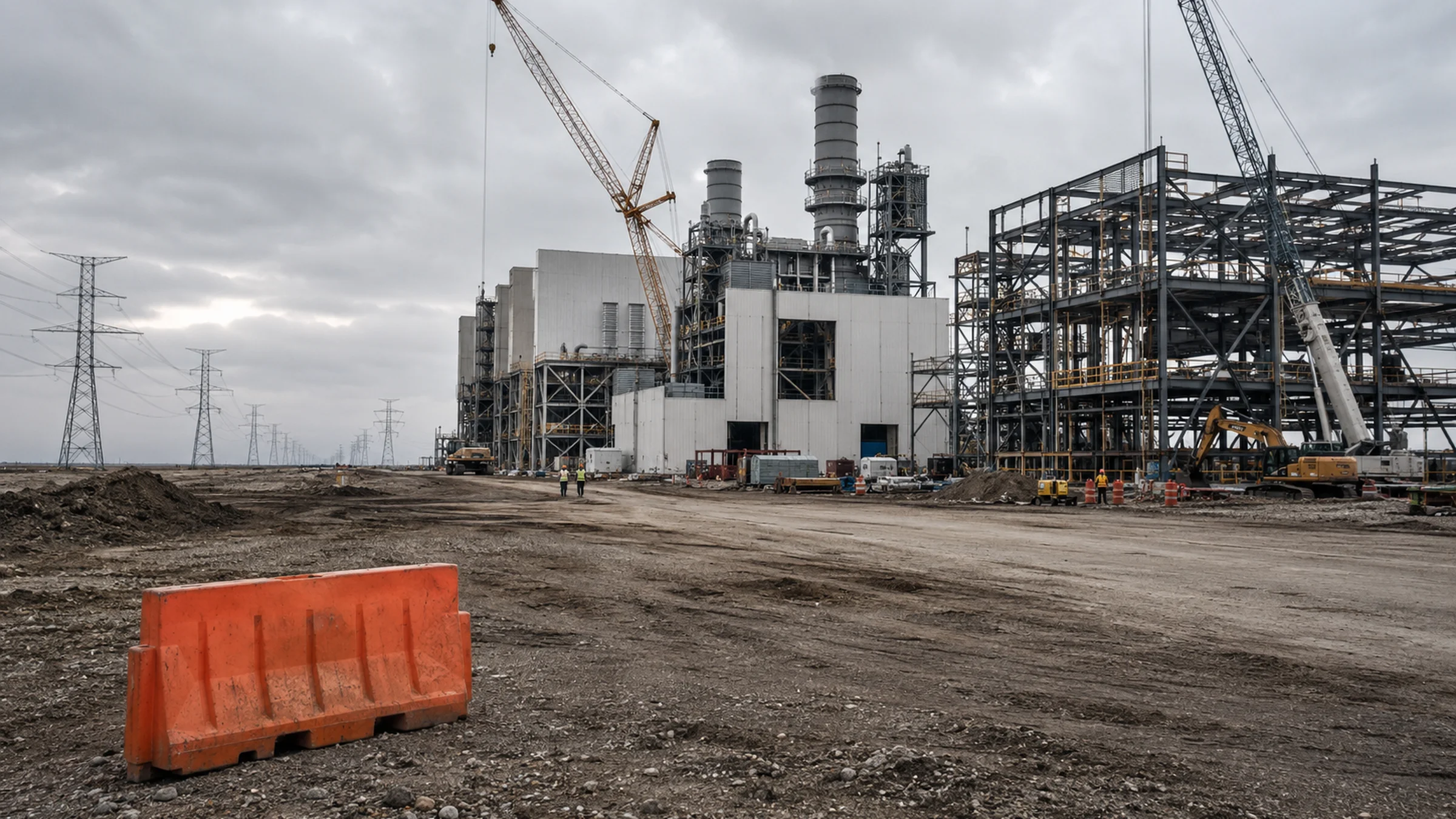
The Grid That Runs on What the Policy Penalizes
In 2025, generation from combustible fuels — natural gas, coal, biomass, and diesel — hit a series high of 143.4 million MWh. [1] Three consecutive years of drought pushed hydro generation to a record-low share of 54.9%. [2] Canada experienced months of net electricity imports in late 2025, including October through December — a pattern without recent precedent. [2]
The country's energy regulator, the CER, projects electricity demand growing 44% by 2050, driven by electrification of transport, heating, and industrial processes. [11] Alberta alone has 21 GW of data centre connection requests against a grid with 12.8 GW of peak capacity. [12]
Nuclear generation remained flat at 81.6 million MWh. [1] New nuclear takes ten to fifteen years from approval to operation. Ontario's SMR demonstration at Darlington is expected to deliver 300 MW around 2026–2027, at pilot scale. [13] Site C, British Columbia's single major hydro project, adds 1,100 MW upon completion. [14] Renewables require storage and transmission infrastructure that has not been costed publicly at the scale the demand projections require.
So what fills the gap? Gas. US EIA reference-case modelling projects Canadian natural gas generating capacity growing from 33 GW in 2022 to 51 GW by 2030 — an increase of 55%. [3] CER's own 2026 scenarios similarly show natural gas capacity remaining material or growing for reliability, even as unabated gas generation is projected to fall over the long term. [40] By the EIA's projection, gas capacity reaches 68 GW by 2050. This is not an opposition talking point. It is the reference projection of a G7 energy agency, broadly consistent with Canada's own energy regulator.
Utilities are not choosing gas over clean. They are building gas because clean is not available at the scale or pace required. New Brunswick is one example. But as primary filings across four provinces reveal, it is not an isolated one.
The Race
The Clean Electricity Regulations create a specific deadline architecture. To qualify as a "planned unit" — and defer CER emissions limits until December 31, 2049 — a project must have environmental assessment filings initiated, site control established, and at least $10 million in equipment contracts signed by December 31, 2025, with construction beginning by December 31, 2027. Units commissioned before January 1, 2025 receive a separate deferral of up to 25 years from commissioning. That is a textbook "develop now or lose the grandfathering window" structure. [43]
A primary-source inventory of gas projects across four provinces shows that utilities are responding to that structure exactly as the incentives predict.
In Saskatchewan, SaskPower commissioned Great Plains (370 MW) on December 17, 2024 — two weeks before the pre-2025 cutoff that triggers CER deferral until approximately 2050. [44] The utility fast-tracked its 370 MW Aspen plant by signing an engineering-services agreement in fall 2023 to accelerate design and major equipment procurement — exactly the milestone behaviour the CER's planned-unit rules incentivize. Construction began April 2024, with operation targeted for 2027. [44] SaskPower also added a 46 MW turbine at Ermine in June 2025 and a 46 MW unit at Yellowhead in December 2025. [45] Saskatchewan's own Economic Impact Assessment Tribunal documented that Great Plains, Aspen, Ermine, and Yellowhead were all materially exposed to the federal deadline structure. [46]
In New Brunswick, N.B. Power contracted a 500 MW combined gas plant through the Centre Village RIGS project with PROENERGY, targeting a commissioned date of August 2028 that aligns with planned-unit treatment. The contract was backdated to qualify under the CER's December 2025 milestones. [4] [47] The Conservation Council of New Brunswick described a pattern of utilities rushing to lock in fossil fuel infrastructure before regulations take effect. [5]
In Ontario, Atura Power's Napanee expansion (~430 MW) has construction planned for Q3 2025, with operation targeted for 2028. Capital Power's East Windsor expansion (106 MW) is at an advanced construction stage with a 2026 commissioning date. Both fall within the CER's planned-unit window. [48] [49]
In Nova Scotia, where the grid still runs 69% on fossil fuels, the provincial government approved two 300 MW fast-acting gas sites — Marshdale and Salt Springs — in February 2026, with construction scheduled for 2027 and operational lifespans of at least 30 years. The procurement targets at least 300 MW of new dispatchable gas by 2030. [50]
The conservative, high-confidence total across these four provinces: 2.2 to 2.5 GW of new gas-fired generation under construction, recently commissioned, or formally approved. That count excludes Alberta, where the confirmed pipeline is measured in gigawatts, not megawatts — but through a different channel.
Alberta's data centre framework, established through the Utilities Statutes Amendment Act, 2025, explicitly encourages data centres to bring their own generation. The AESO launched a dedicated "bring your own generation" process for large loads. [51] Projects in public regulatory processes include a 1,400 MW gas plant at Olds and a roughly 1,494 MW plant near Indus, with Beacon AI stating it plans to use onsite gas turbines generating 2,000 MW across its Alberta projects. [52] These are proposals, not confirmed builds. But they illustrate a pathway by which multi-gigawatt private gas generation could proceed outside the CER's grid-connected framework entirely.
No single province is saying outright: we are racing the CER. But across these filings, commissioning dates fall within weeks of federal cutoffs, equipment procurement timelines match planned-unit milestone requirements, and contract structures are backdated to qualify under deadline architectures. The dates line up too precisely with the federal rules to be coincidental.
A Benchmark That Assumes Its Own Success
A note on scope: this article uses "OBPS" as shorthand for the federal industrial carbon-pricing architecture and the benchmark pressure it exerts on gas-fired electricity. In practice, compliance systems vary by province. Alberta operates under its own Technology Innovation and Emissions Reduction (TIER) system, not the federal OBPS directly. Ontario and New Brunswick have transitioned to provincial equivalents. The federal OBPS applies directly in Manitoba, PEI, Yukon, and Nunavut — covering 41 facilities in 2025. [25] However, all provincial systems must meet the federal carbon-pricing benchmark, and the declining output-based standard for gas-fired electricity sets the trajectory nationally regardless of which compliance mechanism a province uses.
The federal Output-Based Pricing System sets an output-based standard for gas-fired electricity generation. For facilities that began operating after January 1, 2021, the benchmark started at 370 t/GWh and declines linearly to 0 t/GWh by 2030. [6]
That starting number, 370 t/GWh, is important. A modern natural gas combined-cycle plant emits approximately 350 t/GWh. [8] So the initial benchmark roughly matched the physical emissions of efficient gas generation. In the early years, an efficient plant owed almost nothing — the free allocation covered the bulk of its actual output.
The endpoint is more important. Zero tonnes per gigawatt-hour is not a performance target that gas technology can achieve. It is not based on what the best available gas plant can do. An unabated gas plant cannot emit zero. Even with carbon capture at 95% efficiency — a technology not deployed at commercial scale on Canadian gas generation — residual emissions remain above 20 t/GWh. [15]
The Canada Gazette regulatory impact analysis states the consequence plainly: by 2030, new gas-fired electricity facilities "would have no free allocation and would therefore pay for 100% of the GHG emissions emitted from the facility." [6]
The benchmark does not assume gas generation will become cleaner. It assumes gas generation will not exist. It is a price signal that says: this technology should not be operating by 2030. It is running alongside a capacity projection from the government's own regulator showing gas expanding 55% by the same date.
Existing gas plants — the ones that existed before 2021, the ones actually filling the gap right now — are treated differently. They remain at the 370 t/GWh benchmark, paying only on emissions above that level. [6] The split creates a two-tier system: legacy plants are largely shielded; new plants face full exposure. The incentive structure discourages building new, efficient gas generation while grandfathering older, less efficient capacity. The New Brunswick backdating manoeuvre is one visible consequence.
Three Costs on One Bill
A Canadian household connected to a gas-dependent grid is absorbing three simultaneous cost layers on the same electricity bill.
The first is the capital cost of building clean generation. Ontario's nuclear refurbishment program exceeds $25 billion. [16] Clean electricity investment tax credits are projected at $25.7 billion through 2035. [17] These costs are recovered through rates.
The second is the grid itself. Transmission and distribution infrastructure must be expanded to carry electrified transport, heating, and industrial load. Provincial regulators have not published integrated cost projections for these upgrades at the scale the CER's demand growth implies.
The third is the carbon price on the gas generation that fills the gap while the first two layers are being built. At full exposure under a $170-per-tonne carbon price, a plant emitting 350 t/GWh would face approximately $59.50/MWh, or roughly 6¢ per kilowatt-hour. [7] [8] Facilities with free allocations, banked credits, or provincial compliance flexibility could face less. On Alberta wholesale electricity prices of 12–18¢/kWh, even a partial pass-through represents a material cost increase on the generation keeping the grid operational. [18]
Each cost layer is defensible in isolation. Together, they stack on a single bill paid by the same household. We have not identified a federal or provincial document that projects the combined impact of all three layers on residential electricity rates over the transition period.
The Demand the Government Is Adding
While those three cost layers accumulate, federal and provincial policy is simultaneously driving electricity demand higher. The same government penalizing gas-fired generation is mandating that Canadians consume more electricity.
The federal Powering Canada Strong strategy, released May 14, 2026, commits to energy-saving retrofits for up to one million Canadian households, including electrifying home heating through heat pump transitions from propane, oil, and electric baseboard systems. [33] Quebec has already banned fossil fuel heating in new residential buildings. Vancouver will require heat pump water heaters in most replacement installations starting 2027. Building codes are tightening nationally toward electrification. A Fraser Institute analysis found that converting all passenger vehicles to zero-emission would require Ontario to increase electricity supply by 26%. [34]
Then there are data centres. Alberta's grid operator reported more than 20,000 MW of data centre connection requests as of late 2025, against a provincial peak demand of 12.8 GW. [35] The proposed data centre load exceeds Alberta's entire current peak demand by more than 60%. AESO capped near-term connections at 1,200 MW because that is all the grid can absorb without new generation or upgrades. [36] In Ontario, data centre connection requests exceed 6,500 MW, nearly 30% of the province's 2024 peak demand. [37] Quebec has halted new large data centre power procurement entirely since 2024 because grid capacity does not exist. [38]
The Canadian Climate Institute warned that if Alberta's planned data centres proceed using gas power, the province's electricity emissions would roughly double, wiping out the gains from the coal phase-out. [39] Alberta's response has been to create a "behind the meter" framework where data centres bring their own generation, much of it gas-fired, bypassing grid costs and, in many configurations, the Clean Electricity Regulations. One proposed project alone — Kevin O'Leary's Wonder Valley — would run on 7.5 GW of gas-fired generators. [38]
So what does the grid itself need? The Powering Canada Strong strategy projects over $1 trillion to double Canada's electricity system from now to 2050. [33] Since 2000, provincial and territorial ratepayers have already supported almost $450 billion in electricity infrastructure. [33] The CER projects installed capacity must grow from 160 GW today to 310–400 GW by 2050, depending on the scenario. [40]
The arithmetic on that trillion-dollar figure deserves scrutiny. Total Canadian electricity sales in 2024 were $46.9 billion. [41] One trillion dollars over 25 years is $40 billion per year in grid investment — roughly 85% of the entire current annual electricity revenue of the country. Even assuming demand and revenue double over the period, grid capital costs would consume a large share of the revenue base for decades. In Alberta, AESO has already identified $14.5 billion in critical transmission projects, estimating an additional $8 per month on a typical residential bill from transmission alone. [42]
We have not identified a federal or provincial document that stacks grid capital costs, generation capital costs, and carbon pricing costs into a projected household electricity bill over the transition period. The demand is being mandated. The supply is being penalized. The infrastructure is being costed at a trillion dollars. And nobody has told the ratepayer what it adds up to.
The Rebate That Exists and the One That Doesn't
The federal government understood that carbon costs on energy are regressive. It demonstrated that understanding when it built the Canada Carbon Rebate for the consumer fuel charge. Under that program, 93% of fuel charge proceeds were returned directly to households. [10] The design was specifically motivated by the recognition that lower-income households spend a larger share of income on energy and have less capacity to change consumption in response to a price signal.
The OBPS operates on the same commodity — energy — and the cost reaches the same consumer via a different path: the electricity bill rather than the gas pump. But OBPS proceeds are returned to provinces through the OBPS Proceeds Fund, which supports clean technology projects through the Decarbonization Incentive Program and clean electricity projects through the Future Electricity Fund. [9]
No portion of OBPS electricity proceeds is directed to household ratepayer relief. [9] The money flows to industry decarbonization. The cost flows to the ratepayer. The household rebate principle established for the fuel charge was not extended.
Some provinces have their own electricity affordability programs. Ontario provides a 23.5% electricity rebate through the OER and targeted support through the Ontario Electricity Support Program. [19] But these are general affordability measures, not offsets for OBPS carbon cost pass-through, and they do not exist in every province. Alberta, where gas-fired electricity generates the majority of power and the carbon cost impact is largest, has no equivalent general ratepayer rebate program.
Who Absorbs the Signal
The economic logic of carbon pricing assumes the person paying the cost can respond to the signal. In commodity markets, this holds: a cement producer facing a carbon cost can invest in process efficiency, switch fuels, or adopt carbon capture. The price creates a choice.
Electricity ratepayers face no equivalent choice. A renter in Alberta cannot install rooftop solar. A household on a fixed income cannot invest in battery storage. A small business operating on thin margins cannot rebuild its energy infrastructure. The electricity bill arrives, and the only option is to pay it.
The carbon price on gas-fired electricity is functionally a consumption tax on a necessity. Energy expenditure as a share of household income is inversely correlated with income — lowest-income households spend the highest proportion. [20] This is the textbook definition of a regressive tax. It is the same distributional pattern that motivated the Canada Carbon Rebate for the fuel charge.
The difference is that the fuel charge cost was visible. It appeared on every gas station receipt and home heating bill. It was politically salient. The OBPS electricity pass-through is invisible. No line item on a Canadian electricity bill reads "carbon cost." The carbon penalty on gas generation is embedded in the wholesale electricity price, passed through to the distribution rate, and absorbed by the consumer as a higher bill with no explanation.
What is not visible is not politically accountable. What is not politically accountable does not get a rebate.
The Policy Architecture They Already Built
This article does not allege that anyone designed this system to be regressive. What it documents is a sequence of decisions where every piece of information needed to foresee the outcome was available to the decision-makers, generated by their own agencies.
The CER projected gas capacity expanding 55% by 2030. [3] ECCC set the benchmark declining to zero by the same date. [6] Finance structured OBPS proceeds to flow to industry projects. [9] The OBPS regulatory impact analysis acknowledged cost pass-through to electricity consumers. [6] StatsCan data shows energy expenditure is regressive. [20]
Each decision was made by a different arm of the same government. CER modelled the grid. ECCC set the carbon price. Finance allocated the proceeds. Nobody published a document stacking these three decisions on a household electricity bill. Nobody asked: what happens when the penalty schedule assumes a grid transformation that the grid regulator's own projections say will not arrive on time?
The government demonstrated it understood the principle. The Canada Carbon Rebate exists because regressive energy costs require mitigation. That principle was applied to the fuel charge. It was not applied to the OBPS electricity pass-through, despite the identical distributional pattern.
On May 14, 2026, the federal government released its Powering Canada Strong electricity strategy, which explicitly acknowledged a "strategic role" for natural gas and signalled adjustments to the Clean Electricity Regulations to provide additional flexibility for gas-fired units. [33] [53] That concession confirms what this article documents: the prior regulatory architecture assumed a grid transition that has not materialized. The flexibility may reduce reliability risk. It does not answer the distributional question: who absorbs the carbon-cost pass-through during the transition?
Whether this constitutes negligence is a judgment the reader can make. What is documented is an asymmetry: the same government that built a household rebate because energy costs are regressive chose not to extend it to a carbon cost that reaches the same households through the same commodity.