
1. The System
In 2017, the Xinjiang Uyghur Autonomous Region launched a campaign of mass internment targeting Uyghurs and other predominantly Turkic Muslim groups. At its peak, an estimated one million or more people were detained in what Beijing called "vocational education and training centres." [8] The camps drew global condemnation, sanctions, and import bans. What drew less attention was the other system that expanded alongside them.
The Poverty Alleviation Through Labour Transfer programme predates the camps. It evolved from rural-urban migration policies in the early 2000s, and by the time international attention focused on the detention facilities, the transfer system had become the larger forced labour mechanism. The U.S. Department of Labor has described it as Xinjiang's "primary coercive labour system," recording more than 3 million transfer instances in 2022 alone. [4] (The DOL's figures draw on research by Adrian Zenz at the Victims of Communism Memorial Foundation, the leading but single-source academic researcher on Xinjiang labour transfers. [21]) In January 2026, five UN Special Rapporteurs concluded the coercion was severe enough that it "may amount to forcible transfer and/or enslavement as a crime against humanity." [8]
The programme works through local government work teams that mobilize ethnic minority labourers, transfer them in supervised groups, and monitor them on-site with political indoctrination sessions and surveillance. Research based on Chinese government documents found that workers who refused transfers were detained in re-education camps. [26] From 2021, Xinjiang's own policy documents show the programme intensified further, with a new "Unemployment Monitoring and Early Warning" system that effectively prevents workers from leaving their assigned jobs. [21]
The sectors touched by this system are not confined to the cotton fields that first drew scrutiny. The DHS Forced Labor Enforcement Task Force designates cotton, apparel, polysilicon, PVC, seafood, aluminum, and tomatoes as high-priority sectors, and in 2025 added caustic soda, copper, lithium, red dates, and steel. [3] The Coalition to End Uyghur Forced Labour has identified links across more than 17 global industries. [30] A joint investigation by the Bureau of Investigative Journalism, the New York Times, and Der Spiegel traced supply chains from Xinjiang labour transfers to factories producing washing machines, precision lenses, shoes, and processed food in multiple Chinese provinces. [36]
The point is not that every product leaving Xinjiang involves coerced labour. The point is that the system is so embedded in the region's economic architecture that separating clean goods from tainted ones requires granular, shipment-level tracing that the region's own governance structure is designed to obscure.
2. The Scale
Xinjiang's export economy did not contract under international pressure. It expanded, substantially.
According to Urumqi Customs annual briefs, Xinjiang's reported exports rose from 1,272.8亿元 in 2021 to 4,607.3亿元 in 2025, a factor of 3.62. (Chinese customs data uses 亿元 units, where 1亿 = 100 million RMB. The 2025 figure is approximately US$63 billion.) [9] Not all of this growth is attributable to forced labour sectors. Xinjiang sits at the crossroads of China's Belt and Road overland trade routes, and a significant portion of the region's trade figures reflect goods transiting through the region to Central Asian markets. But the growth in documented forced labour sectors is not incidental to this expansion. Xinjiang produces approximately 85% of China's cotton and more than 20% of the global supply. [25] China exports over 90% of the world's polysilicon, and 45% of all polysilicon originates from the Uyghur Region. [24]
In the solar industry, the response to U.S. enforcement was not to clean the supply chain but to bifurcate it. Companies created Xinjiang-free production lines for the American market while continuing to supply other global buyers from the same regional facilities. Because the U.S. market accounts for only 7% to 14% of Chinese solar companies' total production, researchers at Sheffield Hallam University found that "the vast majority of modules produced globally continues to have exposure to the Uyghur Region." [29] The raw production volume of Xinjiang polysilicon has actually increased alongside global demand, even as the region's global market share declined.
So what does this mean for trade enforcement? It means the contamination is structural, not episodic. A country that wants to keep forced labour goods out of its market cannot do it by inspecting individual shipments. The supply chain is designed to make that impossible.
3. The Wall
The United States concluded exactly that. The Uyghur Forced Labor Prevention Act, signed in December 2021 and implemented in June 2022, created a rebuttable presumption: all goods mined, produced, or manufactured wholly or in part in the Xinjiang Uyghur Autonomous Region are presumed to be made with forced labour. [1] The burden flips. It is not the government's job to prove the goods are tainted. It is the importer's job to prove they are clean.
The enforcement record reflects the design. By August 2025, U.S. Customs and Border Protection had detained 16,755 shipments valued at nearly US$3.7 billion under the UFLPA, according to CSIS analysis of the CBP dashboard. [23] In the first year alone, more than US$1.3 billion in products were detained and at least 679 shipments were denied entry outright. [2]
The system is not without contradictions. CBP detentions dropped sharply in 2025, falling to just 14 shipments in July of that year, an unprecedented low. [23] In total, the value of goods detained under UFLPA in 2025 fell sharply from the prior year. Reported figures vary by cut-off date and methodology: the Globe and Mail reported a decline to US$171 million from US$1.38 billion; Reuters, citing CBP data in February 2026, reported US$187.7 million down from US$1.78 billion. [31] Whether this reflects successful deterrence, supply chain bifurcation, or a policy choice by the Trump administration to deprioritize enforcement while stabilizing commercial relations with Beijing is contested. What is not contested is that the legal architecture exists, the presumption is operational, and it produced measurable enforcement results for three years.
4. The Absence
Canada's approach is the structural opposite.
Customs Tariff item 9897.00.00, effective since July 2020, prohibits the import of goods mined, manufactured, or produced wholly or in part by forced labour. [10] The prohibition was adopted to meet Canada's CUSMA commitments. [14] Bill S-211, effective January 2024, expanded the prohibition to include child labour and introduced annual supply chain reporting requirements for large companies. [11] On paper, the legal tools exist.
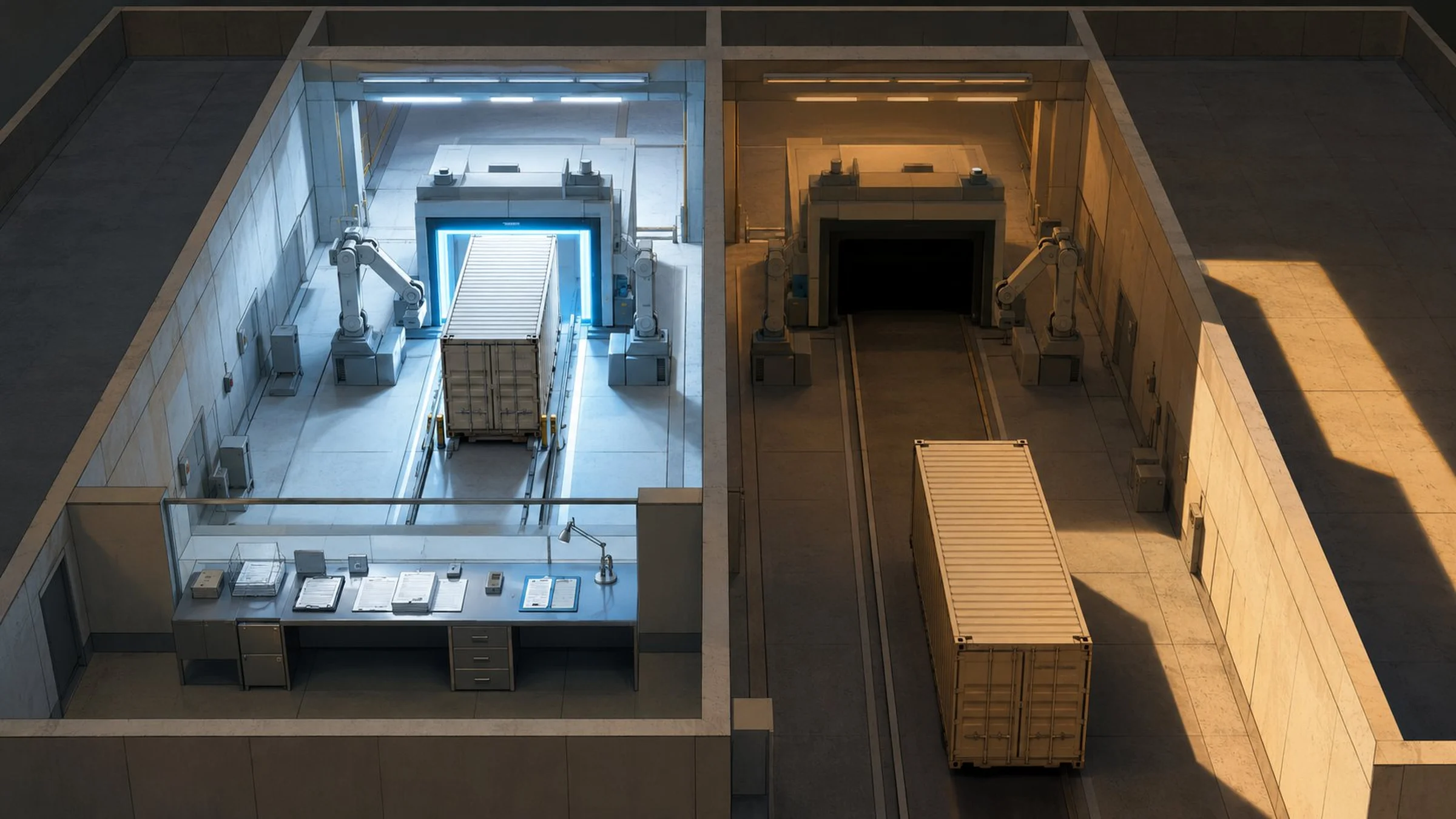
In practice, the enforcement architecture inverts the American model. Under CBSA Memorandum D9-1-6, the burden of proof sits with the government. CBSA must establish, on a case-by-case basis, that a specific shipment involves forced labour before it can be detained. [12] There is no regional presumption, no entity list, no sector-wide enforcement priority. Each container arriving at a Canadian port is, by default, presumed clean.
Human rights advocates challenged this framework in court. In Kilgour v. Canada, they argued CBSA should presumptively prohibit imports from Xinjiang, mirroring the American approach. CBSA responded that it lacked the legal authority for a blanket regional presumption. The Federal Court agreed. [13]
The enforcement record reflects the architecture. In June 2024, a parliamentary committee intervention stated Canada had not seized a single shipment under the forced labour prohibition. By November 2025, a separate committee intervention cited 50 interceptions and one denial of entry. Globe and Mail reporting referenced two blocked shipments. [31] [32] These figures are not reconcilable from public sources. No authoritative CBSA statistical output providing a definitive cumulative count appears to exist in the public record. The government's own accounting of its enforcement record is, itself, contradictory.
Meanwhile, Chinese customs data as reported by the Globe and Mail shows Xinjiang exports to Canada jumped 160% year-over-year to US$601 million in 2025. [31] These are Chinese-reported figures for goods shipped, not goods accepted. But the trajectory is not ambiguous.
In October 2024, Global Affairs Canada launched public consultations on strengthening enforcement of the forced labour import ban, acknowledging the existing framework's limitations. [15] As of June 2026, no new enforcement mechanism has been implemented.
5. The Delegation
In January 2026, Prime Minister Mark Carney travelled to Beijing and negotiated an agreement to import 49,000 Chinese-manufactured electric vehicles into Canada at reduced tariff rates. [18] A Privy Council Office report subsequently submitted to Parliament stated that "human rights and foreign interference were not brought up proactively" during Carney's meeting with Xi Jinping. The Prime Minister's Office later described the document as "submitted in error" and sent a corrected version to Parliament. [17]
In March 2026, the House of Commons Standing Committee on Industry and Technology held hearings on the EV agreement's forced labour implications. Margaret McCuaig-Johnston, a senior fellow at the University of Ottawa's Institute for Science, Society and Policy, testified that aluminum, polysilicon, and critical minerals essential for EV batteries and components are tied to Xinjiang's coercive labour transfer programmes. [16]
Liberal MP Michael Ma, part of Carney's official delegation to Beijing, questioned the expert's evidence. He asked whether she had personally observed forced labour with her own eyes. The exchange drew condemnation from Uyghur advocacy organizations and Conservative members of the committee. Ma later issued a public apology. [16] [33] [37]
The incident crystallized something that the enforcement data already showed. The question is not whether Canada's political leadership is aware of the forced labour system. The question is whether the country's enforcement architecture, trade posture, and diplomatic practice are designed to act on that awareness. The documented record suggests they are not.
6. The Deadline
On June 2, 2026, the United States Trade Representative released the findings of a Section 301 investigation into forced labour enforcement across 60 economies, proposing a 10% additional tariff on countries found to have inadequate enforcement regimes. Canada is on the list. Reuters reported that goods qualifying under CUSMA/USMCA rules of origin would be exempt from the proposed tariff, though the scope of that exemption remains subject to public comment. [34] [5] [6] [7]
The investigation was launched in March 2026, shortly after the U.S. Supreme Court struck down the "Liberation Day" tariffs under Section 122. Legal analysts at Norton Rose Fulbright noted the Section 301 forced labour track provides an alternative legal vehicle for tariffs the courts removed, with a compressed five-month timeline that coincides with the CUSMA mandatory review deadline of July 1, 2026. [27] The USTR's 2026 National Trade Estimate Report specifically alleged that Canada had failed to prevent goods made with forced labour from entering the U.S. market. [6]
Carney's response came the same day the tariff proposal was released. The Prime Minister said the tariffs were "not a surprise" given the U.S. had signalled its intent to replace the Section 122 tariffs, and announced that the government would "soon introduce legislation" on forced labour in supply chains. [19] Conservative finance critic Adam Chambers said the current laws "are not working in the way that they should." [20]
CUSMA's labour chapter already requires Canada to prohibit forced labour imports and to cooperate with the United States on enforcement. [14] The agreement's mandatory review is four weeks away. The U.S. has now formally documented its position that Canada is not meeting its obligations. Whether the forced labour tariffs survive legal challenge is uncertain, but the negotiating leverage they create for the CUSMA review is not.