
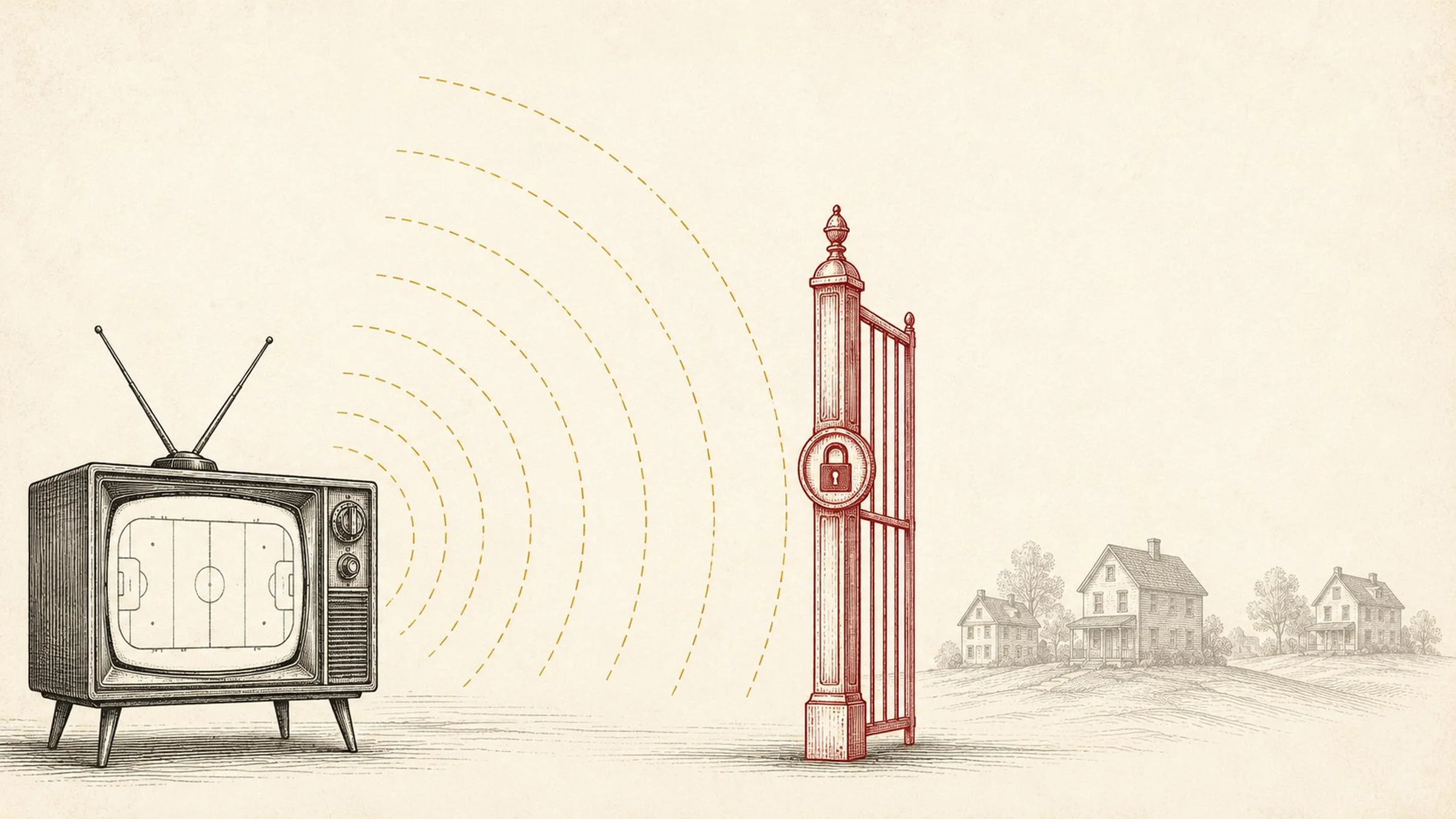
There is nothing in the constitution about free hockey on Saturday night. That observation, already circulating in response to this week's news, is true and almost entirely beside the point. Public goods are not things citizens are owed by law. They are things a society decides to provide because providing them reflects what the society takes itself to be. For nearly 75 years, the most-watched expression of that idea in Canada was a hockey broadcast that cost nothing and asked nothing, reachable by anyone within range of a broadcast signal, regardless of income. That feature of Canadian life ended this week. Not because anyone was entitled to it, and not at the hands of a single villain, but because at no point did the system that governs Canadian broadcasting decide it was worth keeping.
What ended this week
In a joint statement on June 16, 2026, Rogers Sportsnet and CBC announced that the public broadcaster will no longer carry NHL games after the current season, ending a relationship that began when CBC first televised hockey in 1952. [1] The sub-licensing agreement that had kept Hockey Night in Canada on CBC expired at the end of the 2025-26 Stanley Cup playoffs and was not renewed for 2026-27. [2] The statement framed the move as part of a new sports-programming direction for CBC following its Olympic coverage; the two sides were unable to reach a new sub-licensing deal. [1]
The detail that matters most is the one easiest to miss: CBC was not the owner of what it broadcast. Since 2014, the national rights to NHL hockey in Canada have belonged to Rogers, which holds editorial control, sells the advertising, and keeps the revenue; CBC supplied airtime and production resources and, in place of a rights fee, carried a production subsidy and gave up the advertising the broadcast generated. [3] When the arrangement lapsed, CBC had nothing of its own to fall back on, because it had never held the rights to fall back on. The free broadcast existed, for the last twelve years, entirely at the discretion of a private rights-holder that chose to license it back.
How a shared good was steadily enclosed
It was not always this way, and the history matters because it shows that the present arrangement was built, step by step, rather than inevitable. Before 2013, national NHL rights in Canada were split among multiple packages and broadcasters, carried at once across several networks: CBC on Saturday nights, TSN with its own slate, others alongside. [4] The last time the national rights came up before that, in 2006, the package was a six-year, non-exclusive deal worth $569 million. [4] The rights to the national game were distributed rather than concentrated, and the public broadcaster held a meaningful share of them.
In 2013 the model changed. The NHL consolidated its Canadian rights with a single national rights-holder for the first time, and selected Rogers' exclusive bid: a 12-year, $5.2-billion agreement, at the time the largest media-rights deal in league history. [5] CBC submitted a proposal of its own, as did Bell Media. [6] Whether CBC was outmaneuvered or simply declined to match a telecom willing to treat hockey as a strategic asset is, for the purposes of this story, immaterial. What matters is the result: rights that had been spread across several broadcasters, including the public one, became the exclusive property of a single private company. Rather than disappear from CBC entirely, the games stayed on free television through a sub-license Rogers granted back, the public broadcaster reduced from rights-holder to tenant.
This week, the lease ended. Each step in the sequence was defensible on its own terms: the NHL maximized its revenue, Rogers bought an asset, CBC avoided overspending public money, and a sub-license kept the games free for another twelve years. The cumulative effect of those reasonable steps is a commons enclosed — a commons not of ownership, since the games were always league-owned commercial content, but of access: free to all, by custom, and now converted into a holding available for a fee. No single decision did it. The structure did it.
A free good becomes a flat fee: who actually loses access
To replace what the free broadcast provided, a household now needs a paid subscription. Sportsnet's standalone streaming service, Sportsnet+, costs $29.99 a month for its standard tier, or $249.99 a year billed annually, with a premium tier at $42.99 a month for full out-of-market national coverage. [7] Sportsnet's own listings confirm the standard tier carries the national Saturday window; those prices rose in September 2025, in the wake of Rogers signing its new rights deal. [7] [8] Through the 2025-26 season, CBC offered the games free over the air and, for regular-season games, on its Gem streaming service, but only under the Rogers arrangement now ending; playoff games were already excluded from Gem, and CBC's own help materials state that the NHL programming is the exclusive property of Sportsnet. [18] With the rights remaining exclusively Sportsnet's, no free CBC window, broadcast or streaming, has been renewed or announced for 2026-27. The one other national-game arrangement outside Sportsnet, a package of Monday games on Amazon Prime Video, also requires a paid membership. [1]
The question of who loses access is where this stops being an abstraction. The free broadcast was, by definition, the option available without paying for it. By the broadcast regulator's own measure, 29 per cent of Canadian households had cut traditional television entirely by 2024, and only 62 per cent still subscribed to a traditional service. [9] One industry model, Convergence Research's annual Couch Potato Report, puts the share without any cable, satellite, or telco-TV subscription higher still: 46 per cent at the end of 2024, and nearly half a year later. [10] The two figures measure slightly different things, and the gap between them is real; either way, the population that had moved away from paid television, and for whom a free broadcast was the no-cost way to watch, numbers in the millions.
So the national game is not gone. It is sorted. Anyone can still watch, provided they can pay. This is where the change is regressive, in the specific economic sense of the word: the burden falls more heavily, as a share of income, on those with less of it. Free universal access was income-neutral by construction, the same to a household earning $30,000 as to one earning $300,000. A flat fee is not. At $29.99 a month it is an identical dollar figure for both households, which means it claims a far larger share of the smaller income. The point does not depend on who, exactly, watched the free broadcast; it follows from the structure of the change itself. Converting a free universal good into a flat-priced one shifts cost regressively, whoever ends up paying. A subscription that is a rounding error for an affluent household is a real line item for one near the bottom of the distribution. The cost of keeping the national game in the living room did not just appear. It appeared unevenly, and the unevenness tracks income.
A paywall arrives in a hard year for household budgets
The timing sharpens the effect without requiring anyone to have intended it. Canadian households are under a documented affordability strain: by the Royal Bank's account, the prices of essentials including food and housing have each risen roughly 30 per cent since 2020, outpacing wage growth, and the burden falls hardest on lower-income households that spend more of their income on those essentials. [12] The federal government's own spring 2026 update describes its focus as helping Canadians with the affordability of fuel, food, and housing. [13] Into that environment, a cost that used to be zero becomes a recurring bill.
No one timed the end of free hockey to the downturn; the contract simply expired when it expired. Even the NHL's commissioner, announcing the new deal, acknowledged concern about the state of the Canadian economy. [14] The point is not that a private company chose a cruel moment. The point is structural: nothing in the system ensures that access to a shared national event survives a household's budget or a single rights-holder's renewal math, and so when both pressures arrived at once, there was nothing to catch the people caught between them.
The contradiction at the centre of the system
Here is the part that should be hardest to explain. The entire architecture of Canadian broadcasting policy rests on a single premise: that the market, left alone, will not preserve the things Canadians value about their own culture, and so the state will require their preservation. That is what Canadian content rules are. The regulator compels minimum percentages of Canadian music on commercial radio, sets Canadian programming expenditure requirements for television, and maintains an elaborate, decades-old apparatus dedicated to ensuring that Canadian voices are not crowded out by market forces. [15] The premise is explicit and long-standing: some things matter enough that access to them cannot be left entirely to what pays.
A free broadcast of the national winter sport was, for most of its life, the most-watched programming the public broadcasting system carried, reaching a broader slice of the country than any content quota. Yet it is the one thing the system let pass entirely behind a paywall, with no rule and no protection. The reason is not hypocrisy; it is that these are different policy instruments. Canadian content rules address the *supply* of Canadian programming, ensuring it gets made, funded, and seen. What is missing is any parallel instrument addressing *access* to events of national significance. Canada has no anti-siphoning or "listed events" regime, no equivalent to the rules in the United Kingdom or Australia that guarantee free availability of nationally important events. [16] The regulator itself has raised the gap: in a 2025 consultation it noted that some jurisdictions use such measures, warned of "a growing risk that Canadians will lose access" to important events, and asked whether Canada should consider similar rules. [16] Canada has access tools of other kinds, over-the-air stations carried in basic packages, CBC's mandated carriage, but none amounts to a guarantee of free access to nationally significant live events.
This is not the failure of any one official, broadcaster, or government. It is a structural gap: a system designed to keep Canadian programming from being crowded out by the market, which never built a comparable safeguard for free access to the events Canadians most reliably gathered around. The question the regulator is now asking, whether such a safeguard should exist, was answerable before this week. The disappearance of free access was therefore something the system permitted by omission, not a fact of nature.