
The Receipt
On July 12, 2026, Prime Minister Mark Carney told CTV Calgary that Canada was “sharing after Canada is paid back” on the Gordie Howe International Bridge [2]. He described a sequence: Canada would collect revenue, service the bridge’s construction debt, and only then split what remained with the United States for 15 years [2]. On July 16, he was more direct: toll revenue would not be shared “until all debt is repaid” [3].
The agreement in principle, published on the Windsor-Detroit Bridge Authority’s website on July 22, does not contain that sequence. It defines the shared amount as “all revenues collected with respect to the bridge, less all incurred operating costs of the bridge” [1]. The text makes no reference to debt, interest, or principal repayment. U.S. Commerce Secretary Howard Lutnick has publicly stated that the American share comes before debt repayment [4]. Under standard accounting usage, principal repayment is a financing cash flow, and interest is conventionally classified as a financing or borrowing cost rather than an operating cost [13].
Under the 2012 Canada-Michigan Crossing Agreement, bridge revenues remaining after specified project and operating costs were applied toward Canada’s unrecouped contributions [5] [6]. The U.S. side did not receive an equivalent revenue share during the recoupment period. Under the new framework, half of defined net revenue flows from day one into a fund “established and solely controlled by the Government of the United States,” with eligible purposes that both countries must agree on [1]. Canada also accepted a conditional U.S. consent right over certain toll changes [1]. The U.S. federal government provided no construction capital for the project [5] [7]. This is a published agreement in principle; Section 5 states that officials will still develop and finalize the implementing arrangements [1]. Those arrangements have not been published.
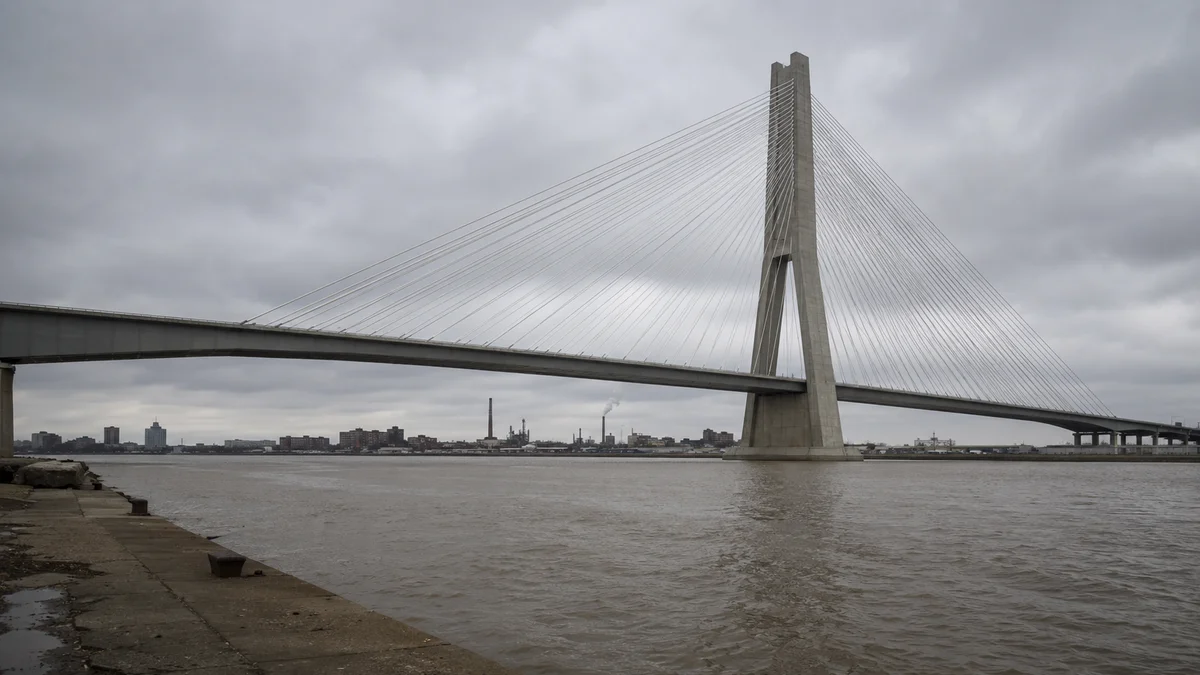
The Gordie Howe International Bridge was substantially complete by late 2025 [9]. When it opens on July 27 [18], it will do so under terms that did not exist when the bridge was designed, financed, or built. What changed was not the bridge. What changed was the price of opening it.
What the Prime Minister Said
Carney addressed the deal terms publicly on at least two occasions. On July 12, at the Calgary Stampede, he told CTV News: “We are sharing after Canada is paid back. We get the revenues. Then the servicing of the costs of the bridge and paying the debt of the bridge, and then what’s left over, there’s a split of that for 15 years” [2]. The sequence was explicit: revenue, then debt repayment, then sharing.
On July 16, during an event in London, Ontario, he stated that toll revenue would not be shared “until all of the debt is repaid” [3]. He then described the shared amount as revenue remaining after operating costs, listing maintenance, snow clearing, and toll booth staffing as examples [3]. He did not explain how both propositions could be true: if the split is calculated after operating costs such as maintenance, the debt has not been subtracted; if the split waits until all debt is repaid, the timeline extends decades beyond what “net revenue after operating costs” implies.
These were specific, public responses to direct questions about the terms of a deal governing a multibillion-dollar public asset. They told Canadians that little or nothing would flow to the U.S. until Canada’s investment had been recovered.
What the Agreement Says
The proposed agreement in principle runs to six numbered sections [1]. Section 1, titled “Economic Participation,” states that Canada will provide annual payments equal to 50 percent of “net bridge and crossing related revenues” for the first 15 fiscal years. It defines that term in the next sentence: “all revenues collected with respect to the bridge, less all incurred operating costs of the bridge” [1].
The text makes no reference to debt, interest payments, or principal repayment. In standard accounting, principal repayment is a financing cash flow, not an operating expense. Interest is conventionally classified as a financing or borrowing cost rather than an operating cost [13]. The 2012 Crossing Agreement itself uses distinct defined categories for project costs, operating and maintenance costs, and Canadian contributions, treating them as separate items in the revenue waterfall [5]. The new agreement’s drafters could have incorporated those categories or referred to unrecouped Canadian contributions. They did not.
Lutnick confirmed the American reading in a public social media post: the U.S. share is calculated before interest and principal [4]. The published text is consistent with that position. It is inconsistent with the sequence Carney described on July 12 and July 16.
Section 4 states that nothing in the agreement amends the 2012 Crossing Agreement [1]. But on the face of the published framework, the new payment obligation diverts half of net operating revenue before Canada can apply it toward recovering construction costs. The 2012 agreement is formally intact. The revenue flowing through it is reduced. Whether the final implementing arrangements alter this apparent effect remains to be seen.
What the Original Deal Protected
The 2012 Canada-Michigan Crossing Agreement was negotiated between Prime Minister Stephen Harper and Michigan Governor Rick Snyder after the Michigan legislature declined to contribute state funding [5] [6]. The privately owned Ambassador Bridge had been the only truck-capable crossing between Windsor and Detroit, and its owner had spent years opposing a publicly owned competitor, including more than $30 million on a failed 2012 Michigan ballot initiative [16].
Canada agreed to provide all construction capital, including land acquisition on the Michigan side and the Interstate 75 interchange [5] [6]. The bridge would be publicly owned, 50/50 by Canada and Michigan. Tolls for both directions would be collected on the Canadian side by the WDBA, a federal Crown corporation. Under the agreement’s payment waterfall, revenues remaining after specified project and operating costs were applied toward Canada’s unrecouped contributions [6]. Michigan did not receive an equivalent revenue share during the recoupment period. Media estimates of the recoupment timeline have ranged widely, and the 2012 agreement sets no fixed repayment date [8] [14].
The U.S. federal government was not a party to the Crossing Agreement and provided no construction capital [5] [7]. It remains responsible for its own federal border operations and staffing at the U.S. port of entry.
What Canada Conceded
On the face of the published framework, the new agreement created three concessions not present in the 2012 deal.
The first is revenue sharing. For the first 15 fiscal years, 50 percent of defined net bridge revenue will flow to a United States-Canada Economic Development Fund [1]. The fund is “established and solely controlled by the Government of the United States,” but its eligible purposes must be agreed upon by both countries and directed toward “the benefit of the United States and trade between Canada and the United States” [1]. Under the original deal, the U.S. side received no equivalent revenue share during recoupment. The P3 concession with Bridging North America runs 36 years [21]. The 15-year revenue-sharing period covers nearly half that contractual span.
The second is a conditional U.S. consent right over toll-setting. The WDBA must seek U.S. consent for any toll increase exceeding 10 percent within a fiscal year that would result in rates above the average of comparable regional crossings, and for any toll reduction that would bring rates below that average [1]. If the U.S. does not respond within 30 days, consent is deemed to have been given [1]. That 30-day deadline is a meaningful constraint on delay: it converts an open-ended approval process into a time-limited objection window. Under the 2012 agreement, no equivalent U.S. federal consent right existed during the recoupment period.
The third is a pricing floor and ceiling tied to comparable regional crossings. The agreement does not define which crossings or vehicle classes constitute the comparator set [1]. Depending on the methodology, the provision could constrain the WDBA’s ability to underprice the Ambassador Bridge, but it could also function as a broader anti-distortion measure across multiple crossings including the Detroit-Windsor Tunnel and the Blue Water Bridge at Port Huron. Until the comparator methodology is public, the provision’s practical scope is uncertain.
Why Canada’s Position Was Exposed
The 2012 Crossing Agreement was between Canada and the State of Michigan [5]. The U.S. federal government was not a signatory. It undertook multiple enabling actions over the following decade, including federal environmental review and, in February 2026, port-of-entry designation [17]. But the agreement contained no enforceable federal commitment to operationalize the crossing by a specified date. Port-of-entry designation was an administrative classification; the U.S. Customs and Border Protection stated separately that it would notify the public when the crossing became fully operational [17].
Whatever the ultimate legal limits on presidential authority, U.S. federal agencies retained practical control over port-of-entry activation, staffing, and the commencement of border processing. On February 9, 2026, President Trump posted that he would not allow the bridge to open until the United States was “fully compensated” [10]. A ribbon-cutting scheduled for June 12 was cancelled the day before, with the WDBA citing the need to “resolve any outstanding issues” [11]. Carney said the delay was at the request of the United States [12].
Canada bore the bridge’s direct financing and asset-carrying cost during the delay. As of March 31, 2025, the WDBA’s own audited annual report recorded $6,331.4 million in unrecouped Canadian contributions [20]. The bridge had not yet collected a dollar in toll revenue [9]. The United States had not supplied construction capital. Businesses and travellers on both sides bore economic costs from the crossing remaining closed [15]. But the financial exposure was asymmetric: Canada had committed billions in capital that sat unproductive, while the U.S. had committed none.
The Strongest Case for the Deal
The argument for accepting these terms is not trivial and deserves its full weight.
The Gordie Howe Bridge is not primarily a revenue-generating asset for the Canadian government. It is trade infrastructure. The Windsor-Detroit corridor is the busiest commercial land border crossing in North America [19]. Before this bridge, commercial truck traffic was limited to the Ambassador Bridge, a nearly century-old private crossing without direct highway access, and the Detroit-Windsor Tunnel, which does not permit large trucks. Auto parts cross the border multiple times during vehicle assembly, making a modern second crossing operationally significant regardless of its financial terms [15].
An analyst at Carleton University argued that Canada could not afford to let the bridge become a “stranded asset” during active CUSMA renegotiation [15]. A multibillion-dollar investment generating no revenue and no trade capacity was a worse position than the same investment generating half its defined net revenue and full trade capacity.
The concessions are also time-limited. The revenue-sharing and toll-governance provisions both expire after 15 fiscal years [1]. They are temporary economic participation rights, not permanent amendments to the 2012 framework or to ownership.
The deal also delivered something the 2012 agreement lacked. Section 6 of the agreement in principle commits both parties to “direct their respective officials, agencies and authorities to undertake all actions necessary to open” the bridge by July 27 [1]. That is a written federal opening commitment. The value Canada received was not merely the absence of continued obstruction; it obtained an operational commitment that previously did not exist in any binding instrument.
The economic development fund, while U.S.-controlled, must be directed toward purposes both countries agree on, including trade between Canada and the United States [1]. Investments in feeder roads, customs technology, inspection capacity, or logistics facilities serving the corridor could benefit Canadian exporters directly. And a U.S. government with a financial stake in bridge revenue has a structural incentive to maximize throughput rather than restrict it.
In our assessment, the financial cost of the concession may prove modest if operating costs consume most revenue during the debt-repayment period. The governance concessions are structural, but they are bounded by time, scope, and the 30-day deemed-consent mechanism. The question the deal does not answer is whether the Prime Minister needed to describe its terms to Canadians differently than the published text shows.
What Would Change This Assessment
This article’s central finding is testable against documents that have not yet been published. Section 5 of the agreement states that officials will finalize the implementing arrangements [1]. Three developments could weaken or change the finding.
- If the implementing arrangements define “incurred operating costs” to include interest and principal repayment on the construction financing, the net revenue available for sharing drops substantially, potentially to nothing during the repayment period. The Prime Minister’s characterization would retroactively align with the implemented terms, even though the published agreement in principle does not support it as written.
- If the governance of the economic development fund is structured to include meaningful Canadian representation in disbursement decisions, or if the fund’s investments demonstrably benefit Canadian trade infrastructure serving the corridor, the “solely controlled by the Government of the United States” language may prove narrower in practice than it reads.
- If the 2012 Crossing Agreement or any related instrument contains an unreported federal government commitment to operationalize the crossing by a specific date, the analysis that the agreement lacked an enforceable federal opening deadline would need revision.