
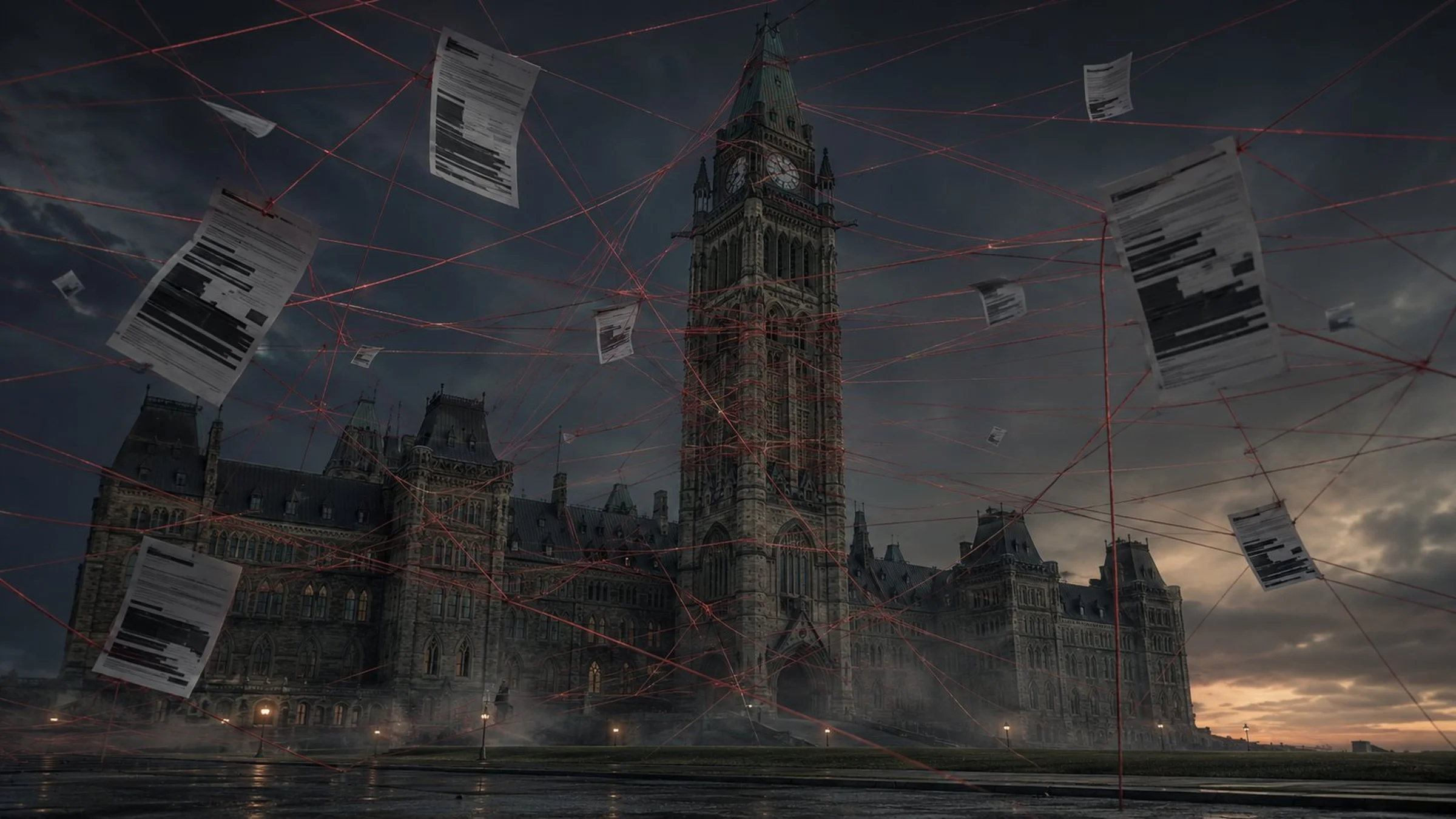
1. The Warning Chain
Start with the record. Between January 2025 and May 2026, six major documents examined the question of Chinese interference in Canada. Hogue, CSIS, NSICOP, and independent researchers all point in the same direction: PRC interference is persistent, sophisticated, and the most active foreign-interference threat Canada faces.
The chain begins with Justice Marie-Josée Hogue's final report, delivered January 28, 2025, after sixteen months of testimony from more than 150 witnesses. Hogue found that China was the "most active perpetrator of foreign interference targeting Canadian democratic institutions." She concluded that foreign interference "tainted" the 2019 and 2021 federal elections and called transnational repression a "genuine scourge," writing that what she had learned was "sufficient for me to sound the alarm." [1]
Six months earlier, NSICOP had already laid the structural foundation. Its June 2024 special report identified 11 current and former parliamentarians and 13 ministers, ministerial staff, and public office holders as targets or participants in foreign interference activities. More importantly, it diagnosed the institutional failure: four "significant unaddressed challenges" that "help to perpetuate a permissive environment for foreign actors to operate." NSICOP first identified those challenges in 2019. By 2024, they remained unresolved. [2]
CSIS picked up the thread across three consecutive publications. The 2024 Public Report named the PRC an "enduring threat" and disclosed Five Eyes findings on Volt Typhoon, a PRC cyber campaign pre-positioning in North American critical infrastructure. [3] The July 2025 landscape document went further: the PRC is "the most active state conducting FI activities in Canada, in scale and scope," its objectives include exerting "control over Chinese Canadian communities" and pushing politicians "toward adopting pro-PRC positions and policies that run counter to Canada's national interests," and it "almost certainly views PRC FI activities as low-risk, high-reward endeavours." [5] The 2025 Public Report, tabled in Parliament in early May 2026, documented the evolution of PRC tradecraft: mass-recruitment through fake job advertisements posted by front companies on mainstream employment sites, a "broad-net approach" that "permits engagement with far more people, many unknowingly." [4]
The independent sector confirmed the pattern. The Montreal Institute for Global Security released two reports in quick succession. The first, in February 2026, called transnational repression "one of the most serious yet least understood threats to security and democracy in Canada" and warned that Canada had "underestimated the scale and sophistication" of the threat. [8] The second, "Guarding the G7," was released from the floor of Parliament Hill on May 28, 2026. It described Chinese interference as "systemic," documented operations across electoral processes, elite networks, academia, media ecosystems, and diaspora communities, and called Canada a "permissive environment" for PRC interference due to "institutional weaknesses and political hesitation." [7]
Co-author Marie Lamensch described the nature of the threat at the press conference: it resembles the ancient Chinese strategy game wei qi. It takes space over a long time. It is adaptive. And the government takes its time responding.
So what does this mean? Six documents from four institutions, spanning eighteen months, with access to classified and open-source intelligence. All reached the same conclusion. There is no dissenting assessment in the public record.
2. The Opposite Direction
On January 16, 2026, Prime Minister Mark Carney met with President Xi Jinping in Beijing and forged a strategic partnership across five pillars: energy, economic and trade cooperation, public safety and security, multilateralism, and culture. A preliminary tariff deal lowered Chinese duties on Canadian canola seed from approximately 85% to 15% and opened the Canadian market to 49,000 Chinese electric vehicles. Canada committed to increasing exports to China by 50% by 2030. [9] [10]
Carney described it as "value-based realism." During the April 2025 federal election campaign, he had identified China as Canada's biggest security threat.
Bundled into the strategic partnership was a policing agreement between the RCMP and China's Ministry of Public Security. The government framed the MOU around cooperation on corruption, transnational crime, telecom and cyber fraud, and synthetic drugs. The agreement covers exchange of information, investigative assistance, training, and coordination with other domestic law enforcement. The text has never been made public. The RCMP says releasing it requires Chinese consent. When pressed by CBC, Carney called this "standard practice." [11]
The MPS is the same Chinese security ministry that CSIS has linked to coercive return efforts and threats against family members in China. CSIS's 2024 report specifically named the MPS among agencies whose foreign interference "can include coercing a victim to return to the PRC or threatening their family members in China." [3]
Five months later, on May 28, 2026, Chinese Foreign Minister Wang Yi arrived in Ottawa for the first visit by a Chinese foreign minister in over a decade. Foreign Affairs Minister Anita Anand committed Canada to serving as "country of honour" at the China International Import Expo and to holding at least annual foreign-ministerial meetings. [12]
The visit took place one day after MIGS released its report calling Chinese interference in Canada "systemic" from the floor of Parliament Hill.
3. What the Majcher Trial Revealed
On May 13, 2026, B.C. Supreme Court Justice Martha Devlin acquitted former RCMP Inspector William Majcher on a single charge under the Security of Information Act. The Crown alleged Majcher had prepared materials to compel a Vancouver real-estate investor to return to China. Justice Devlin found the case "entirely circumstantial" and insufficient to meet the criminal standard. [15]
The acquittal matters for two reasons. First, it was the only foreign interference prosecution Canada has brought in connection with Chinese operations. It failed. Second, the trial's collateral disclosures put far more on the public record than the original charge ever could.
Court documents filed during the proceedings revealed that at least 25 Canadian residents had been targeted by Chinese police under Operations Fox Hunt and Sky Net, some facing life imprisonment or death sentences if forcibly returned. [16]
Testimony from RCMP Superintendent Peter Tsui, a former liaison officer at the Canadian Embassy in Beijing, described a 2018 incident in which three of fourteen visiting MPS officers went "missing" for six hours during an RCMP-escorted visit to Vancouver. The RCMP's concern at the time was that the officers "could be trying to illegally repatriate someone." [15]
The case of Xie Weidong, a Chinese government critic living in Canada, also entered the record: the MPS imprisoned his sister, kidnapped his son from an underground garage in China, and sent agents to Toronto to threaten and harass him. [16]
These are not anonymous allegations. They appeared in court documents and sworn testimony in a Canadian criminal proceeding, alongside evidence from a senior RCMP officer. They describe operations by the same ministry that Ottawa concluded an unreleased policing agreement with seven months earlier.
4. The Missing Safeguard
Parliament passed Bill C-70 on June 20, 2024, creating the Foreign Influence Transparency and Accountability Act. The legislation established a registry, a commissioner's office, and administrative penalties up to $1 million for non-compliance. The original goal was to have it operational by October 2025, in time for the next federal election. [6]
It is now June 2026 and the registry does not exist.
The timeline of delays is documented in Parliament's own records. The dissolution of Parliament on March 23, 2025 pushed the first target. A Public Safety Canada question-period note from June 2025 acknowledged the miss and cited the need for a "reassessment of timelines." [13] Draft regulations were published in the Canada Gazette on January 2, 2026. [14] Anton Boegman, former Chief Electoral Officer of British Columbia, was named as the proposed commissioner on March 13, 2026, following approval by both Houses. [17]
At his PROC committee appearance on February 26, Conservative MP Michael Cooper pressed on the slipping schedule. Parliamentary records show the government faced repeated questioning over shifting expectations — June 2025, December 2025, spring 2026 — none of which have been met. [18] As of this writing, the most recent public estimate is "as early as the summer." The delay is partly explained by genuine complexity: legal design, IT build, privacy consultation, and concerns raised by the Canadian Bar Association about solicitor-client privilege in the draft regulations. But implementation difficulty and political will are not the same thing, and the result is the same: two years after Royal Assent, the safeguard does not exist.
Boegman told the committee: "Canada's institutions and interests are increasingly under threat from foreign interference. Malign foreign actors seek to exert influence through covert means to shape public policy, to change public opinion or to interfere with our democratic processes." [18]
He is not wrong. But the office he was appointed to lead remains unfunded, unstaffed, and unoperational. The $25.9 million in projected costs over ten years has been allocated in draft regulations, but the IT system to support the registry is not built. The enforcement apparatus does not yet exist. [14]
5. What Canada's Allies Did Instead
Canada is not operating in isolation. Its Five Eyes partners have faced the same threat. The difference is in how they responded.
Australia is the clearest comparison. In 2024, after ABC's Four Corners program revealed that the Australian Federal Police had permitted Chinese MPS officers to interview targets on Australian soil between 2015 and 2019, the AFP terminated its policing arrangement with the MPS. Senate hearings revealed that at least six Australian residents had been interviewed by Chinese police under the agreement, five returned to China "voluntarily," and AFP oversight was found to be "negligent or even absent." A separate arrangement with China's National Supervision Commission was also allowed to lapse. Australia's Foreign Influence Transparency Scheme has been operational since December 2018. [19]
The United Kingdom legislated its National Security Act in July 2023. The Foreign Influence Registration Scheme came into force on July 1, 2025, roughly two years after Royal Assent. [20] Canada's Bill C-70 received Royal Assent on June 20, 2024. Two years later, no registry.
The United States has maintained its Foreign Agents Registration Act since 1938. The FBI continues to publicly attribute PRC-linked cyber campaigns, including Volt Typhoon (pre-positioning in critical infrastructure) and Salt Typhoon (telecoms compromise). In January 2025, the U.S. Treasury sanctioned Chinese cyber actors directly linked to those campaigns. [3]
What makes the Canadian posture distinct is not the pace of implementation alone. The UK also took two years. What is distinct is that Canada's registry remains non-operational while the government simultaneously deepens institutional engagement with Beijing, including an unreleased policing MOU with the ministry identified as conducting the interference. That combination is unusual among Five Eyes partners.