
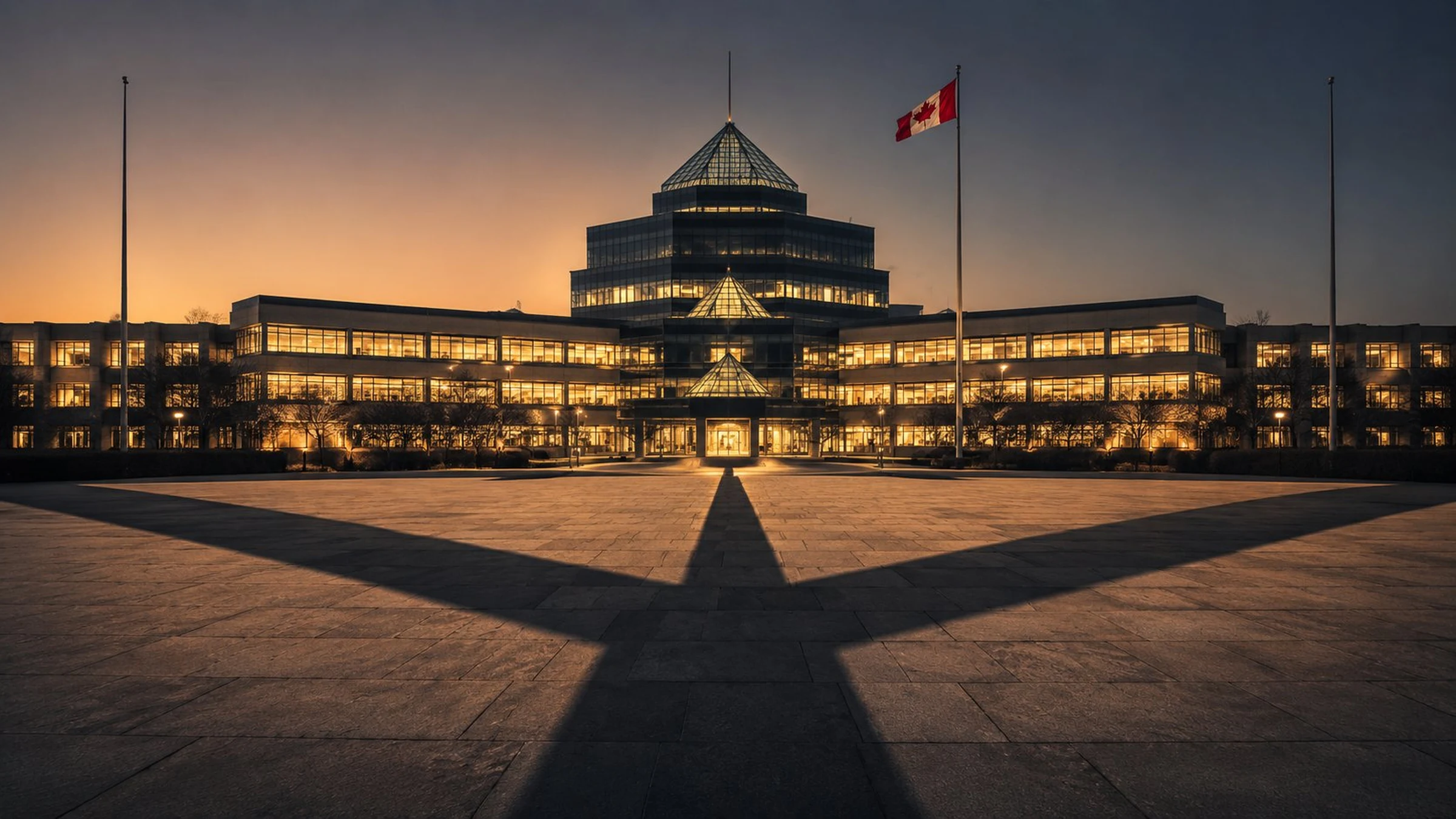
The Inflation Jaw: From the Strait of Hormuz to the Grocery Aisle
The transmission chain from geopolitical conflict to Canadian consumer prices runs through a well-documented sequence. The Iran conflict, which escalated in late February 2026, disrupted roughly 20% of global oil supply through the Strait of Hormuz. [8] Brent crude surged more than 55% from pre-conflict levels, reaching nearly $120 per barrel at its peak before settling above $100 in late April. [9]
For Canadian consumers, the impact was immediate. Statistics Canada recorded the largest monthly gasoline price increase on record in its March CPI release, pushing headline inflation from 1.8% to 2.4% in a single month. [3] The Bank of Canada projects that April CPI will reach approximately 3%, which would place it at the upper bound of the BoC's 1-3% control range. [1]
The question facing Governing Council is whether energy prices are passing through into broader inflation. So far, Macklem has maintained that there is "little evidence" of broader pass-through. [10] But the warning signs are accumulating. Wage growth remains at 4.5%, meaning inflation expectations are being baked into compensation demands before any secondary pass-through has been measured. [11] The US Producer Price Index for April posted its fastest pace since 2022, and US CPI reached 3.8%, both of which foreshadow Canadian import-price pressure. [12]
The BoC's baseline forecast assumes Brent crude will gradually decline from US$90 per barrel in Q2 to US$75 by mid-2027, based on oil futures curves. [5] If that assumption holds, the "look-through" strategy works: the central bank absorbs a temporary energy shock without tightening into a weak economy. If it doesn't, the April MPR acknowledged that "monetary policy will have more work to do." [2]
The Growth Jaw: Tariffs, Exports, and a Deteriorating Labour Market
On the other side of the trap, the Canadian economy is growing at 1.2%, barely above stall speed. [1] The labour market is deteriorating. Unemployment rose to 6.9% in April, above expectations of 6.7%. [11] The private sector has shed approximately 112,000 jobs since January 2026, and losses have been concentrated almost entirely in full-time work, which has fallen by 111,000 since the start of the year. [17]
Youth unemployment reached 14.3% in April, well above the pre-pandemic average of 10.8%. [11] The BoC's own characterization of the labour market is that weak hiring is "balanced only by slow labour supply growth," a fragile equilibrium that requires no additional shock to tip. [2]
That additional shock may already have a deadline. The CUSMA joint review formally begins July 1, 2026. [7] USTR Jamieson Greer told congressional committees that the agreement's "shortcomings are such that a rubberstamp of the Agreement is not in the national interest." US Commerce Secretary Howard Lutnick has floated replacing USMCA with separate bilateral deals. [7] The Bank of Canada modelled what happens if CUSMA exemptions are removed in its January 2026 MPR: a deep recession. [6]
So what does this mean for the rate decision? A central bank facing a potential recession cannot hike rates. A central bank facing accelerating inflation cannot cut. The BoC's Governing Council is aware of this: Macklem stated on April 29 that if the United States imposes "significant new trade restrictions on Canada, we may need to cut the policy rate further to support economic growth." [2] He made this statement in the same press conference where he warned of consecutive rate hikes if energy inflation persists.
The Mortgage Wall: 1.3 Million Renewals in the Crossfire
The third constraint on BoC action is not a macroeconomic indicator but a household-level exposure. OSFI's Annual Risk Outlook 2026-2027 identifies 1.3 million higher-risk mortgages renewing for the first time since origination during the low-rate period, with the condo segment already at levels of distress not seen since the early 1990s. [4]
The mechanism works in both directions. Variable-rate mortgage holders feel rate hikes immediately through higher monthly payments. Fixed-rate mortgage holders face repricing at renewal, and the benchmark for fixed-rate pricing is the Canada 5-year government bond yield, which has risen to approximately 3.2% as US inflation data and elevated oil prices push yields higher. [5]
A rate hike accelerates the stress on the segment of the population least able to absorb it. But the alternative, cutting rates to relieve mortgage pressure, risks validating inflation expectations that are already being embedded in 4.5% wage settlements. Neither path is costless, and the mortgage wall ensures that both paths have direct, measurable consequences for millions of Canadian households.
The Fiscal Accelerant: Ottawa Loosens While the BoC Holds
The dimension that transforms a difficult policy decision into a structural trap is the federal government's fiscal stance. The Spring Economic Update 2026 projects a 2025-26 federal deficit of $67 billion, down from $78 billion in Budget 2025 but still elevated by any historical standard. [14] Combined federal-provincial deficits are projected at $102 billion, or 3.1% of GDP. [14] Every province is running a deficit simultaneously, a pattern not seen outside of recessions since the early 1990s. [16]
Oxford Economics estimates that the fiscal impulse in 2026 exceeds 2% of GDP, the largest since 1980 outside of the COVID-19 pandemic. [16] Budget 2025, titled "Canada Strong," committed $280 billion in spending over five years, including $30 billion for defence, $115 billion for infrastructure, and $25 billion for housing. [15] The Spring Economic Update then allocated more than 90% of a $60-billion fiscal dividend to current operations rather than capital investment or deficit reduction. [14]
This creates a direct tension with monetary policy. Deficit-financed spending adds demand to an economy where prices are already rising. The BoC is trying to hold the line on inflation while Ottawa is injecting stimulus that works against that objective. If the BoC hikes to contain the combined demand pressure, it tightens into an economy that is already shedding private-sector jobs. If it holds, the fiscal impulse risks feeding the pass-through from energy prices to core inflation that Macklem has said would require "more work" from monetary policy.
And the spending is not reaching the sectors that are bleeding. The private sector has lost 112,000 jobs since January 2026, concentrated in goods-producing industries. [17] Public sector employment, which masked private-sector weakness for years, is now itself contracting, with approximately 8,700 public-sector jobs lost in the first four months of 2026. [17] The fiscal impulse is large, but its composition does not align with the areas of the economy under the most acute stress.
The Net Exporter Illusion: National Income vs. the Kitchen Table
Canada is a major net oil exporter, and this creates a statistical illusion the BoC itself has acknowledged. The April MPR states that higher oil prices increase national income even as they squeeze consumers. [1] Energy export revenues rise, headline GDP stabilizes or improves, and the national accounts tell a story of resilience. The Spring Economic Update's own sensitivity analysis echoes this: a persistent 10% increase in oil prices raises nominal GDP by about 0.5% per year but only 0.1% for real GDP. [14]
The kitchen table tells a different story. Gasoline prices are up. Transportation surcharges are flowing through to food costs. Heating costs are rising. The household that doesn't own oil sands equity is absorbing the full cost of the energy shock without participating in the revenue side. The same event, an oil price surge, lifts the national aggregate while compressing household purchasing power for the majority of consumers who are net energy buyers.
This divergence matters for monetary policy because the BoC's mandate is price stability, not GDP optimization. This is not an argument that higher oil prices are bad for Canada in aggregate; energy exports support employment, investment, and government revenues in producing provinces. The point is that the distributional effect complicates the BoC's read of the economy. If national income looks healthy while household inflation expectations are rising, the headline GDP number provides false reassurance.
The Global Context: Same Trap, Different Variables
The Bank of Canada is not alone in this position. The US Federal Reserve faces an analogous constraint. The US 10-year Treasury yield sits at 4.49%, with the 30-year breaching 5% for the first time since 2007. [13] US CPI reached 3.8% in April. Nonfarm payrolls added only 115,000 jobs in April, with unemployment at 4.3%, and February payrolls were revised sharply lower to -156,000. [12] Markets have priced out all 2026 Fed rate cuts and are now pricing a probability of a hike. Recently confirmed Fed Chair Kevin Warsh inherits a policy environment where the inflation mandate and the employment mandate are pulling in opposite directions.
This is not a Canadian aberration. The Iran conflict has created a global energy shock that traps commodity-importing central banks between inflation and recession, while commodity exporters like Canada face the additional complication of headline GDP resilience masking household-level stress.
What Markets Are Pricing
The market consensus as of mid-May 2026 treats the next BoC decision on June 10 as a hold. The divergence begins in October. Interest rate swap markets, as reported by Bloomberg, are pricing two to three quarter-point hikes by year-end, starting in the fall. [5] Money markets separately price one 25-basis-point hike for October. [10]
Not all forecasters agree. TD Economics expects the BoC to hold for the duration of 2026, consistent with a Reuters poll of economists that sees downside growth risks offsetting inflation pressures. [10] The split in market expectations reflects the genuine uncertainty the BoC itself has communicated: if oil declines as futures assume, a hold is defensible; if oil stays above $100 and pass-through accelerates, hikes become unavoidable.