
The Ledger
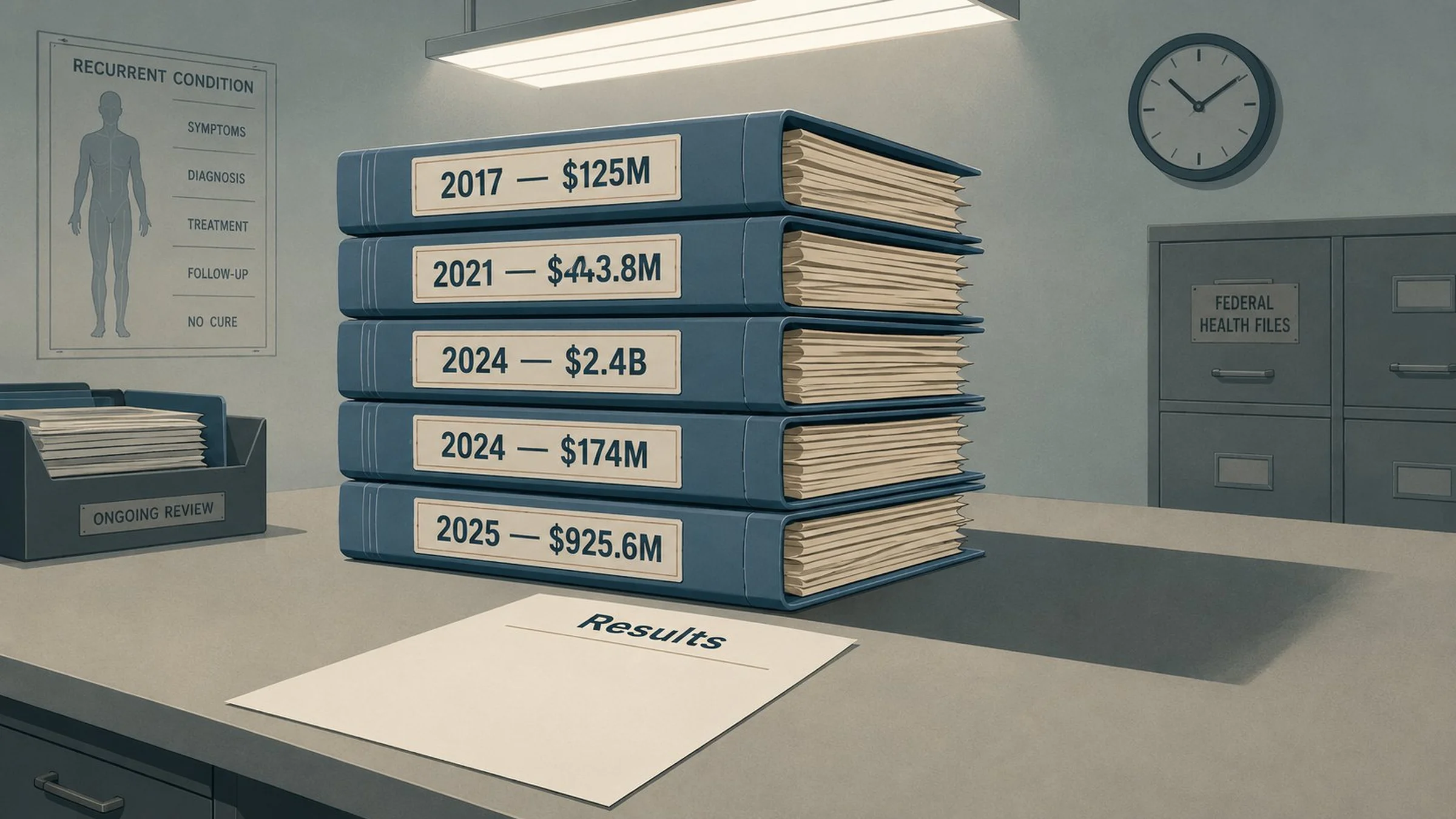
The federal government's AI spending began modestly. Budget 2017 allocated $125 million to CIFAR for the Pan-Canadian AI Strategy, a named-recipient transfer program designed to retain top academic talent at three national AI institutes: the Vector Institute in Toronto, Mila in Montreal, and Amii in Edmonton. The stated problem was specific: Canadian deep learning researchers were being recruited away by Google, Facebook, and other foreign firms. The money was a talent retention play. [1]
Four years later, Budget 2021 added $443.8 million for a second phase. The problem had shifted. The research base was now stronger, but Canadian AI ideas were not being "commercialized here at home," as the strategy framing put it. The new money went to ISED, the Global Innovation Clusters, the Standards Council of Canada, and additional institute funding. Adoption and commercialization became explicit objectives for the first time. [2]
Budget 2024 marked a step change. The government committed $2.4 billion in a single package, the largest AI investment in Canadian history. The diagnosis had expanded again: most compute capacity was located outside Canada, creating dependency and security risks. Low business adoption persisted. SMEs lacked tools. Workers needed transition support. The money went to a new AI Compute Access Fund, a Sovereign AI Compute Strategy, regional development agencies for adoption, NRC AI Assist for SMEs, and a new AI Safety Institute. [3]
The Fall Economic Statement in December 2024 broke the compute envelope into sub-programs and added $174 million for commercialization extensions through the Global Innovation Clusters and national AI institutes. [4] Budget 2025 then layered on $925.6 million for large-scale sovereign public AI infrastructure, though $800 million of that headline figure was sourced from funds already provisioned in the fiscal framework, making the net-new increment approximately $125.6 million. [5]
On June 4, 2026, the Prime Minister launched "AI for All," committing a further $2.3 billion over five years. The strategy includes a $500 million LIFT financing program for scaling AI companies, a $500 million Canadian Tech Growth Fund, a $500 million expansion of the Regional AI Initiative, $700 million in additional funding for the AI Compute Access Fund, a $200 million health AI mission, and $130 million for commercialization across the national AI institutes. The headline targets are 60 per cent business adoption by 2034, up to 250,000 new AI-related jobs by 2031, and nearly $200 billion in GDP gains. [6]
The cumulative announced commitments now exceed $5.5 billion in federal AI funding over nine years, counting Budget 2025 on a net-new basis where the budget identifies prior provisioning. Because some later announcements extend or repackage earlier compute envelopes, the total should be read as an announced-commitment ledger, not a disbursement total. The question the public record does not answer is what that money has produced.
This ledger is federal only. It does not include provincial spending, university contributions, private co-investment, or institute-level partner funding. Those layers matter to the broader ecosystem, but they also strengthen rather than weaken the accountability question: Canada's real AI portfolio is larger than the federal ledger alone, while public outcome reporting remains fragmented across jurisdictions and delivery partners.
The Diagnosis on Repeat
If each funding round had been designed to solve a distinct, new problem, the escalation in spending might tell a straightforward story of a government adapting to a fast-moving field. The documented record tells a more complicated story. The same structural problems appear, often in nearly identical language, across multiple rounds.
In 2017, Budget documents said Canadian discoveries "often find greater success — and create jobs — in other countries" and that firms felt they "must relocate to grow." [1] In 2021, the second phase said it would ensure Canadian ideas are "mobilized and commercialized here at home." [2] In 2024, Budget documents funded regional agencies to "accelerate AI adoption" and NRC AI Assist to help SMEs "increase productivity." [3] In June 2026, the AI for All release opened by acknowledging that Canada is "among the slowest countries to adopt AI at scale." [6]
The commercialization and capital-retention problem appears in every major round. The adoption problem appears in every round from 2021 onward. Compute dependence, identified as a risk in 2024, remains the centre of gravity in 2026. The pattern is visible in the government's own stated justifications across six funding announcements and nine years of budget documents and official strategy releases.
This does not, by itself, prove that earlier programs failed. AI is a general-purpose technology, and policy may legitimately need to move through stages: research capacity first, then commercialization infrastructure, then adoption at scale, then compute sovereignty as the technology's resource demands changed. The recurrence of a problem is not automatic evidence of program failure. It is, however, evidence that the government needs a stronger public scorecard before escalating commitments further.
The Scorecard That Doesn't Exist
Program-by-program, there are measurable outputs in the public record. The first phase of the Pan-Canadian AI Strategy has the strongest documentation. By 2020, CIFAR reported 80 Canada CIFAR AI Chairs, with more than half recruited to Canada; over 1,200 graduate students and postdoctoral fellows trained; 45 new AI R&D labs established by multinationals; and $658 million in venture capital to Canadian AI startups in 2019, up 49 per cent year over year. An Accenture-led impact assessment added that active AI startups exceeded 620 in 2019 and 34 had been acquired. [11]
These are real ecosystem outputs. They show that the strategy coincided with stronger talent attraction, startup formation, and private investment. They do not, however, constitute hard program-attribution evidence, and they did not prevent the downstream commercialization and adoption gaps from persisting. Ottawa's decision to fund a second phase centred on commercialization is itself evidence that phase one did not close those gaps.
Phase two reporting is more fragmented but not empty. CIFAR's 2023–24 data shows 129 active AI Chairs, 310 trainees graduating annually, and 357 active research partnerships with industry. [13] The Global Innovation Clusters report 94 announced projects, $372 million co-invested by industry, and 427 project partners as of December 2025. [14] These are credible outputs. They are not the same thing as a target-versus-result ledger for the full $443.8 million strategy.
The compute-era programs are less mature in their reporting. The AI Compute Access Fund has announced support for 44 Canadian companies, representing $66 million of the $300 million fund. [7] The program received what ISED described as "numerous applications," but the total application count, the acceptance rate, and any portfolio-level outcomes data remain unpublished. The flagship sovereign compute infrastructure build was still in procurement by June 2026. The government announced exploratory work with TELUS on a large-scale sovereign AI data centre, but the official release explicitly said no funding had been committed or distributed.
Several programs worth hundreds of millions have no published outcomes data in the reviewed public record. The $200 million Regional Artificial Intelligence Initiative, the $100 million NRC AI Assist Program, the $50 million AI Safety Institute, and the $50 million for worker transition supports do not appear to have consolidated public outcomes dashboards. [3]
No dedicated Auditor General performance audit focused on federal AI spending programs was identified in reviewed public records. [12] Broader innovation or ISED program audits may touch on AI spending indirectly, but the strongest assurance mechanisms identified are routine Treasury Board transfer-payment controls and departmental evaluations. ISED's supplementary information tables indicate a Pan-Canadian AI Strategy 2.0 evaluation was planned for 2025–26, with the last completed evaluation in 2022–23. [12]
Outputs are reported program by program. What is missing is a consolidated public scorecard that reconciles commitments, disbursements, targets, outputs, outcomes, and lapses across the full federal AI portfolio. If a parliamentarian or journalist wants the full ledger, they still have to stitch it together from budgets, program pages, departmental plans, grants portal entries, and recipient reports.
The Target Without a Mechanism
The AI for All strategy sets the most ambitious quantitative target in Canadian AI policy: raise business adoption from just over 12 per cent to 60 per cent by 2034. [6] That is a fivefold increase over eight years. The strategy also projects nearly $200 billion in additional economic growth and up to 250,000 new AI-related jobs by 2031.
What the strategy does not specify is how those targets will be measured against milestones, what happens if they are not met, or what the interim checkpoints are. There is no published measurement framework, no interim target for 2028 or 2030, and no consequence mechanism if adoption remains flat.
The adoption data cuts both ways. Statistics Canada data shows 12.2 per cent of Canadian firms used AI to produce goods or deliver services in 2025, doubling from 6.1 per cent the prior year. [8] That doubling is real progress and may reflect accelerating diffusion as tools become cheaper and more accessible. But it also leaves nearly seven in eight firms outside operational AI use, with adoption concentrated in a few sectors: information and culture, professional services, and finance. That makes the 60 per cent target plausible only if the next phase moves beyond pilots and professional-services use cases into broad SME deployment across sectors where adoption is currently negligible.
A KPMG survey of 753 Canadian business leaders found that only two per cent of organizations reported seeing a return on their generative AI investments. [9] A Bank of Canada staff paper published in June 2026 found that while personal use of AI among business leaders is widespread, adoption for actual production purposes remains limited, and firms anticipate modest net negative impacts on employment over the next three years. [15]
Canada's relative position has also been declining. The C.D. Howe Institute documented that Canada's Global AI Index ranking fell from 4th in 2021 to 8th in 2025, and its Government AI Readiness ranking fell from 5th in 2022 to 12th in 2025. The same report noted that Canada's absolute scores improved in some categories, but improvements did not keep pace with international peers. [10]
The gap between the 60 per cent target and the documented starting conditions is the distance between ambition and accountability. Without a measurement framework, there is no way to determine whether the next $2.3 billion is producing results until it is time to announce the round after that.
The Underlying Condition
There is a structural question that the AI for All strategy does not engage with directly: whether Canada's AI adoption gap is only an AI-specific problem, or whether it is also a symptom of a broader investment and competitiveness crisis that AI-targeted spending alone cannot address.
There are legitimate AI-specific barriers. Compute cost, data governance uncertainty, privacy regulation gaps, skills shortages, procurement friction, and the difficulty of adapting general-purpose AI tools to sector-specific use cases are all real obstacles that AI-targeted programs can address. The AI for All strategy itself identifies cost, expertise, and uncertainty as the primary barriers businesses cite. [6]
But the broader investment picture suggests those AI-specific barriers sit on top of a structural underinvestment problem. Canadian business investment per available worker has been falling relative to peers for a decade. By Q2 2025, Canadian businesses invested 37 cents in new capital for every dollar invested per worker by American businesses, down from 60 cents in the 2000s and around 40 cents over the previous decade. [16] That is not an AI-specific metric. It is a measure of the entire business economy's willingness to equip workers with better tools, and it is moving in the wrong direction.
The venture capital picture adds another dimension. The BDC's own 2026 VC Landscape report found that while venture investment remained resilient at $8 billion in 2025, capital is concentrated in fewer, larger deals and later-stage growth remains heavily exposed to foreign decision-making. BDC's executive vice president framed this explicitly: the reliance on foreign capital to scale Canadian companies "is no longer just a feature of the market" and "has implications for Canada's ability to retain ownership, decision-making, and long-term value." [17]
Analysis of fund-level returns argues that the median Canadian venture fund has produced multiples of invested capital between 1.2x and 1.4x over the past quarter century, which would place them in the bottom quartile by US standards. [18] If accurate, the problem is not just that there is less capital available in Canada. It is that the capital that does exist generates lower returns, which discourages further private investment and increases dependence on government programs to fill the gap.
Meanwhile, analysis of cross-border talent flows points to high marginal tax rates and lower income thresholds relative to the US as creating competitiveness concerns for professionals and business owners, with lower-tax US states continuing to attract Canadian workers and entrepreneurs. [19]
None of this proves that AI-specific spending is useless. AI-targeted programs can address real barriers that general investment climate reforms cannot. But the recurring diagnosis Ottawa keeps making, the persistent gap between world-class research and weak commercial adoption, is also downstream of structural conditions the AI spending ledger does not touch: tax competitiveness, regulatory burden, venture capital performance, and a business investment culture oriented more toward assets than productive expansion. [20] The AI programs address symptoms that the broader investment climate continues to reproduce.
The Pattern
What the documented record shows is a sequence. In 2017, Ottawa diagnosed a talent problem and funded retention. The talent stayed, but the companies didn't form fast enough. In 2021, it diagnosed a commercialization problem and funded adoption. Adoption barely moved. In 2024, it diagnosed a compute and sovereignty problem and funded infrastructure. The infrastructure is still being built. In 2026, it diagnosed all of the above again and committed the largest round yet.
These may be legitimate stages in a general-purpose technology strategy. AI policy in 2017 could not have anticipated the compute demands of foundation models in 2024. Spending that moves from talent to commercialization to infrastructure to sectoral adoption may reflect adaptive governance rather than circular failure.
But at no point in this sequence did the government publish a consolidated accounting of what the previous round achieved before announcing the next one. At no point did it reconcile commitments against outcomes across all AI programs. At no point did it establish measurement frameworks with interim milestones and consequence mechanisms for the targets it set. Whether the programs are working is a question the public record, as currently structured, cannot answer. The portfolio-level scorecard remains missing.